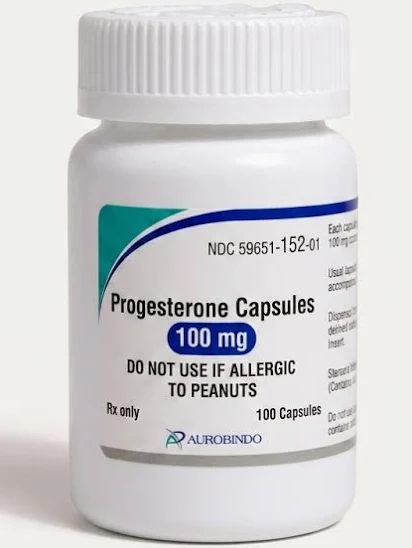
Progesterone
Progesterone 100MG
What is Progesterone?
Progesterone is a prescription hormone medication used to support fertility, pregnancy, hormone replacement therapy (HRT), and menstrual health. It helps regulate the menstrual cycle, prepare the uterus for pregnancy, and balance estrogen levels in women with low progesterone.
Side Effects
- Allergic reaction: Itching or hives, swelling in your face or hands, swelling or tingling in your mouth or throat, chest tightness, trouble breathing
- Breast lumps
- Chest pain, trouble breathing, or coughing up blood
Warnings
- This medicine may cause the following problems:Blood clots, which could lead to stroke, heart attack, or other serious problemsDementia (when used together with estrogen in women older than 65)Increased risk of breast or endometrial cancer (when used together with estrogen)
- Tell any doctor or dentist who treats you that you are using this medicine. You may need to stop using this medicine several days before you have surgery or medical tests. You may also need to stop if you will be inactive for a long time. This medicine may affect certain medical test results.
- This medicine may make you dizzy or drowsy. Do not drive or do anything else that could be dangerous until you know how this medicine affects you.
- Your doctor will check your progress and the effects of this medicine at regular visits. Keep all appointments.
- Keep all medicine out of the reach of children. Never share your medicine with anyone.
Prescription savings · · · ·
What is Progesterone ?
Progesterone is a prescription hormone medication used to support fertility, pregnancy, hormone replacement therapy (HRT), and menstrual health. It helps regulate the menstrual cycle, prepare the uterus for pregnancy, and balance estrogen levels in women with low progesterone.
- Allergic reaction: Itching or hives, swelling in your face or hands, swelling or tingling in your mouth or throat, chest tightness, trouble breathing
- Breast lumps
- Chest pain, trouble breathing, or coughing up blood
- Depression
- Heavy or nonstop vaginal bleeding
- Rapid weight gain, swelling in your hands, ankles, or feet
- Numbness or weakness on one side of your body, sudden or severe headache, problems with vision, speech, or walking
- This medicine may cause the following problems:Blood clots, which could lead to stroke, heart attack, or other serious problemsDementia (when used together with estrogen in women older than 65)Increased risk of breast or endometrial cancer (when used together with estrogen)
- Tell any doctor or dentist who treats you that you are using this medicine. You may need to stop using this medicine several days before you have surgery or medical tests. You may also need to stop if you will be inactive for a long time. This medicine may affect certain medical test results.
- This medicine may make you dizzy or drowsy. Do not drive or do anything else that could be dangerous until you know how this medicine affects you.
- Your doctor will check your progress and the effects of this medicine at regular visits. Keep all appointments.
- Keep all medicine out of the reach of children. Never share your medicine with anyone.
- Rapid weight gain, swelling in your hands, ankles, or feet
- Tell your doctor if you are pregnant or breastfeeding, or if you have kidney disease, asthma, diabetes, endometriosis, epilepsy, migraine headaches, lupus, thyroid problems, or a history of depression. Tell your doctor about any problems with your heart or blood, such as heart disease, blood clotting problems, high blood pressure, or high cholesterol. Tell your doctor if you smoke.
Progesterone Coupons & Prices
Progesterone 100MG
Weight-loss medication, prescribed online
Licensed U.S. providers · No insurance needed · Shipped to your door
Looking for a progesterone coupon? Progesterone (micronized) is a female sex hormone available as a low-cost generic, so you often do not need insurance to pay a fair cash price. Cash prices still vary widely from one pharmacy to the next, which is exactly why comparing matters. Rx.com checks progesterone prices across more than 60,000 U.S. pharmacies so you can enter your ZIP above to see today's price and grab a free discount coupon to use at the register.
What is progesterone and how does it work?
Progesterone is a progestin (a progestogen, or female sex hormone). Oral micronized progesterone, sold under the brand name Prometrium, is FDA-approved to prevent endometrial hyperplasia (overgrowth of the uterine lining) in postmenopausal women who still have a uterus and are taking estrogen as part of menopausal hormone therapy. It is also approved to treat secondary amenorrhea, meaning it can help bring on menstruation in women whose periods have stopped due to a lack of progesterone.
Vaginal formulations such as Crinone and Endometrin are used for progesterone supplementation and replacement in assisted reproductive technology (IVF) and for secondary amenorrhea. Progesterone is also prescribed off-label by some providers for luteal phase support during fertility treatment and other uses; your provider can explain whether progesterone is right for your situation.
Progesterone cost without insurance and how to save
Progesterone is available as a generic, so it is generally one of the more affordable hormone medications. Even so, the cash price you pay can differ a lot depending on which pharmacy you use, your dose, and your formulation (oral capsule versus vaginal gel or insert). Because the same prescription can cost noticeably more at one pharmacy than another nearby, it pays to compare before you fill.
Rx.com compares progesterone prices across more than 60,000 pharmacies and gives you a free discount coupon you can use whether or not you have insurance. Enter your ZIP above to see today's price at pharmacies near you. There is no manufacturer savings card for generic progesterone, but the generic itself is typically inexpensive, and comparing prices is the most reliable way to keep your cost down.
Progesterone vs. related hormone options
Progesterone belongs to a group of hormone medications, and your provider chooses among them based on your needs. Micronized progesterone is the same active ingredient as brand-name Prometrium. It is often prescribed alongside estradiol for menopausal hormone therapy, and it is also available combined with estradiol in the brand Bijuva.
Other progestins your provider might consider include medroxyprogesterone and norethindrone. These are different medications with their own dosing and considerations, so only your provider can decide which is appropriate for you. Whichever one you are prescribed, you can compare its cash price and find a coupon on Rx.com.
Progesterone safety and side effects
Progesterone can cause drowsiness or dizziness, which is one reason many providers suggest taking the oral capsule at bedtime. Avoid grapefruit juice while taking it, and note that it can interact with CYP3A4 inducers such as St. John's wort. Prometrium capsules contain peanut oil, so they should not be used by anyone allergic to peanuts. Progesterone is not appropriate for everyone; it is contraindicated in known or suspected pregnancy loss, undiagnosed vaginal bleeding, active or past blood-clotting disorders, liver dysfunction, and known or suspected breast cancer.
Serious risks can include blood clots, stroke, and breast changes. Get medical help right away if you have leg swelling or pain, sudden shortness of breath, chest pain, a severe headache, vision changes, facial drooping, or a new breast lump. Historically, progesterone used in menopausal hormone therapy carried a boxed warning about cardiovascular events, stroke, blood clots, invasive breast cancer, and probable dementia based on the Women's Health Initiative; in November 2025 the FDA directed removal of that boxed warning from Prometrium and several other menopausal hormone therapy products after a literature review. This is general information, not medical advice; talk with your provider or pharmacist about the risks and benefits for you.
This Progesterone information was written and reviewed against authoritative U.S. medical sources — MedlinePlus (U.S. National Library of Medicine), DailyMed, and FDA prescribing information — and checked for accuracy. It is provided for education and is not a substitute for professional medical advice.
Verify the official label: Progesterone on DailyMed (FDA)
Reviewed against FDA labeling · Last reviewed July 2026
Related Drugs
Browse more medications: starting with P · full A-Z directory · by condition · common drugs
Medical disclaimer: This information is provided for general educational purposes only and is not medical advice. It is not a substitute for professional diagnosis or treatment. Always consult a licensed physician, pharmacist, or other qualified healthcare provider before starting, stopping, or changing any medication or treatment. Never disregard professional medical advice or delay seeking it because of something you read here. If you think you may have a medical emergency, call your doctor or 911 immediately.


