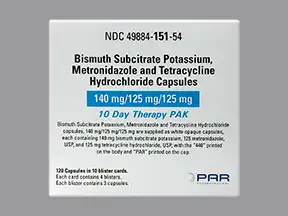
Bismuth/Metronidaz/Tetracyclin
Bismuth/Metronidaz/Tetracyclin
What is Bismuth/Metronidaz/Tetracyclin?
Bismuth/Metronidazole/Tetracycline is a combination medication used primarily to treat Helicobacter pylori infections, which are often the cause of peptic ulcers. This regimen leverages the synergistic effects of bismuth subsalicylate, a gastrointestinal mucosal protectant, metronidazole, an antibiotic effective against anaerobic bacteria, and tetracycline, a broad-spectrum antibiotic. This combination both inhibits bacterial growth and protects the stomach lining, enhancing ulcer healing and reducing symptoms.
Side Effects
- Dark urine or pale stools, nausea, vomiting, loss of appetite, stomach pain, yellow skin or eyes
- Seizure, headache, dizziness, blurred vision, problems with muscle control, clumsiness, shakiness, trouble talking
- Fever, chills, cough, sore throat, swollen, painful, or tender lymph glands in the neck, armpit, or groin
Warnings
- Keep all medicine out of the reach of children. Never share your medicine with anyone.
- Your doctor will check your progress and the effects of this medicine at regular visits. Keep all appointments.
- Call your doctor if your symptoms do not improve or if they get worse.
- This medicine may make your skin more sensitive to sunlight. Wear sunscreen. Do not use sunlamps or tanning beds.
- Tell any doctor or dentist who treats you that you are using this medicine. This medicine may affect certain medical test results.
Prescription savings · · · ·
What is Bismuth/Metronidaz/Tetracyclin ?
Bismuth/Metronidazole/Tetracycline is a combination medication used primarily to treat Helicobacter pylori infections, which are often the cause of peptic ulcers. This regimen leverages the synergistic effects of bismuth subsalicylate, a gastrointestinal mucosal protectant, metronidazole, an antibiotic effective against anaerobic bacteria, and tetracycline, a broad-spectrum antibiotic. This combination both inhibits bacterial growth and protects the stomach lining, enhancing ulcer healing and reducing symptoms.
- Dark urine or pale stools, nausea, vomiting, loss of appetite, stomach pain, yellow skin or eyes
- Seizure, headache, dizziness, blurred vision, problems with muscle control, clumsiness, shakiness, trouble talking
- Fever, chills, cough, sore throat, swollen, painful, or tender lymph glands in the neck, armpit, or groin
- Stiff neck, drowsiness, painful eye movements, eye sensitivity to light
- Yellowing of your skin or the whites of your eyes
- Numbness, tingling, or burning pain in your hands, arms, legs, or feet
- Change in how much or how often you urinate, difficult or painful urination
- Allergic reaction: Itching or hives, swelling in your face or hands, swelling or tingling in your mouth or throat, chest tightness, trouble breathing
- Blistering, peeling, red skin rash
- Keep all medicine out of the reach of children. Never share your medicine with anyone.
- Your doctor will check your progress and the effects of this medicine at regular visits. Keep all appointments.
- Call your doctor if your symptoms do not improve or if they get worse.
- This medicine may make your skin more sensitive to sunlight. Wear sunscreen. Do not use sunlamps or tanning beds.
- Tell any doctor or dentist who treats you that you are using this medicine. This medicine may affect certain medical test results.
- This medicine may cause the following problems:Brain or nerve problems, including seizures, encephalopathy, peripheral neuropathy, meningitis, intracranial hypertensionPermanent discoloration of teeth in childrenSerious skin reactions, including Stevens-Johnson syndrome, toxic epidermal necrolysis, drug reaction with eosinophilia and systemic symptoms (DRESS)
- Your doctor may tell you to stop breastfeeding, and pump and discard your breast milk during treatment for at least 2 days after treatment with this medicine.
- Tell your doctor if you have kidney disease, liver disease, fungal infections, brain and nerve problems (including encephalopathy), or a history of blood problems or seizures.
- It is not safe to take this medicine during pregnancy. It could harm an unborn baby. Tell your doctor right away if you become pregnant. Using this medicine especially during the second and later part of a pregnancy can harm your unborn baby. Birth control pills may not work as well to prevent pregnancy when used with this medicine. Use an effective form of birth control (including condoms, spermicide) during treatment with this medicine.
Bismuth/Metronidaz/Tetracyclin Coupons & Prices
Bismuth/Metronidaz/Tetracyclin
4 ED medications in one dose
Apomorphine, sildenafil, tadalafil & vardenafil · One sublingual dose · Free express shipping
Bismuth/Metronidaz/Tetracyclin prices by dosage
Lowest cash price with a free Rx.com coupon vs. the average retail price.
| Dosage | Quantity | Retail price | Rx.com price |
|---|---|---|---|
| 140-125-125mg · Capsule | 120 | $799.95 | $219.94 |
Cash prices near ZIP 77433; updated regularly. Actual pharmacy price may vary.
A bismuth subcitrate potassium, metronidazole, and tetracycline hydrochloride coupon from Rx.com can lower what you pay at the pharmacy counter for this short H. pylori treatment course, whether you are filling the brand Pylera or the generic capsules (140 mg / 125 mg / 125 mg). This is a one-time course rather than a long-term refill, so the cash price you are quoted on that single fill is what matters, and it can differ a lot from one pharmacy to the next, even across the street. Rx.com compares cash prices at more than 60,000 pharmacies nationwide. Enter your ZIP code above to see today's price near you, then show the free coupon to the pharmacist.
What bismuth, metronidazole, and tetracycline capsules are and how they work
These capsules combine three medicines in one: bismuth subcitrate potassium (a gastroprotective, antibacterial bismuth salt), metronidazole (a nitroimidazole antibiotic), and tetracycline hydrochloride (a tetracycline-class antibiotic). They are FDA-approved to be taken together with omeprazole to treat Helicobacter pylori (H. pylori) infection in people with duodenal ulcer disease, meaning an active duodenal ulcer or a history of one within the past five years. Wiping out H. pylori lowers the chance the ulcer comes back. The brand name is Pylera.
The adult regimen on the FDA label is three capsules four times a day, after each meal and at bedtime, for 10 days, plus omeprazole 20 mg twice a day with the morning and evening doses. Because the capsules plus the omeprazole add up to four medicines working at once, doctors call this "bismuth quadruple therapy." The two antibiotics attack the bacteria from different angles, the bismuth helps break down the bacteria's protective layer and soothes the stomach lining, and the omeprazole cuts stomach acid so the antibiotics can do their job. Finishing the full course is essential; stopping early is a common reason the infection survives. Your prescriber decides whether this regimen is right for you and how long you should take it.
Cost and coupons: what to expect without insurance
An FDA-approved generic of this exact capsule (bismuth subcitrate potassium / metronidazole / tetracycline hydrochloride 140 mg / 125 mg / 125 mg) is available, which gives you a second product to price. A generic is not automatically the cheaper one at every counter, though, so it is worth checking both. This is a combination product, not a simple single-ingredient antibiotic, and cash prices swing widely between pharmacies for the same course. That spread is exactly why comparing before you fill is worth the two minutes. We are not aware of a current manufacturer copay savings card for this product, but manufacturer programs start and stop and this brand has changed hands between companies, so check the manufacturer's official website (H2-Pharma) for any current brand program; terms and eligibility vary.
If you are paying cash or have a high deductible, do this before you drop off the prescription: enter your ZIP code above, look at the price at several pharmacies near you, and bring the free Rx.com coupon to the counter. The coupon is not insurance; it is a cash-discount price, and you use it instead of insurance, not with it. Also ask the pharmacy to confirm they can supply the whole course at once, since you should not have to interrupt the regimen mid-treatment.
How it compares to other H. pylori regimens
Bismuth quadruple therapy is the approach US gastroenterology guidelines now put first. The 2024 American College of Gastroenterology (ACG) guideline recommends optimized bismuth quadruple therapy for 14 days as the preferred first-line regimen for people who have not been treated for H. pylori before, when the bacteria's antibiotic susceptibility is not known. The older clarithromycin-based triple regimen (a proton pump inhibitor plus clarithromycin and amoxicillin) has fallen out of favor as clarithromycin resistance has risen, and the guideline advises against using it unless susceptibility testing shows the bacteria will actually respond to clarithromycin. Bismuth quadruple therapy is also used as salvage therapy when an earlier course has failed. Note the difference in duration: Pylera's own FDA label describes a 10-day course, while the guideline-preferred duration is 14 days. Follow the course length your prescriber writes.
The acid-reducing partner drug can also vary by prescription. Pylera's label pairs it specifically with omeprazole, though other proton pump inhibitors such as lansoprazole and pantoprazole are used in H. pylori regimens generally. Some prescribers build the same four-drug approach from separate prescriptions instead of the combination capsule, using individual metronidazole and tetracycline along with bismuth and a PPI. One caution matters here: the 2024 ACG guideline specifically advises against substituting doxycycline for tetracycline in this regimen, because doing so has been shown to lower eradication rates by roughly 10 to 17 percent. Filling the pieces separately can change the total cash cost in either direction, so it is worth pricing whatever your prescriber writes. Never swap or drop a component on your own; the specific combination is what eradicates the infection.
Safety, warnings, and side effects to know
This product carries a boxed warning because of the metronidazole component: metronidazole has been shown to cause cancer in mice and rats. It is unknown whether this applies to humans, so unnecessary use should be avoided. The capsules are contraindicated in pregnancy, in anyone who has taken disulfiram in the past two weeks, with alcohol use during treatment and for at least 3 days after, in people with Cockayne syndrome (risk of severe liver injury and liver failure), in severe kidney impairment, and in anyone allergic to any ingredient or to other tetracyclines or nitroimidazoles. They are also not recommended in severe liver impairment. Do not drink any alcohol during the course or for 3 days after; it can cause a disulfiram-like reaction with flushing, nausea, and vomiting. The tetracycline component can permanently discolor teeth and slow bone growth if used in the second or third trimester of pregnancy or in children under 8.
Call your prescriber right away for a rash with fever, blistering, or sores in the mouth or eyes (severe skin reactions including Stevens-Johnson syndrome, toxic epidermal necrolysis, and DRESS have been reported), for numbness or tingling, seizures, confusion, vision changes, or severe headache (metronidazole can cause seizures, encephalopathy, aseptic meningitis, and optic or peripheral nerve problems; increased pressure in the skull has also been reported), or for severe or bloody diarrhea, which can signal a C. difficile infection. This medicine also makes your skin burn more easily, so stay out of the sun and sun lamps and use sunscreen. Harmless darkening of the tongue and black stools from the bismuth is expected and goes away. Take each dose with a full 8-ounce glass of water, swallow the capsules whole, do not lie down right afterward (to avoid throat irritation or ulcers), and keep dairy, antacids, iron, and other mineral supplements away from your dosing times, since they bind up the tetracycline. This page is general information, not medical advice; talk with your doctor or pharmacist about your own situation.
This Bismuth/Metronidaz/Tetracyclin information was written and reviewed against authoritative U.S. medical sources — MedlinePlus (U.S. National Library of Medicine), DailyMed, and FDA prescribing information — and checked for accuracy. It is provided for education and is not a substitute for professional medical advice.
Verify the official label: Bismuth/Metronidaz/Tetracyclin on DailyMed (FDA)
Reviewed against FDA labeling · Last reviewed July 2026
Related Drugs
Browse more medications: starting with B · full A-Z directory · by condition · common drugs
Medical disclaimer: This information is provided for general educational purposes only and is not medical advice. It is not a substitute for professional diagnosis or treatment. Always consult a licensed physician, pharmacist, or other qualified healthcare provider before starting, stopping, or changing any medication or treatment. Never disregard professional medical advice or delay seeking it because of something you read here. If you think you may have a medical emergency, call your doctor or 911 immediately.


