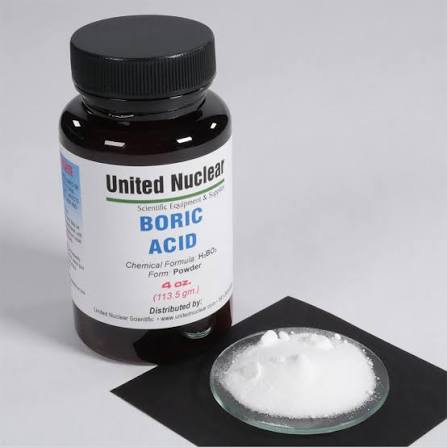
Boric Acid
Boric Acid
What is Boric Acid?
Boric acid, chemically represented as H3BO3, is a mild acid derived from boron, commonly used both as an antiseptic and a preservative. In pharmaceutical applications, it is frequently utilized in eye wash solutions to alleviate irritation and remove pollutants, as well as in vaginal suppositories to treat yeast infections and bacterial vaginosis due to its antifungal and antibacterial properties.
Side Effects
- Allergic reaction: Itching or hives, swelling in your face or hands, swelling or tingling in your mouth or throat, chest tightness, trouble breathing
- Menstrual-type pain.
- Diarrhea that may contain blood.
Warnings
- Make sure your doctor knows if you are pregnant or breast feeding. Tell your doctor if you have any nerve disorders, liver disease, or a history of alcohol abuse.
- This medicine can cause diarrhea. Call your doctor if the diarrhea becomes severe, does not stop, or is bloody. Do not take any medicine to stop diarrhea until you have talked to your doctor. Diarrhea can occur 2 months or more after you stop taking this medicine.
- Vaginal routeThis medicine may leak out of your vagina during the day. You may wear a sanitary pad to protect your clothing, but do not use a tampon.
- Vaginal routeKeep using this medicine for the full time of treatment, even if your symptoms improve after the first few doses. Do not stop using the medicine if your menstrual period begins during your treatment time. Use sanitary pads rather than tampons.
- Do not have sexual intercourse while you are using this medicine and for 3 days after your treatment ends.
Prescription savings · · · ·
What is Boric Acid ?
Boric acid, chemically represented as H3BO3, is a mild acid derived from boron, commonly used both as an antiseptic and a preservative. In pharmaceutical applications, it is frequently utilized in eye wash solutions to alleviate irritation and remove pollutants, as well as in vaginal suppositories to treat yeast infections and bacterial vaginosis due to its antifungal and antibacterial properties.
- Allergic reaction: Itching or hives, swelling in your face or hands, swelling or tingling in your mouth or throat, chest tightness, trouble breathing
- Menstrual-type pain.
- Diarrhea that may contain blood.
- Numbness, tingling, or burning pain in your hands, arms, legs, or feet.
- Problems with urination.
- Seizure.
- Unusual bleeding.
- Vaginal pain.
- Make sure your doctor knows if you are pregnant or breast feeding. Tell your doctor if you have any nerve disorders, liver disease, or a history of alcohol abuse.
- This medicine can cause diarrhea. Call your doctor if the diarrhea becomes severe, does not stop, or is bloody. Do not take any medicine to stop diarrhea until you have talked to your doctor. Diarrhea can occur 2 months or more after you stop taking this medicine.
- Vaginal routeThis medicine may leak out of your vagina during the day. You may wear a sanitary pad to protect your clothing, but do not use a tampon.
- Vaginal routeKeep using this medicine for the full time of treatment, even if your symptoms improve after the first few doses. Do not stop using the medicine if your menstrual period begins during your treatment time. Use sanitary pads rather than tampons.
- Do not have sexual intercourse while you are using this medicine and for 3 days after your treatment ends.
- Unusual bleeding.
- Tell any doctor or dentist who treats you that you are using this medicine. This medicine may affect certain medical test results.
- Vaginal pain.
Boric Acid Coupons & Prices
Boric Acid
No Prescription Needed
Boric Acid is available over the counter — order online or pick up at a pharmacy near you.
Where to Buy Boric Acid
No prescription needed. Purchase online or in-store.
Weight-loss medication, prescribed online
Licensed U.S. providers · No insurance needed · Shipped to your door
Boric Acid prices by dosage
Lowest cash price with a free Rx.com coupon vs. the average retail price.
| Dosage | Quantity | Retail price | Rx.com price |
|---|---|---|---|
| 1gm of · Bottle | 30 | — | $10.61 |
| 113gm of · Bottle | 113 | $22.45 | $16.70 |
| 125gm of · Bottle | 125 | $109.69 | $106.25 |
| 500gm of · Bottle | 30 | $11.99 | $6.87 |
Cash prices near ZIP 77433; updated regularly. Actual pharmacy price may vary.
Boric acid vaginal suppositories (sold over the counter under names like pH-D Feminine Health, The Killer by Love Wellness, NutraBlast, Boric Life and V-Bella, and also prepared as pharmacy-compounded vaginal capsules) are a weak acid antiseptic used inside the vagina, most often when a yeast infection keeps coming back or does not respond to the usual antifungal medicines. Because there is no FDA-approved boric acid vaginal drug product, the store-bought versions are sold as unapproved over-the-counter items and the compounded capsules are prepared by a licensed pharmacy on a clinician's prescription. Any medical use of boric acid is off-label, it is not first-line treatment, and it should be used only after a clinician has confirmed what is actually causing your symptoms. This page is general information, not medical advice.
What is boric acid (vaginal) and how does it work?
Boric acid is a vaginal antiseptic, not an antibiotic and not an azole antifungal. It is a weak acid that is fungistatic and bacteriostatic, meaning it slows the growth of yeast and bacteria and helps restore an acidic vaginal environment rather than killing organisms outright the way a prescription antifungal or antibiotic does. It is normally supplied as a 600 mg gelatin capsule or suppository that is inserted into the vagina.
An important point that product packaging rarely makes clear: there is no FDA-approved boric acid vaginal drug product. Every consumer version is marketed over the counter as an unapproved or homeopathic drug or as a "feminine hygiene" item, so its potency and purity are not FDA-verified, and any medical use of it is off-label.
Where boric acid shows up in guidelines is narrower than the marketing suggests. In the CDC's STI Treatment Guidelines it appears under non-albicans vulvovaginal candidiasis (yeast caused by species other than Candida albicans, such as Candida glabrata). For that infection the guidelines suggest first trying a longer course, 7 to 14 days, of a nonfluconazole azole. Only if the infection then recurs do the guidelines describe boric acid 600 mg in a gelatin capsule inserted vaginally once daily for 3 weeks, a regimen with clinical and mycologic eradication rates of roughly 70% in that specific group. That 70% figure applies to recurrent non-albicans yeast, not to yeast infections in general. Boric acid is also sometimes used alongside (never instead of) an antibiotic in recurrent bacterial vaginosis. It is not first-line treatment for a simple yeast infection or for BV.
How to use boric acid suppositories
Follow the directions your clinician or pharmacist gives you, or the package instructions on the product you bought. In general:
- The capsule goes into the vagina only, usually at bedtime so it stays in place. It is never taken by mouth.
- Dosing schedules differ by product and by why it is being used. Over-the-counter labels typically direct one suppository a day and do not set a fixed course length, while the regimen the CDC guidelines describe for non-albicans yeast that has recurred is 600 mg once daily for 3 weeks. Use the schedule you were actually given, and do not extend or repeat a course on your own.
- Expect some watery discharge; a panty liner helps. Do not use tampons to absorb it while treating an infection unless your clinician says otherwise.
- Avoid intercourse during the course of treatment. Boric acid can irritate a partner and can weaken latex condoms and diaphragms, so barrier protection may fail.
- Store the capsules where children and pets cannot reach them.
If your symptoms are new, undiagnosed, or have not been checked by a clinician, get evaluated first rather than self-treating.
Cost and how to save on boric acid
Boric acid suppositories are sold two different ways, and the money side works differently for each. Off-the-shelf boxes at pharmacies, grocery stores and online are bought like any other over-the-counter item, so prices vary by brand and retailer and it is worth comparing a few before you buy. The other route is a pharmacy-compounded prescription boric acid vaginal capsule, which a clinician can write for; because it is prepared by a licensed compounding pharmacy, it is the more controlled option when purity and dose matter.
Two things to know before you go looking for a discount. There is no manufacturer copay card for boric acid, because there is no FDA-approved brand for one to attach to. And prescription discount cards, including ours, generally cannot be applied to compounded prescriptions: a compounded capsule is priced by the pharmacy that mixes it rather than run through a standard pharmacy benefit, so there is no cash-price network rate to look up. The practical way to save is to call two or three compounding pharmacies and ask each for its cash price, since those prices vary a lot, and to ask your insurer whether compounded prescriptions are covered under your plan.
Boric acid vs. the standard treatments
For most vaginal infections, boric acid is not the first choice. Standard, FDA-approved treatments generally work faster and have far more evidence behind them:
- Yeast infection (vulvovaginal candidiasis): oral fluconazole, or a vaginal azole cream or suppository such as miconazole, clotrimazole, or terconazole, is standard therapy.
- Bacterial vaginosis: an antibiotic such as metronidazole or clindamycin is the treatment. Boric acid does not replace the antibiotic; when it is used at all in BV, it is as an add-on in recurrent cases.
Where boric acid earns its place is the harder situation: yeast caused by non-albicans species such as Candida glabrata that comes back after a longer azole course. Even there it is a second step, not a starting point, and it is a call for your clinician to make after testing. Boric acid is also marketed over the counter for vaginal odor and pH balance, but odor that is new or persistent deserves an actual diagnosis, because BV, trichomoniasis, and other conditions each need different treatment.
Safety, side effects, and who should not use it
For vaginal use only. Never swallow boric acid. It is toxic if ingested: swallowing it can cause blue-green vomit, diarrhea, a red "boiled lobster" rash, kidney injury, seizures, and death, and MedlinePlus notes the death rate from boric acid poisoning in infants is high. Keep it well away from children and pets, and if any is swallowed, call Poison Help right away at 1-800-222-1222.
Do not use vaginal boric acid if you are pregnant. Product labeling says not to use it if you are pregnant, and it is treated as contraindicated in pregnancy; the safety of intravaginal boric acid in pregnancy has not been established. Do not use it on open wounds or on ulcerated or eroded vaginal tissue, or if you have an active pelvic infection such as PID. The most common effects are local: watery discharge, vaginal burning, itching, redness, and occasional spotting. It can damage latex condoms and diaphragms and irritate a partner, so avoid intercourse while using it. Call your clinician if symptoms last beyond the treatment course, or if you have fever, pelvic pain, or foul-smelling discharge. Because over-the-counter boric acid is an unapproved product whose potency and purity are not FDA-verified, a compounded capsule from a licensed pharmacy is the more controlled choice. None of this replaces advice from your own healthcare provider.
This Boric Acid information was written and reviewed against authoritative U.S. medical sources — MedlinePlus (U.S. National Library of Medicine), DailyMed, and FDA prescribing information — and checked for accuracy. It is provided for education and is not a substitute for professional medical advice.
Verify the official label: Boric Acid on DailyMed (FDA)
Reviewed against FDA labeling · Last reviewed July 2026
Related Drugs
Browse more medications: starting with B · full A-Z directory · by condition · common drugs
Medical disclaimer: This information is provided for general educational purposes only and is not medical advice. It is not a substitute for professional diagnosis or treatment. Always consult a licensed physician, pharmacist, or other qualified healthcare provider before starting, stopping, or changing any medication or treatment. Never disregard professional medical advice or delay seeking it because of something you read here. If you think you may have a medical emergency, call your doctor or 911 immediately.


