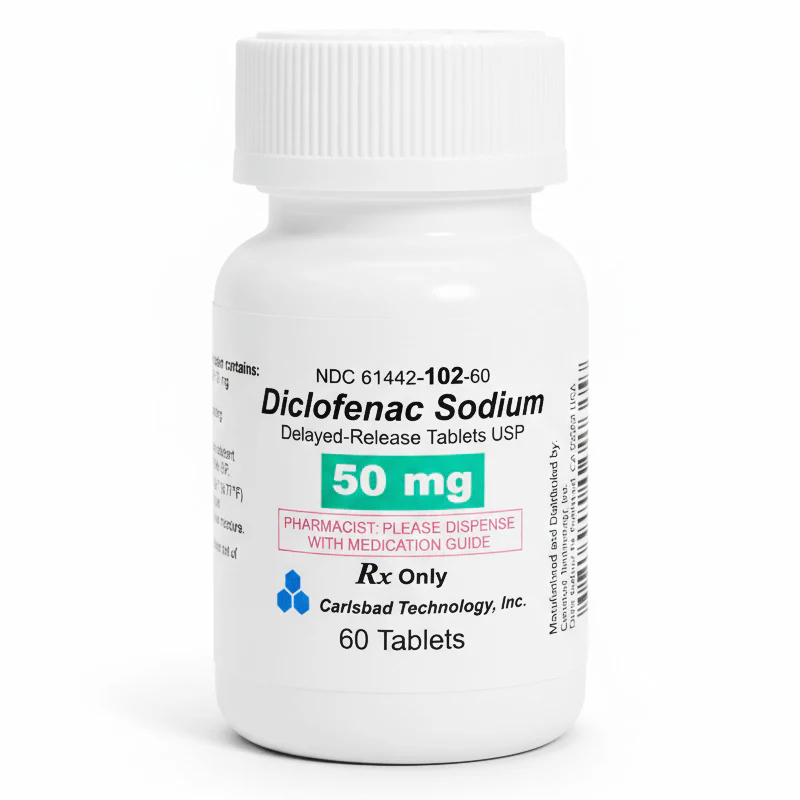
Diclofenac Sodium Er
Diclofenac Sodium ER
What is Diclofenac Sodium Er?
Diclofenac Sodium ER (Voltaren XR) is a prescription nonsteroidal anti-inflammatory drug (NSAID) used to treat arthritis, chronic pain, and inflammatory conditions. Its extended-release formulation provides long-lasting relief from pain, stiffness, and swelling with convenient once-daily dosing.
Side Effects
- Bloody or black, tarry stools, severe stomach pain, vomiting blood or material that looks like coffee grounds
- Confusion, uneven heartbeat, trouble breathing, numbness or tingling in your hands, feet, or lips
- Change in how much or how often you urinate
Warnings
- Tell your doctor if you are pregnant or breastfeeding. Do not use this medicine during the later part of a pregnancy, unless your doctor tells you to.
- Tell your doctor if you have kidney disease, liver disease, asthma, heart failure, high blood pressure, or heart or blood vessel problems, or a history of stomach ulcers or bleeding problems. Tell your doctor if you have phenylketonuria (PKU). Also tell your doctor if you drink alcohol.
- This medicine may cause the following problems:Increased risk of blood clots, heart attack, stroke, or heart failureBleeding problems, including stomach or bowel bleeding or ulcerLiver problemsHigh blood pressureKidney problemsSerious skin reactions, including Stevens-Johnson syndrome, exfoliative dermatitis, toxic epidermal necrolysis, and drug reaction with eosinophilia and systemic symptoms (DRESS)
- This medicine may cause a delay in ovulation for women and may affect their ability to have children. If you plan to have children, talk with your doctor before using this medicine.
- Tell any doctor or dentist who treats you that you are using this medicine.
Prescription savings · · · ·
What is Diclofenac Sodium Er ?
Diclofenac Sodium ER (Voltaren XR) is a prescription nonsteroidal anti-inflammatory drug (NSAID) used to treat arthritis, chronic pain, and inflammatory conditions. Its extended-release formulation provides long-lasting relief from pain, stiffness, and swelling with convenient once-daily dosing.
- Bloody or black, tarry stools, severe stomach pain, vomiting blood or material that looks like coffee grounds
- Confusion, uneven heartbeat, trouble breathing, numbness or tingling in your hands, feet, or lips
- Change in how much or how often you urinate
- Dark urine or pale stools, nausea, vomiting, loss of appetite, stomach pain, yellow skin or eyes
- Unusual bleeding, bruising, or weakness
- Rapid weight gain, swelling in your hands, ankles, or feet
- Chest pain that may spread to your arms, jaw, back, or neck, trouble breathing, unusual sweating, faintness
- Numbness or weakness in your arm or leg, or on one side of your body, pain in your lower leg, sudden or severe headache, or problems with vision, speech, or walking
- Allergic reaction: Itching or hives, swelling in your face or hands, swelling or tingling in your mouth or throat, chest tightness, trouble breathing
- Blistering, peeling, or red skin rash
- Tell your doctor if you are pregnant or breastfeeding. Do not use this medicine during the later part of a pregnancy, unless your doctor tells you to.
- Tell your doctor if you have kidney disease, liver disease, asthma, heart failure, high blood pressure, or heart or blood vessel problems, or a history of stomach ulcers or bleeding problems. Tell your doctor if you have phenylketonuria (PKU). Also tell your doctor if you drink alcohol.
- This medicine may cause the following problems:Increased risk of blood clots, heart attack, stroke, or heart failureBleeding problems, including stomach or bowel bleeding or ulcerLiver problemsHigh blood pressureKidney problemsSerious skin reactions, including Stevens-Johnson syndrome, exfoliative dermatitis, toxic epidermal necrolysis, and drug reaction with eosinophilia and systemic symptoms (DRESS)
- This medicine may cause a delay in ovulation for women and may affect their ability to have children. If you plan to have children, talk with your doctor before using this medicine.
- Tell any doctor or dentist who treats you that you are using this medicine.
- Your headaches may become worse if you use a headache medicine for 10 or more days per month. Write down how often your headaches occur and how often you use this medicine.
- Your doctor will do lab tests at regular visits to check on the effects of this medicine. Keep all appointments.
- Keep all medicine out of the reach of children. Never share your medicine with anyone.
Diclofenac Sodium Er Coupons & Prices
Diclofenac Sodium ER
Weight-loss medication, prescribed online
Licensed U.S. providers · No insurance needed · Shipped to your door
Diclofenac Sodium Er prices by dosage
Lowest cash price with a free Rx.com coupon vs. the average retail price.
| Dosage | Quantity | Retail price | Rx.com price |
|---|---|---|---|
| 100mg · Tablet | 30 | $72.99 | $29.03 |
Cash prices near ZIP 77433; updated regularly. Actual pharmacy price may vary.
Use a free Rx.com diclofenac sodium ER coupon to compare cash prices on the once-daily extended-release tablet at more than 60,000 pharmacies near you. Diclofenac sodium extended-release is the generic form of Voltaren-XR, a prescription NSAID taken once a day for relief of the signs and symptoms of osteoarthritis and of rheumatoid arthritis. Cash prices vary from one pharmacy to the next, sometimes a great deal, even on the same block and for the same tablet. Enter your ZIP code above to see today's price at pharmacies near you and bring the coupon to the counter.
What is diclofenac sodium ER and how does it work?
Diclofenac sodium extended-release is a nonsteroidal anti-inflammatory drug (NSAID). It is a phenylacetic acid derivative that blocks both COX-1 and COX-2, the enzymes your body uses to make prostaglandins, the chemical messengers behind swelling, stiffness, and pain. Turning that production down eases the inflammation that drives arthritis symptoms.
The "ER" part matters. The tablet is built to release the medicine slowly over the day, so the usual dose is one 100 mg tablet once daily. Its FDA-approved uses are relief of the signs and symptoms of osteoarthritis and relief of the signs and symptoms of rheumatoid arthritis. It is not approved for acute pain or for fast relief, and it is not designed to work that way. If short-term pain is the problem, talk with your prescriber about whether a different medicine is appropriate, rather than taking extra ER tablets. Swallow ER tablets whole with food. Never crush, split, or chew them.
What diclofenac sodium ER costs without insurance, and why comparing pharmacies matters
The brand Voltaren-XR is largely discontinued or hard to find in the U.S., and the extended-release tablet is dispensed almost entirely as generic diclofenac sodium ER. There is no manufacturer savings card to hunt for. What trips people up is that the cash price is not one number. Each pharmacy sets its own, and the spread between a grocery-store pharmacy, a big chain, and an independent a few miles away can be surprisingly wide for the exact same 30-day supply of the exact same tablet. The only way to know what you will pay is to compare.
That is what an Rx.com coupon is for. Enter your ZIP code above and we compare the cash price across more than 60,000 pharmacies, then show you the coupon to hand the pharmacist. It costs nothing to use, there is no membership required, and it works whether or not you have insurance. A few things worth knowing:
- A coupon is a cash-price discount, so it is used instead of insurance, not on top of it. If your copay is lower, use your plan.
- Prices move. It is worth re-checking when you refill rather than assuming last month's price still holds.
- Ask about the quantity your prescriber wrote for. A 90-day fill often prices out better per tablet than three 30-day fills.
How diclofenac sodium ER compares with other NSAIDs
All oral NSAIDs work in a broadly similar way, and none is simply "stronger" than another once the dose is accounted for. What differs is how long each lasts, how often you take it, and the side-effect profile. Your prescriber picks based on your heart, stomach, kidney, and liver history, not on a ranking.
- Diclofenac sodium delayed-release is the same salt in an enteric-coated tablet (25 mg, 50 mg, and 75 mg) taken two to four times a day. It is approved for the signs and symptoms of osteoarthritis and rheumatoid arthritis, and additionally for ankylosing spondylitis. Like the ER tablet, it is not a fast-relief product; the coating deliberately delays absorption. Diclofenac potassium immediate-release tablets are a different salt and are the diclofenac form approved for pain and primary dysmenorrhea.
- Naproxen is a long-acting NSAID usually taken twice daily.
- Meloxicam is another once-daily NSAID commonly used for osteoarthritis and rheumatoid arthritis.
- Celecoxib is a COX-2 selective NSAID, sometimes chosen when stomach tolerance is a concern.
- Ibuprofen is short-acting and dosed several times a day.
One rule applies across the board: do not combine diclofenac sodium ER with another NSAID (including over-the-counter ibuprofen or naproxen). Doubling up raises the risk of stomach bleeding and kidney harm without adding benefit. Ask your pharmacist before adding any OTC pain reliever.
Safety, warnings, and side effects
Diclofenac sodium ER carries an FDA boxed warning with two parts. First, cardiovascular thrombotic events: NSAIDs increase the risk of serious and sometimes fatal heart attack and stroke. That risk can appear early in treatment and grows with higher doses and longer use. It is contraindicated for pain around coronary artery bypass graft (CABG) surgery. Second, gastrointestinal bleeding, ulceration, and perforation of the stomach or intestines, which can be fatal and can happen at any time, often without warning symptoms. Older adults and anyone with a past ulcer or GI bleed are at greatest risk. That is why the guidance is always the lowest effective dose for the shortest duration consistent with your treatment goals.
Other important risks on the label include liver injury (diclofenac raises liver enzymes more often than other NSAIDs, so your provider should check liver tests around 4 to 8 weeks and periodically after that), high blood pressure, new or worsening heart failure and fluid retention, kidney injury (avoid in advanced kidney disease), high potassium, anemia, severe allergic reactions, serious skin reactions such as SJS/TEN and DRESS, and asthma attacks in people with aspirin-sensitive asthma. Avoid it at 20 weeks of pregnancy and beyond because of fetal kidney problems and low amniotic fluid, and at 30 weeks and beyond because it can close the fetal ductus arteriosus early. Take it with food, limit alcohol, and tell your provider about blood thinners or antiplatelet drugs, SSRIs, steroids, ACE inhibitors, ARBs, diuretics, lithium, methotrexate, and cyclosporine. Get medical help right away for chest pain, weakness on one side, slurred speech, black or bloody stools, vomit that looks like coffee grounds, yellowing skin or eyes, or a spreading rash with blistering. This page is general information, not medical advice. Talk with your doctor or pharmacist about what is right for you.
This Diclofenac Sodium Er information was written and reviewed against authoritative U.S. medical sources — MedlinePlus (U.S. National Library of Medicine), DailyMed, and FDA prescribing information — and checked for accuracy. It is provided for education and is not a substitute for professional medical advice.
Verify the official label: Diclofenac Sodium Er on DailyMed (FDA)
Reviewed against FDA labeling · Last reviewed July 2026
Related Drugs
Browse more medications: starting with D · full A-Z directory · by condition · common drugs
Medical disclaimer: This information is provided for general educational purposes only and is not medical advice. It is not a substitute for professional diagnosis or treatment. Always consult a licensed physician, pharmacist, or other qualified healthcare provider before starting, stopping, or changing any medication or treatment. Never disregard professional medical advice or delay seeking it because of something you read here. If you think you may have a medical emergency, call your doctor or 911 immediately.


