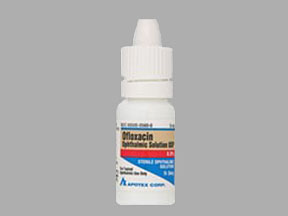
Ofloxacin
Ofloxacin 5ML of 0.3%
What is Ofloxacin?
Ofloxacin is a quinolone antibiotic medication prescribed to patients to treat bacterial infections. Ofloxacin is a generic drug. The average Ofloxacin price is about $525 for a supply of 50, 300 mg oral tablets. However, you can use our free Rx.com coupon card to save significantly on Ofloxacin prices at a participating pharmacy near you.Side Effects
- Allergic reaction: Itching or hives, swelling in your face or hands, swelling or tingling in your mouth or throat, chest tightness, trouble breathing
- Blistering, peeling, red skin rash
- Lightheadedness, dizziness, or fainting
Warnings
- Tell your doctor if you are pregnant or breastfeeding, or if you have other eye problems.
- Call your doctor if your symptoms do not improve or if they get worse.
- Keep all medicine out of the reach of children. Never share your medicine with anyone.
Prescription savings · · · ·
What is Ofloxacin ?
Ofloxacin is a quinolone antibiotic medication prescribed to patients to treat bacterial infections. Ofloxacin is a generic drug. The average Ofloxacin price is about $525 for a supply of 50, 300 mg oral tablets. However, you can use our free Rx.com coupon card to save significantly on Ofloxacin prices at a participating pharmacy near you.- Allergic reaction: Itching or hives, swelling in your face or hands, swelling or tingling in your mouth or throat, chest tightness, trouble breathing
- Blistering, peeling, red skin rash
- Lightheadedness, dizziness, or fainting
- Severe redness, itching, or swelling that was not there before you started using the medicine
- Trouble breathing
- Tell your doctor if you are pregnant or breastfeeding, or if you have other eye problems.
- Call your doctor if your symptoms do not improve or if they get worse.
- Keep all medicine out of the reach of children. Never share your medicine with anyone.
Ofloxacin Coupons & Prices
Ofloxacin 5ML of 0.3%
4 ED medications in one dose
Sildenafil, tadalafil, apomorphine & L-Citrulline · Works in ~15 min · Lasts up to 36 hours
Ofloxacin prices by dosage
Lowest cash price with a free Rx.com coupon vs. the average retail price.
| Dosage | Quantity | Retail price | Rx.com price |
|---|---|---|---|
| 5ml, 0.3% (eye) ophth soln · Bottle | 5 | $52.99 | $10.75 |
| 5ml, 0.3% (ear) otic soln · Bottle | 5 | $164.93 | $18.77 |
| 5ml of 0.3% · Bottle | 5 | $52.99 | $10.01 |
| 10ml, 0.3% (ear) otic soln · Bottle | 5 | $162.99 | $18.07 |
| 10ml, 0.3% (eye) ophth soln · Bottle | 5 | $67.61 | $15.99 |
| 10ml of 0.3% · Bottle | 5 | $23.56 | $18.07 |
Cash prices near ZIP 77433; updated regularly. Actual pharmacy price may vary.
An ofloxacin coupon from Rx.com can lower what you pay at the pharmacy counter when you are paying cash or your insurance does not cover this antibiotic. Ofloxacin is a fluoroquinolone antibiotic that is now sold in the United States only as a generic, because the oral brand Floxin was discontinued. Cash prices are set pharmacy by pharmacy, so the price for the very same tablets can differ a lot from one store to the next, sometimes by several times over. Rx.com compares prices at more than 60,000 US pharmacies, so you can see what each one near you charges before you fill. Enter your ZIP code above to see today's price and print, text, or email your free coupon.
What is ofloxacin and how does it work?
Ofloxacin is a broad-spectrum fluoroquinolone antibiotic. It kills bacteria by blocking two enzymes they need to copy and repair their DNA, called DNA gyrase and topoisomerase IV. Without those enzymes, the bacteria cannot multiply and the infection is brought under control. Ofloxacin works only against bacteria, so it will not help with colds, the flu, or other viral illnesses.
Oral ofloxacin tablets are FDA-approved for adults with certain mild-to-moderate bacterial infections caused by susceptible organisms. The tablet label lists acute bacterial worsening of chronic bronchitis, community-acquired pneumonia, uncomplicated skin and skin-structure infections, acute uncomplicated urethral and cervical gonorrhea, nongonococcal urethritis and cervicitis caused by Chlamydia trachomatis, mixed infections of the urethra and cervix, acute pelvic inflammatory disease, uncomplicated cystitis, complicated urinary tract infections, and prostatitis caused by E. coli. Because of the serious risks described below, the label says to reserve ofloxacin for people who have no alternative treatment options when it is used for an acute bacterial worsening of chronic bronchitis or for uncomplicated cystitis specifically; that reserve-for-no-alternatives language is not applied to the other indications.
An important caution about the gonorrhea and pelvic inflammatory disease indications. Those two uses remain printed on the FDA tablet label, but the label language predates today's resistance picture. Since 2007, the CDC has recommended against using fluoroquinolones such as ofloxacin to treat gonorrhea because of widespread resistance in Neisseria gonorrhoeae; current CDC guidance makes an injection of ceftriaxone the first-line treatment for uncomplicated gonorrhea, and current CDC regimens for pelvic inflammatory disease do not include fluoroquinolones either. Do not assume ofloxacin is an appropriate choice for these infections just because they appear on the label. If you are being treated for gonorrhea or pelvic inflammatory disease, ask your prescriber whether your regimen follows current CDC guidance.
Ofloxacin is also made as eye drops (for bacterial conjunctivitis and corneal ulcer) and as ear drops (for otitis externa, or swimmer's ear, and for middle-ear infection in children with tympanostomy tubes). Those are separate products with their own labeling; this page is about the oral tablets.
Ofloxacin cost and how to save without insurance
Oral ofloxacin is available only as a generic. There is no brand version of the oral tablet still on the U.S. market, and because of that there is currently no brand manufacturer savings card for it, so a pharmacy discount coupon is the usual way cash-paying patients lower the price. What a generic actually costs you still varies: cash prices are set pharmacy by pharmacy, and the identical course of ofloxacin tablets can be priced very differently at a chain drugstore, a grocery store pharmacy, a big-box store, and an independent pharmacy in the same town. That is exactly why comparing prices is worth the two minutes it takes.
If you are uninsured, have a high-deductible plan, or your plan does not cover this antibiotic, an Rx.com discount coupon is free to use and does not require insurance or a membership fee. Enter your ZIP code above to see today's price at pharmacies near you, then show the coupon at the counter. A few practical tips: ask the pharmacist to run the coupon instead of insurance if the cash price is lower, ask whether a different pharmacy in the same chain is cheaper, and ask your prescriber whether the number of days prescribed can be filled in one go rather than split. Coupon prices are not insurance and do not count toward your deductible.
Ofloxacin vs. other antibiotics: alternatives to ask about
Ofloxacin is one of several fluoroquinolones, and it is prescribed far less often in the U.S. today than it once was. Its close relatives are ciprofloxacin, levofloxacin, and moxifloxacin. All four share the same class-wide boxed warning, so switching among them does not avoid those risks. They differ mainly in which bacteria they cover best and in how often they are dosed.
Because of the boxed-warning risks, prescribers often reach for a non-fluoroquinolone antibiotic first when one will do the job, and for some infections current guidelines steer away from fluoroquinolones entirely (gonorrhea and pelvic inflammatory disease being the clearest examples). Depending on the infection, common alternatives include nitrofurantoin for uncomplicated bladder infections, doxycycline or azithromycin for chlamydia and some respiratory infections, and amoxicillin for a range of common bacterial infections. Which antibiotic is right depends on the specific bug, local resistance patterns, your allergies, and your kidney function, so this is a conversation for your prescriber rather than a swap you make on your own. Prices for each of these vary by pharmacy, and you can compare cash prices for all of them on Rx.com.
Ofloxacin safety: boxed warning and important precautions
Ofloxacin carries a boxed warning that applies to fluoroquinolone antibiotics as a class. It warns of disabling and potentially permanent serious reactions that can happen together in the same person: tendinitis and tendon rupture (most often the Achilles tendon, but also the hand and shoulder; the risk is highest in people over 60, people taking corticosteroids, and kidney, heart, or lung transplant recipients, and it can appear during treatment or months after stopping); peripheral neuropathy, which is nerve damage causing pain, burning, tingling, numbness, or weakness and may be permanent; and effects on the central nervous system such as seizures, confusion, hallucinations, anxiety, depression, and suicidal thoughts. Ofloxacin can also worsen muscle weakness in people with myasthenia gravis and should not be used if you have that condition. Stop the medicine and call your prescriber right away if you develop tendon pain or swelling, nerve symptoms, or new mood or thinking changes.
Other important safety points: serious allergic and anaphylactic reactions can occur even after the first dose; severe diarrhea from Clostridioides difficile can develop during or after treatment; the drug can prolong the QT interval of the heartbeat; it has been linked to aortic aneurysm and aortic dissection; it can raise or lower blood sugar (a particular concern if you take diabetes medicines); it can make your skin burn easily in sunlight; and it can cause crystals in the urine, so drink plenty of fluids. Do not use ofloxacin if you have had a reaction to any quinolone antibiotic. It is not recommended for people under 18 because of possible harm to joints and cartilage, or in pregnancy unless clearly needed. Antacids, sucralfate, multivitamins, and any product with calcium, iron, zinc, magnesium, or aluminum can block ofloxacin from being absorbed, so separate them from your dose by at least 2 hours. Tell your prescriber if you take warfarin, theophylline, NSAIDs, corticosteroids, diabetes medicines, or any drug that affects heart rhythm. This page is general information, not medical advice; talk with your doctor or pharmacist about your own situation.
This Ofloxacin information was written and reviewed against authoritative U.S. medical sources — MedlinePlus (U.S. National Library of Medicine), DailyMed, and FDA prescribing information — and checked for accuracy. It is provided for education and is not a substitute for professional medical advice.
Verify the official label: Ofloxacin on DailyMed (FDA)
Reviewed against FDA labeling · Last reviewed July 2026
Related Drugs
Browse more medications: starting with O · full A-Z directory · by condition · common drugs
Medical disclaimer: This information is provided for general educational purposes only and is not medical advice. It is not a substitute for professional diagnosis or treatment. Always consult a licensed physician, pharmacist, or other qualified healthcare provider before starting, stopping, or changing any medication or treatment. Never disregard professional medical advice or delay seeking it because of something you read here. If you think you may have a medical emergency, call your doctor or 911 immediately.


