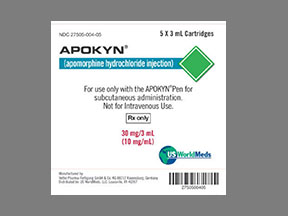
Apokyn
Apokyn 3ML of 30MG/3ML
What is Apokyn?
Apokyn is used to treat patients with hypomobility or off episodes in people with advanced Parkinson’s disease. An off episode may include symptoms such as muscle stiffness, slow movements, and difficulty starting movements. There is currently no generic version of Apokyn available in the United States. The average price of Apokyn subcutaneous solution (10 mg/mL) is around $5,270 for a supply of 15 milliliters. By using our Rx.com savings offer, you can get a discount of up to 80% off of the cost of your prescription at participating pharmacies near you.Side Effects
- Fever, loss of appetite, lower stomach or back pain, cough
- Allergic reaction: Itching or hives, swelling in your face or hands, swelling or tingling in your mouth or throat, chest tightness, trouble breathing
- Chest pain that may spread to your arms, jaw, back, or neck, trouble breathing, unusual sweating
Warnings
- Keep all medicine out of the reach of children. Never share your medicine with anyone.
- Tell your doctor if you are pregnant or breastfeeding, or if you have kidney disease, liver disease, heart or blood vessel disease, heart rhythm problems, mental illness, low blood pressure, asthma, sleeping problems, or an allergy to sulfa medicines.
- This medicine may cause the following problems:Changes in mood or behavior, including hallucinationsNew or worsening dyskinesia (trouble controlling movements)Blood problem, including hemolytic anemiaUnusual changes in thoughts or behavior, including an urge to gamble or spend money or an increased sex driveIncreased risk of heart rhythm problems, chest pain, or heart attackFibrotic problems (tissue changes in the pelvis, lungs, and heart valves)Prolonged or painful erection (in males)
- This medicine may make you dizzy or drowsy, or cause trouble with controlling body movements, which may lead to falls. It may also cause you to fall asleep without warning. This could happen while you are driving, eating, or talking. Tell your doctor right away if this happens. Do not drive or do anything else that could be dangerous until you know how this medicine affects you. Standing up slowly from a sitting or lying position can help prevent getting dizzy.
- Do not stop using this medicine suddenly. Your doctor will need to slowly decrease your dose before you stop it completely.
Prescription savings · · · ·
What is Apokyn ?
Apokyn is used to treat patients with hypomobility or off episodes in people with advanced Parkinson’s disease. An off episode may include symptoms such as muscle stiffness, slow movements, and difficulty starting movements. There is currently no generic version of Apokyn available in the United States. The average price of Apokyn subcutaneous solution (10 mg/mL) is around $5,270 for a supply of 15 milliliters. By using our Rx.com savings offer, you can get a discount of up to 80% off of the cost of your prescription at participating pharmacies near you.- Fever, loss of appetite, lower stomach or back pain, cough
- Allergic reaction: Itching or hives, swelling in your face or hands, swelling or tingling in your mouth or throat, chest tightness, trouble breathing
- Chest pain that may spread to your arms, jaw, back, or neck, trouble breathing, unusual sweating
- Dizziness, lightheadedness, or fainting, severe sleepiness
- Fast, pounding, or uneven heartbeat
- Prolonged or painful erection, which lasts for more than 4 hours (in males)
- Unusual mood or behavior, anxiety, irritability, seeing, hearing, or feeling things that are not there, trouble sleeping
- Tiredness, yellow skin or eyes
- Twitching, twisting, uncontrolled repetitive movements of the tongue, lips, face, arms, or legs
- Keep all medicine out of the reach of children. Never share your medicine with anyone.
- Tell your doctor if you are pregnant or breastfeeding, or if you have kidney disease, liver disease, heart or blood vessel disease, heart rhythm problems, mental illness, low blood pressure, asthma, sleeping problems, or an allergy to sulfa medicines.
- This medicine may cause the following problems:Changes in mood or behavior, including hallucinationsNew or worsening dyskinesia (trouble controlling movements)Blood problem, including hemolytic anemiaUnusual changes in thoughts or behavior, including an urge to gamble or spend money or an increased sex driveIncreased risk of heart rhythm problems, chest pain, or heart attackFibrotic problems (tissue changes in the pelvis, lungs, and heart valves)Prolonged or painful erection (in males)
- This medicine may make you dizzy or drowsy, or cause trouble with controlling body movements, which may lead to falls. It may also cause you to fall asleep without warning. This could happen while you are driving, eating, or talking. Tell your doctor right away if this happens. Do not drive or do anything else that could be dangerous until you know how this medicine affects you. Standing up slowly from a sitting or lying position can help prevent getting dizzy.
- Do not stop using this medicine suddenly. Your doctor will need to slowly decrease your dose before you stop it completely.
- Call your doctor if your symptoms do not improve or if they get worse.
- Your doctor will do lab tests at regular visits to check on the effects of this medicine. Keep all appointments.
Apokyn Coupons & Prices
Apokyn 3ML of 30MG/3ML
4 ED medications in one dose
Sildenafil, tadalafil, apomorphine & L-Citrulline · Works in ~15 min · Lasts up to 36 hours
Apokyn prices by dosage
Lowest cash price with a free Rx.com coupon vs. the average retail price.
| Dosage | Quantity | Retail price | Rx.com price |
|---|---|---|---|
| 3ml of 30mg/3ml · Cartridge | 6 | $2,897.50 | $2,896.58 |
Cash prices near ZIP 77433; updated regularly. Actual pharmacy price may vary.
Looking for an Apokyn coupon? Apokyn (apomorphine hydrochloride) is a prescription "rescue" injection used to quickly treat sudden "off" episodes of stiffness and slowness in people with advanced Parkinson's disease. Because it is a brand-name specialty drug, the out-of-pocket cost can be high, but you have options. Enter your ZIP above to see today's Rx.com cash price at pharmacies near you, and read on to compare the Rx.com coupon with the manufacturer's savings program and with lower-cost generic apomorphine.
What is Apokyn and how does it work?
Apokyn is the brand name for apomorphine hydrochloride, a non-ergoline dopamine agonist. It is FDA-approved for the acute, intermittent treatment of hypomobility, or "off" episodes, in people with advanced Parkinson's disease. That includes both end-of-dose "wearing off" and the more unpredictable "on/off" swings. Apokyn works by stimulating dopamine receptors in the brain, helping restore movement during an off episode.
Apokyn is given as a subcutaneous (under-the-skin) injection using the multiple-dose Apokyn Pen. It is a rescue therapy for breakthrough symptoms, not a scheduled maintenance medicine, so it is used alongside your regular Parkinson's drugs rather than replacing them. It should never be given intravenously. A related sublingual apomorphine film, Kynmobi, treats the same off episodes for people who prefer an under-the-tongue option instead of an injection.
Apokyn cost, coupons, and savings options
As a brand-name specialty injectable, Apokyn can be expensive without help. There are three main ways people lower the cost:
- Rx.com cash coupon: Our free coupon gives you a cash price you can use even if you are uninsured, on Medicare, or if a manufacturer card is declined. Enter your ZIP above to see today's price at pharmacies near you, then show the coupon at the pharmacy counter.
- Manufacturer savings card: The maker of Apokyn runs an official copay savings program, described on the manufacturer's site at apokyn.com. Like most brand copay cards, it is generally limited to people with commercial (non-government) insurance and is not available to those on Medicare, Medicaid, or other federal plans. Terms, eligibility, and any caps vary and change over time, so check the current details directly. Manufacturers of specialty Parkinson's drugs often also offer a patient-assistance program for qualifying uninsured or low-income patients; ask your prescriber or the manufacturer whether you qualify.
- Generic apomorphine: This is usually the biggest savings lever. A generic apomorphine hydrochloride injection is FDA-approved and available in the US. It contains the same active ingredient as Apokyn, and asking your prescriber and pharmacist whether the generic is appropriate for you can lower your cost considerably. Enter your ZIP above to compare the cash price on the generic as well.
Alternatives and related Parkinson's medicines
Apokyn is a rescue treatment for off episodes, so it is typically used with other Parkinson's therapies rather than instead of them. Depending on your symptoms and how your care team manages your treatment, related options include:
- Kynmobi (sublingual apomorphine film) — another as-needed rescue option for off episodes.
- Inbrija (inhaled levodopa) — an inhaled rescue therapy for off episodes.
- Carbidopa-levodopa — the foundational scheduled Parkinson's therapy that off episodes occur between.
- Oral dopamine agonists such as pramipexole and ropinirole, or the rotigotine transdermal patch.
These medicines differ in how and when they are used. Only your prescriber can decide which combination fits your Parkinson's disease, so use this list to start a conversation, not to self-adjust your regimen.
Important safety information
Apokyn does not carry a boxed warning, but it has serious safety considerations. Most importantly, Apokyn must not be used with 5-HT3 antagonist antiemetics such as ondansetron, granisetron, dolasetron, palonosetron, or alosetron, because the combination can cause profound drops in blood pressure and loss of consciousness. It is also contraindicated in people with a known allergy to apomorphine or to sodium metabisulfite. Apokyn commonly causes nausea and vomiting, so the antiemetic trimethobenzamide is usually recommended before and during early treatment.
Other important risks include a sudden drop in blood pressure when standing (orthostatic hypotension) and fainting, falling asleep suddenly during daily activities, hallucinations or confusion, impulse-control problems (such as gambling, compulsive spending, or hypersexuality), QT-interval prolongation, prolonged painful erections (priapism), injection-site reactions, dyskinesia, and heart or stroke-related events. Do not stop or abruptly lower your dose on your own, as this can trigger a serious withdrawal reaction. This is general information, not medical advice. Tell your provider about all your medicines and health conditions, and review the full FDA label with your care team before starting Apokyn.
This Apokyn information was written and reviewed against authoritative U.S. medical sources — MedlinePlus (U.S. National Library of Medicine), DailyMed, and FDA prescribing information — and checked for accuracy. It is provided for education and is not a substitute for professional medical advice.
Verify the official label: Apokyn on DailyMed (FDA)
Reviewed against FDA labeling · Last reviewed July 2026
Related Drugs
Browse more medications: starting with A · full A-Z directory · by condition · common drugs
Medical disclaimer: This information is provided for general educational purposes only and is not medical advice. It is not a substitute for professional diagnosis or treatment. Always consult a licensed physician, pharmacist, or other qualified healthcare provider before starting, stopping, or changing any medication or treatment. Never disregard professional medical advice or delay seeking it because of something you read here. If you think you may have a medical emergency, call your doctor or 911 immediately.


