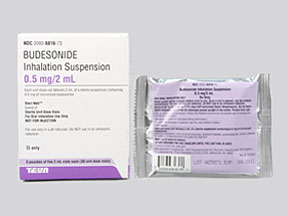
Budesonide
Budesonide 2ML of 0.5MG/2ML
What is Budesonide?
Budesonide is a medication used to treat conditions like Crohn's disease, ulcerative colitis, and certain kidney diseases. It helps reduce inflammation in the body, improving symptoms related to these conditions.Side Effects
- Worsening of asthma symptoms.
- Unusual tiredness or weakness.
- Sores or white patches in your mouth or throat.
Warnings
- This medicine may increase your risk of having an adrenal gland that is less active than normal. This is more likely for people who use steroids for a long time. Check with your doctor right away if you or your child have more than one of the following symptoms: darkening of the skin, diarrhea, dizziness, fainting, loss of appetite, mental depression, nausea, skin rash, unusual tiredness or weakness, or vomiting.
- Your doctor will check your progress and the effects of this medicine at regular visits. Keep all appointments. Eye exams may be needed to check for unwanted effects.
- This medicine may cause children to grow more slowly than normal. This would cause a child not to gain weight or get taller. Talk with your doctor if you think this is a problem.
- Your doctor may want you to carry a medical identification card stating that you or your child are using this medicine and that you or your child may need additional medicine during an emergency, a severe asthma attack or other illness, or unusual stress.
- Call your doctor if your symptoms do not improve or if they get worse.
Prescription savings · · · ·
What is Budesonide ?
Budesonide is a medication used to treat conditions like Crohn's disease, ulcerative colitis, and certain kidney diseases. It helps reduce inflammation in the body, improving symptoms related to these conditions.- Worsening of asthma symptoms.
- Unusual tiredness or weakness.
- Sores or white patches in your mouth or throat.
- Lightheadedness, dizziness, or fainting.
- Changes in vision.
- Chest pain or tightness.
- Fever, chills, sore throat, cough, runny or stuffy nose, and body aches.
- Allergic reaction: Itching or hives, swelling in your face or hands, swelling or tingling in your mouth or throat, chest tightness, trouble breathing
- This medicine may increase your risk of having an adrenal gland that is less active than normal. This is more likely for people who use steroids for a long time. Check with your doctor right away if you or your child have more than one of the following symptoms: darkening of the skin, diarrhea, dizziness, fainting, loss of appetite, mental depression, nausea, skin rash, unusual tiredness or weakness, or vomiting.
- Your doctor will check your progress and the effects of this medicine at regular visits. Keep all appointments. Eye exams may be needed to check for unwanted effects.
- This medicine may cause children to grow more slowly than normal. This would cause a child not to gain weight or get taller. Talk with your doctor if you think this is a problem.
- Your doctor may want you to carry a medical identification card stating that you or your child are using this medicine and that you or your child may need additional medicine during an emergency, a severe asthma attack or other illness, or unusual stress.
- Call your doctor if your symptoms do not improve or if they get worse.
- Check with your doctor right away if you or your child have blurred vision, difficulty with reading, or any other change in vision while using this medicine. Your doctor may want you to have your eyes checked by an ophthalmologist (eye doctor).
- Do not stop using this medicine suddenly. Your doctor will need to slowly decrease your dose before you stop it completely.
- Make sure your doctor knows if you are pregnant or breastfeeding, or if you have bone problems (osteoporosis), cataracts, glaucoma, or any type of infection, especially a lung infection such as tuberculosis (TB) or a herpes infection in the eye.
- Tell your doctor if you or your child have an allergy to milk proteins. This medicine contains small amounts of lactose, which has milk sugar with milk proteins.
- This medicine will not stop an asthma attack that has already started. Your doctor may prescribe another medicine for you to use in case of an acute asthma attack.
- Inhalation routeIf any of your asthma medicines do not seem to be working as well as usual, call your doctor right away. Do not change your doses or stop using your medicines without asking your doctor.
- You may get infections more easily while using this medicine. Avoid people who are sick or have infections. Tell your doctor right away if you or your child have been exposed to someone with chickenpox or measles.
- If you or your child develop a skin rash, hives, or any allergic reaction (including anaphylaxis) to this medicine, stop using the medicine and check with your doctor as soon as possible.
- This medicine may also increase your risk of having infections or sores in your mouth or throat. Check with your doctor right away if you or your child notice any signs of a throat infection.
- This medicine may decrease bone mineral density when used for a long time. A low bone mineral density can cause weak bones or osteoporosis. If you have any questions about this, ask your doctor.
Budesonide Coupons & Prices
Budesonide 2ML of 0.5MG/2ML

Weight-loss medication, prescribed online
Licensed U.S. providers · No insurance needed · Shipped to your door
Looking for a budesonide coupon? Budesonide is a widely used corticosteroid that comes in several forms, including inhalers for asthma, a nasal spray for allergies, and delayed-release capsules and tablets for certain digestive conditions. It is available as a lower-cost generic, but the cash price can still vary a great deal from one pharmacy to the next, so it pays to compare. With Rx.com you can check discount prices across more than 60,000 pharmacies and use a free coupon at the counter, even without insurance. Enter your ZIP code above to see today's price on your exact form and strength.
What is budesonide and how does it work?
Budesonide is a corticosteroid (a glucocorticoid, or anti-inflammatory steroid). It works by calming inflammation in the body, and the specific job it does depends on which form is prescribed. Brand names include Pulmicort Flexhaler, Pulmicort Respules, Entocort EC, Uceris, Ortikos, Tarpeyo, Eohilia, and Rhinocort (the over-the-counter nasal spray).
Depending on the formulation, budesonide is used to:
- Maintain control of asthma and help prevent asthma attacks (inhaled Pulmicort Flexhaler and Respules)
- Relieve seasonal and year-round allergic rhinitis symptoms (Rhinocort nasal spray, sold over the counter)
- Induce and maintain remission of mild-to-moderate Crohn's disease involving the ileum and ascending colon (Entocort EC and Ortikos delayed-release capsules)
- Induce remission of active mild-to-moderate ulcerative colitis and treat ulcerative proctitis (Uceris extended-release tablet and rectal foam)
- Treat eosinophilic esophagitis in patients 11 and older (Eohilia oral suspension)
- Reduce proteinuria in primary IgA nephropathy at risk of rapid progression (Tarpeyo)
Important: the inhaled and nasal forms are for ongoing control and are not meant to relieve a sudden asthma attack or acute symptoms.
Budesonide cost and coupons without insurance
Budesonide is available as a generic, which already helps keep the cost down compared with brand-name versions. Even so, the cash price is not the same everywhere. Because budesonide comes in many forms and strengths, and because each pharmacy sets its own price, what you pay can swing widely from one store to the next, sometimes for the very same product. That is exactly why comparing before you fill matters.
Rx.com compares discount prices across more than 60,000 pharmacies and gives you a free coupon you can show at the pharmacy counter, whether or not you have insurance. There is no manufacturer copay savings card for generic budesonide. To find your price, enter your ZIP code above and select your exact form (inhaler, nasal spray, capsule, tablet, foam, or oral suspension) and strength to see today's price near you.
Budesonide alternatives and related medicines
Budesonide is one of several corticosteroids and controller medicines, and the right choice depends on your condition and what your provider recommends. For asthma and allergy control, other inhaled or nasal steroids include fluticasone and mometasone. Budesonide is also combined with a long-acting bronchodilator in budesonide-formoterol, sold under the brand Symbicort, for people who need both an anti-inflammatory and a bronchodilator.
For the digestive uses, mesalamine is another option used in inflammatory bowel disease, and prednisone is an oral steroid sometimes used for short-term flares. This is not a recommendation to switch; talk with your provider about which medicine and form fit your situation, then use Rx.com to compare prices on whatever you are prescribed.
Budesonide safety and side effects
Budesonide has no boxed warning, but there are important points to know. It is not for treating a sudden asthma attack or acute bronchospasm. Long-term or high-dose use can affect the body's natural steroid balance, leading to hypercorticism or suppression of the hypothalamic-pituitary-adrenal (HPA) axis and adrenal insufficiency, which is why you should not stop it abruptly after long-term use; your provider may have you taper. Steroids can also increase the risk of infection (including chickenpox, measles, and worsening of existing or latent infections such as tuberculosis), so avoid exposure when possible, and they can suppress the immune system. Prolonged use may reduce bone mineral density or lead to osteoporosis, and can slow growth in children. Eye effects such as glaucoma and cataracts are possible.
The inhaled and nasal forms can cause oral thrush (a yeast infection in the mouth) as well as nasal irritation, nosebleeds, or, rarely, septal perforation. Hypersensitivity (allergic) reactions can occur. Budesonide levels can rise if taken with strong CYP3A4 inhibitors such as ketoconazole or ritonavir, so tell your provider about all your medicines. This is general information, not medical advice; talk with your doctor or pharmacist about your health, other conditions, and any side effects you notice.
This Budesonide information was written and reviewed against authoritative U.S. medical sources — MedlinePlus (U.S. National Library of Medicine), DailyMed, and FDA prescribing information — and checked for accuracy. It is provided for education and is not a substitute for professional medical advice.
Verify the official label: Budesonide on DailyMed (FDA)
Reviewed against FDA labeling · Last reviewed July 2026
Related Drugs
Browse more medications: starting with B · full A-Z directory · by condition · common drugs
Medical disclaimer: This information is provided for general educational purposes only and is not medical advice. It is not a substitute for professional diagnosis or treatment. Always consult a licensed physician, pharmacist, or other qualified healthcare provider before starting, stopping, or changing any medication or treatment. Never disregard professional medical advice or delay seeking it because of something you read here. If you think you may have a medical emergency, call your doctor or 911 immediately.


