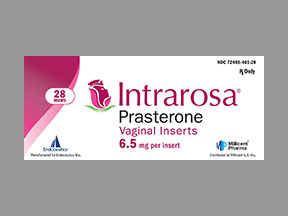
Intrarosa
Intrarosa 28 Insert
What is Intrarosa?
Intrarosa (prasterone) is a vaginal insert approved by the FDA to treat postmenopausal women experiencing moderate to severe dyspareunia (painful sexual intercourse), a symptom of vulvar and vaginal atrophy due to menopause. The active ingredient, prasterone, is a synthetic form of dehydroepiandrosterone (DHEA), which upon administration is converted locally in the vagina into estrogen and androgens, helping to restore vaginal tissue and alleviate discomfort.Warnings
- Tell any doctor or dentist who treats you that you are using this medicine. This medicine may affect certain medical test results.
- Keep all medicine out of the reach of children. Never share your medicine with anyone.
- Tell your doctor if you are breastfeeding, or if you have or have had breast cancer.
- Your doctor will check your progress and the effects of this medicine at regular visits. Keep all appointments.
- Pregnancy after menopause is not likely, but if you think you could be pregnant, tell your doctor. This medicine could harm an unborn baby.
Prescription savings · · ·
What is Intrarosa ?
Intrarosa (prasterone) is a vaginal insert approved by the FDA to treat postmenopausal women experiencing moderate to severe dyspareunia (painful sexual intercourse), a symptom of vulvar and vaginal atrophy due to menopause. The active ingredient, prasterone, is a synthetic form of dehydroepiandrosterone (DHEA), which upon administration is converted locally in the vagina into estrogen and androgens, helping to restore vaginal tissue and alleviate discomfort.- Tell any doctor or dentist who treats you that you are using this medicine. This medicine may affect certain medical test results.
- Keep all medicine out of the reach of children. Never share your medicine with anyone.
- Tell your doctor if you are breastfeeding, or if you have or have had breast cancer.
- Your doctor will check your progress and the effects of this medicine at regular visits. Keep all appointments.
- Pregnancy after menopause is not likely, but if you think you could be pregnant, tell your doctor. This medicine could harm an unborn baby.
Intrarosa Coupons & Prices
Intrarosa 28 Insert

Weight-loss medication, prescribed online
Licensed U.S. providers · No insurance needed · Shipped to your door
Looking for an Intrarosa coupon? Intrarosa (prasterone) is a brand-only 6.5 mg vaginal insert, approved by the FDA in 2016 to treat moderate to severe painful sex (dyspareunia), a symptom of vulvar and vaginal atrophy due to menopause. There is no substitutable generic version, so the cash price at the pharmacy counter can be steep if your insurance does not cover it. The free Rx.com discount coupon on this page is a cash-price coupon you can use instead of insurance at participating pharmacies. Prices vary a lot from pharmacy to pharmacy, so enter your ZIP code above to see today's price near you before you head to the counter, and compare it against whatever the manufacturer currently offers.
What is Intrarosa (prasterone) and how does it work?
Intrarosa is a vaginal insert containing 6.5 mg of prasterone, which is the same molecule as DHEA (dehydroepiandrosterone). Prasterone itself is inactive. Once the insert dissolves, cells in the vaginal wall convert it locally into small amounts of estrogens and androgens, which helps restore the thinner, drier tissue that many women develop after menopause. The label classifies it as a steroid, and it is marketed as a non-estrogen therapy for the genitourinary syndrome of menopause because you are not applying estrogen itself.
The FDA-approved use is narrow and specific: moderate to severe dyspareunia (painful sexual intercourse), a symptom of vulvar and vaginal atrophy, due to menopause. The label directs one 6.5 mg vaginal insert once daily at bedtime, using the applicator that comes with it. Intrarosa is not approved for hot flashes or other vasomotor symptoms, for low libido, or as systemic hormone replacement. Your prescriber will decide whether it fits your situation.
Intrarosa cost: manufacturer programs vs. the Rx.com cash coupon
The "Intrarosa coupon" search results are usually split between two very different things. The first is the manufacturer's own savings program. Millicent, the company behind Intrarosa, has run more than one of these at the same time, including a savings card aimed at commercially insured patients and a separate savings card that is specifically for people with a Medicare Part D or Medicare Advantage prescription plan. Which program you qualify for, what it takes off, and the conditions attached to it are set by the manufacturer and can change without notice, so do not rely on a third-party summary. Check the official Intrarosa website's savings and support page for the current programs and their terms, and call the manufacturer's support line if you are not sure which one applies to you.
The second is a cash discount coupon, like the free one on this page. It is not insurance and it is not the manufacturer's card. It sets a negotiated cash price at participating pharmacies, and you can use it whether you are uninsured, on Medicare, or covered by a plan that does not pay for Intrarosa. Because Intrarosa is brand-only, comparison shopping matters a lot here, and the cash price can differ meaningfully between pharmacies in the same town. Enter your ZIP code above to see today's price at pharmacies near you, then bring the coupon to the counter and ask the pharmacist to run it as a cash claim instead of your insurance. You cannot combine a discount coupon with insurance on the same fill, so ask the pharmacist to compare your options, including any manufacturer program you qualify for, and use whichever comes out lower.
Intrarosa alternatives and how they compare
There is no generic prasterone vaginal insert. If cost is the issue, the biggest savings lever is usually a conversation with your prescriber about whether a different class of treatment for vaginal atrophy is appropriate for you, because several of those do have generic options. Common prescription alternatives include:
- Osphena (ospemifene), a once-daily oral tablet for painful sex due to menopause. It is not a cream or an insert, and it has its own label warnings, including a boxed warning, so it is not a like-for-like swap.
- Low-dose vaginal estrogen products, which work by delivering estrogen directly to the tissue rather than by local conversion. These include Imvexxy (estradiol vaginal inserts), Estrace vaginal cream, and Premarin vaginal cream.
- Generic estradiol vaginal products, which are available as generics when your prescriber agrees a vaginal estrogen is appropriate. Prices still vary by pharmacy, so compare before you fill.
Non-prescription vaginal moisturizers and lubricants are also part of standard care for dryness and friction and can be used alongside whatever your clinician prescribes. Which option is right depends on your symptoms, your medical history (especially any history of breast cancer or other estrogen-sensitive cancer), and what your insurance covers. This is a discussion to have with your provider, not a swap to make on your own.
Safety, side effects, and who should not use Intrarosa
Intrarosa does not carry a boxed warning. It is contraindicated in women with undiagnosed abnormal genital bleeding, and any postmenopausal woman with unexplained, persistent, or recurring genital bleeding should have the cause determined before Intrarosa is considered. The label also carries a warning about estrogen-sensitive cancer: estrogen is a metabolite of prasterone, and use of exogenous estrogen is contraindicated in women with a known or suspected history of breast cancer. Intrarosa itself has not been studied in women with a history of breast cancer. Tell your prescriber about any cancer history before you fill the prescription.
The most common side effect reported in the trials was vaginal discharge, in roughly 6% of women over 12 weeks and about 14% over a full year of use. Abnormal Pap smear findings were reported in about 2% of women. Intrarosa is for postmenopausal women, and the label notes it has not been studied in pregnancy and is not indicated for use in premenopausal women. This page is general information, not medical advice. Talk to your doctor or pharmacist about your own history, your Pap and cancer screening schedule, and any other medicines you take.
This Intrarosa information was written and reviewed against authoritative U.S. medical sources — MedlinePlus (U.S. National Library of Medicine), DailyMed, and FDA prescribing information — and checked for accuracy. It is provided for education and is not a substitute for professional medical advice.
Verify the official label: Intrarosa on DailyMed (FDA)
Reviewed against FDA labeling · Last reviewed July 2026
Related Drugs
Browse more medications: starting with I · full A-Z directory · by condition · common drugs
Medical disclaimer: This information is provided for general educational purposes only and is not medical advice. It is not a substitute for professional diagnosis or treatment. Always consult a licensed physician, pharmacist, or other qualified healthcare provider before starting, stopping, or changing any medication or treatment. Never disregard professional medical advice or delay seeking it because of something you read here. If you think you may have a medical emergency, call your doctor or 911 immediately.


