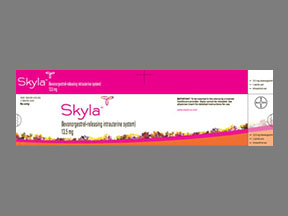
Skyla
Skyla 13.5MG
What is Skyla?
Skyla is a contraceptive intrauterine device used in women to prevent pregnancy. There is not a Skyla generic drug currently available on the market. Skyla costs around $760 for a supply of 1, 13.5 mg device. You can use our Rx.com Amethyst savings card to save on the cost of your prescription when you purchase from any of the pharmacies participating locally.Side Effects
- Unusual bleeding, bruising, or weakness
- Vaginal discharge that has a bad smell, fever, chills, sores on your genitals
- Severe headache, vision changes
Warnings
- If you have the Skyla® or Kyleena®, tell your doctor before you have an MRI test.
- Your doctor will check your progress and the effects of this medicine at regular visits. Keep all appointments.
- This IUD will not protect you from HIV/AIDS or other sexually transmitted diseases.
- Tell your doctor if you have had any problems, infections, or other conditions that affected your reproductive system. There are many problems that could make an IUD a bad choice for you, including if you have fibroids, unexplained bleeding, a uterus that has an unusual shape, a recent infection, a history of pelvic inflammatory disease, an abnormal Pap test, ectopic pregnancy, cancer or suspected cancer, or an existing IUD.
- Tell your doctor if you are breastfeeding, or if you had a baby, miscarriage, or abortion in the past 3 months. Tell your doctor if you have liver disease (including tumor or cancer), heart disease, breast cancer, heart or blood circulation problems (including a slow heartbeat), migraine, high blood pressure, seizures, or a history of fainting, heart valve problems, blood clotting problems, stroke, or heart attack. Tell your doctor if you have problems with your immune system or have had surgery on your female organs (especially fallopian tubes).
Prescription savings · · · ·
What is Skyla ?
Skyla is a contraceptive intrauterine device used in women to prevent pregnancy. There is not a Skyla generic drug currently available on the market. Skyla costs around $760 for a supply of 1, 13.5 mg device. You can use our Rx.com Amethyst savings card to save on the cost of your prescription when you purchase from any of the pharmacies participating locally.- Unusual bleeding, bruising, or weakness
- Vaginal discharge that has a bad smell, fever, chills, sores on your genitals
- Severe headache, vision changes
- Yellow skin or eyes
- Allergic reaction: Itching or hives, swelling in your face or hands, swelling or tingling in your mouth or throat, chest tightness, trouble breathing
- Bloating, stomach or pelvic pain, spasm, tenderness, or cramping that is sudden or severe
- Chest pain, problems with speech or walking, numbness or weakness in your arm or leg or on one side of your body
- Heavy bleeding from your vagina
- Pain during sex, or if your partner feels the hard plastic of the IUD during sex
- If you have the Skyla® or Kyleena®, tell your doctor before you have an MRI test.
- Your doctor will check your progress and the effects of this medicine at regular visits. Keep all appointments.
- This IUD will not protect you from HIV/AIDS or other sexually transmitted diseases.
- Tell your doctor if you have had any problems, infections, or other conditions that affected your reproductive system. There are many problems that could make an IUD a bad choice for you, including if you have fibroids, unexplained bleeding, a uterus that has an unusual shape, a recent infection, a history of pelvic inflammatory disease, an abnormal Pap test, ectopic pregnancy, cancer or suspected cancer, or an existing IUD.
- Tell your doctor if you are breastfeeding, or if you had a baby, miscarriage, or abortion in the past 3 months. Tell your doctor if you have liver disease (including tumor or cancer), heart disease, breast cancer, heart or blood circulation problems (including a slow heartbeat), migraine, high blood pressure, seizures, or a history of fainting, heart valve problems, blood clotting problems, stroke, or heart attack. Tell your doctor if you have problems with your immune system or have had surgery on your female organs (especially fallopian tubes).
- There is a small chance that you could get pregnant when using an IUD, just as there is with any birth control. If you get pregnant, your doctor may remove your IUD to lower the risk of miscarriage or other problems.
- This medicine may cause the following problems:Increased risk of ectopic pregnancy (pregnancy outside the uterus)Increased risk of serious infections, including sepsisIncreased risk of pelvic inflammatory disease (PID) or endometritisPerforation (hole in the wall of your uterus), which can damage other organsIncreased risk for ovarian cystsIncreased risk of cancer of the breast, uterus, or cervixIncreased risk of high blood pressure, stroke, heart attack, or clotting problemsJaundice (yellow skin or eyes)
- You might have some spotting and cramping during the first weeks after the IUD has been inserted. These symptoms should decrease or go away within a few weeks up to 6 months.
- You could have less bleeding or even stop having periods by the end of the first year. Call your doctor if you have a change from your regular bleeding pattern after you have had your IUD for awhile, including more bleeding or if you miss a period (and you were having periods even with your IUD).
- An IUD can slip partly or all the way out of your uterus. If this happens, use condoms or another form of birth control, and call your doctor right away.
Skyla Coupons & Prices
Skyla 13.5MG
Weight-loss medication, prescribed online
Licensed U.S. providers · No insurance needed · Shipped to your door
Skyla prices by dosage
Lowest cash price with a free Rx.com coupon vs. the average retail price.
| Dosage | Quantity | Retail price | Rx.com price |
|---|---|---|---|
| 13.5mg · Intrauterine Device | 1 | $1,291.42 | $1,031.34 |
Cash prices near ZIP 77433; updated regularly. Actual pharmacy price may vary.
Skyla is a small, brand-name hormonal intrauterine device (IUD) that releases levonorgestrel to prevent pregnancy for up to 3 years. Because it's inserted by a healthcare provider rather than picked up at a retail counter like a typical prescription, an Skyla coupon mainly helps with the device and insertion visit cost — enter your ZIP above to see pricing options near you.
What is Skyla and how does it work?
Skyla is a levonorgestrel-releasing intrauterine system made by Bayer. A healthcare provider places it directly into the uterus, where it continuously releases a small amount of the hormone levonorgestrel. It's FDA-approved for the prevention of pregnancy for up to 3 years, and is designed to be a smaller size than some other hormonal IUDs, which can make it a good fit for women who haven't previously given birth.
Manufacturer savings card vs. an Rx.com cash coupon
Bayer, the maker of Skyla, offers an official patient savings program for eligible patients; eligibility and terms vary and are set by Bayer, so check the manufacturer's official site directly for current details. As with most copay programs, it's typically limited to people with commercial insurance and generally can't be combined with Medicare or Medicaid. If you're uninsured or your insurance doesn't cover the device, ask your provider's office about cash pricing, and enter your ZIP above to compare options.
Is there a generic for Skyla, and how does it compare to other IUDs?
- Skyla — smaller size, approved for up to 3 years of use.
- Kyleena — a different Bayer levonorgestrel IUD, approved for up to 5 years, with a different hormone dose.
- Mirena — a Bayer levonorgestrel IUD approved for longer-term use with a higher hormone dose.
- Liletta — a separate manufacturer's levonorgestrel IUD.
There is no FDA-approved generic equivalent of Skyla. These other IUDs are distinct products with their own approved uses and durations, not substitutable generics, so switching between them is a decision to make with your provider.
Safety information
Skyla insertion carries risks including perforation of the uterus, expulsion of the device, and, if pregnancy occurs with the IUD in place, an increased risk of ectopic pregnancy. It should not be used by women with certain conditions, including current pelvic infection, certain cancers, or unexplained vaginal bleeding — your provider will screen for these before placement. This is general information, not medical advice; talk with your doctor about whether Skyla is appropriate for you.
This Skyla information was written and reviewed against authoritative U.S. medical sources — MedlinePlus (U.S. National Library of Medicine), DailyMed, and FDA prescribing information — and checked for accuracy. It is provided for education and is not a substitute for professional medical advice.
Verify the official label: Skyla on DailyMed (FDA)
Reviewed against FDA labeling · Last reviewed July 2026
Related Drugs
Browse more medications: starting with S · full A-Z directory · by condition · common drugs
Medical disclaimer: This information is provided for general educational purposes only and is not medical advice. It is not a substitute for professional diagnosis or treatment. Always consult a licensed physician, pharmacist, or other qualified healthcare provider before starting, stopping, or changing any medication or treatment. Never disregard professional medical advice or delay seeking it because of something you read here. If you think you may have a medical emergency, call your doctor or 911 immediately.


