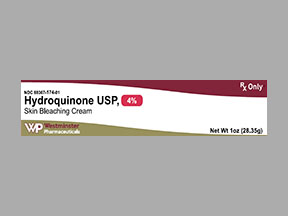
Hydroquinone
Hydroquinone 28.35GM of 4%
What is Hydroquinone?
Hydroquinone is a skin-lightening agent used in the treatment of conditions like hyperpigmentation, age spots, melasma, and freckles. It works by decreasing the formation of melanin in the skin, leading to lighter skin tones in treated areas. Hydroquinone is typically available in topical formulations and should be used under the guidance of a healthcare provider due to potential side effects like skin irritation or increased sensitivity to sunlight.Side Effects
- Allergic reaction: Itching or hives, swelling in your face or hands, swelling or tingling in your mouth or throat, chest tightness, trouble breathing
- Intense itching, blistering, swelling, or blue-black darkening of your skin
Warnings
- Tell your doctor if you are pregnant or breastfeeding, or if you have asthma.
- Cover the treated skin with sunscreen or clothing.
- Call your doctor if your symptoms do not improve or if they get worse.
- Topical application routeDo not use this medicine to treat a skin problem your doctor has not examined.
- Keep all medicine out of the reach of children. Never share your medicine with anyone.
Prescription savings · · · ·
What is Hydroquinone ?
Hydroquinone is a skin-lightening agent used in the treatment of conditions like hyperpigmentation, age spots, melasma, and freckles. It works by decreasing the formation of melanin in the skin, leading to lighter skin tones in treated areas. Hydroquinone is typically available in topical formulations and should be used under the guidance of a healthcare provider due to potential side effects like skin irritation or increased sensitivity to sunlight.- Allergic reaction: Itching or hives, swelling in your face or hands, swelling or tingling in your mouth or throat, chest tightness, trouble breathing
- Intense itching, blistering, swelling, or blue-black darkening of your skin
- Tell your doctor if you are pregnant or breastfeeding, or if you have asthma.
- Cover the treated skin with sunscreen or clothing.
- Call your doctor if your symptoms do not improve or if they get worse.
- Topical application routeDo not use this medicine to treat a skin problem your doctor has not examined.
- Keep all medicine out of the reach of children. Never share your medicine with anyone.
Hydroquinone Coupons & Prices
Hydroquinone 28.35GM of 4%
4 ED medications in one dose
Sildenafil, tadalafil, apomorphine & L-Citrulline · Works in ~15 min · Lasts up to 36 hours
Looking for a hydroquinone coupon? Rx.com lets you compare cash prices for generic hydroquinone cream and gel across more than 60,000 U.S. pharmacies, so you can find a low price near you even without insurance. Hydroquinone is a topical skin-lightening medicine used to gradually fade dark patches such as melasma, age spots, and other hyperpigmentation. Because it is available as a generic, it is already relatively low-cost, but the price you pay can vary widely from one pharmacy to the next. Enter your ZIP above to see today's price at pharmacies near you.
What is hydroquinone and how does it work?
Hydroquinone is a topical depigmenting agent, meaning it works on the skin to lighten areas of extra color. It slows down the production of melanin, the pigment that gives skin its color, so dark patches gradually fade over weeks of regular use. Doctors prescribe it for hyperpigmentation and dyschromia (uneven color), including melasma (also called chloasma), post-inflammatory dark spots left after acne or injury, solar lentigines (age or liver spots), freckles, and similar discoloration.
In the United States, prescription strengths are 4% and 2% cream and 2% gel. The only FDA-approved hydroquinone product is Tri-Luma, a combination cream containing 4% hydroquinone plus tretinoin 0.05% and fluocinolone acetonide 0.01%, approved for the short-term treatment of moderate to severe facial melasma. Single-ingredient hydroquinone creams and gels are widely prescribed but are not individually FDA-approved. Over-the-counter hydroquinone was removed from the U.S. market under the 2020 CARES Act, effective September 23, 2020.
Hydroquinone cost and how to save without insurance
Generic hydroquinone is already one of the more affordable prescription skin treatments, but that does not mean every pharmacy charges the same. Cash prices can differ a lot between one store and the next, even in the same town, which is exactly why comparing before you fill matters. Rx.com compares live cash prices across more than 60,000 pharmacies so you can see who is lowest near you.
If you are paying without insurance, or if your plan does not cover hydroquinone (many plans treat it as cosmetic), a Rx.com coupon can help you pay the cash price instead. Just enter your ZIP above to see today's price and print or show the coupon at the pharmacy. Note that the FDA-approved combination product Tri-Luma is a separate, brand-and-generic item and is usually priced differently from plain hydroquinone cream, so it is worth comparing both if your prescriber gives you a choice.
Alternatives and related treatments
Hydroquinone is one of several options for treating dark spots and uneven skin tone. Your dermatologist may combine it with other ingredients or suggest an alternative depending on your skin and how you respond. Related medicines commonly used for pigmentation include:
- Tri-Luma — the FDA-approved combination of hydroquinone, tretinoin, and fluocinolone for facial melasma.
- Tretinoin — a topical retinoid often used alongside hydroquinone to help even out tone and texture.
- Azelaic acid — a topical option that can help with discoloration and is sometimes used when hydroquinone is not suitable.
- Fluocinolone — a topical corticosteroid, one of the ingredients in the Tri-Luma combination.
You can compare prices on any of these with Rx.com. Which option is right for you is a decision for you and your prescriber; this page is for price comparison, not a treatment recommendation.
Safety and side effects
Hydroquinone is for external use only. The most common effects are local skin reactions: burning, stinging, dryness, redness, and irritant or allergic contact dermatitis, which tend to be more frequent with the 4% strength than the 2%. It is a good idea to test a small area first and to stop and contact your provider if you get blistering or severe irritation. Because hydroquinone can make skin more sensitive to sunlight, daily broad-spectrum sunscreen and sun avoidance are important while using it. Keep it away from the eyes and mucous membranes, and do not use it together with peroxide products, which can stain the skin.
The most serious risk from long-term or heavy use is exogenous ochronosis, a blue-black or gray-brown skin discoloration that can be disfiguring and permanent, which is one reason hydroquinone is meant for limited, monitored use rather than indefinite daily application. Use with caution during pregnancy and breastfeeding. The FDA has also warned about unapproved and imported skin-lightening products, some of which have been found contaminated with mercury, so it is safest to use only what your pharmacist fills from your prescription. This information is not medical advice; talk with your doctor or pharmacist about how long to use hydroquinone and whether it is right for you.
This Hydroquinone information was written and reviewed against authoritative U.S. medical sources — MedlinePlus (U.S. National Library of Medicine), DailyMed, and FDA prescribing information — and checked for accuracy. It is provided for education and is not a substitute for professional medical advice.
Verify the official label: Hydroquinone on DailyMed (FDA)
Reviewed against FDA labeling · Last reviewed July 2026
Hydroquinone — Articles & Guides
3 articles


Related Drugs
Browse more medications: starting with H · full A-Z directory · by condition · common drugs
Medical disclaimer: This information is provided for general educational purposes only and is not medical advice. It is not a substitute for professional diagnosis or treatment. Always consult a licensed physician, pharmacist, or other qualified healthcare provider before starting, stopping, or changing any medication or treatment. Never disregard professional medical advice or delay seeking it because of something you read here. If you think you may have a medical emergency, call your doctor or 911 immediately.


