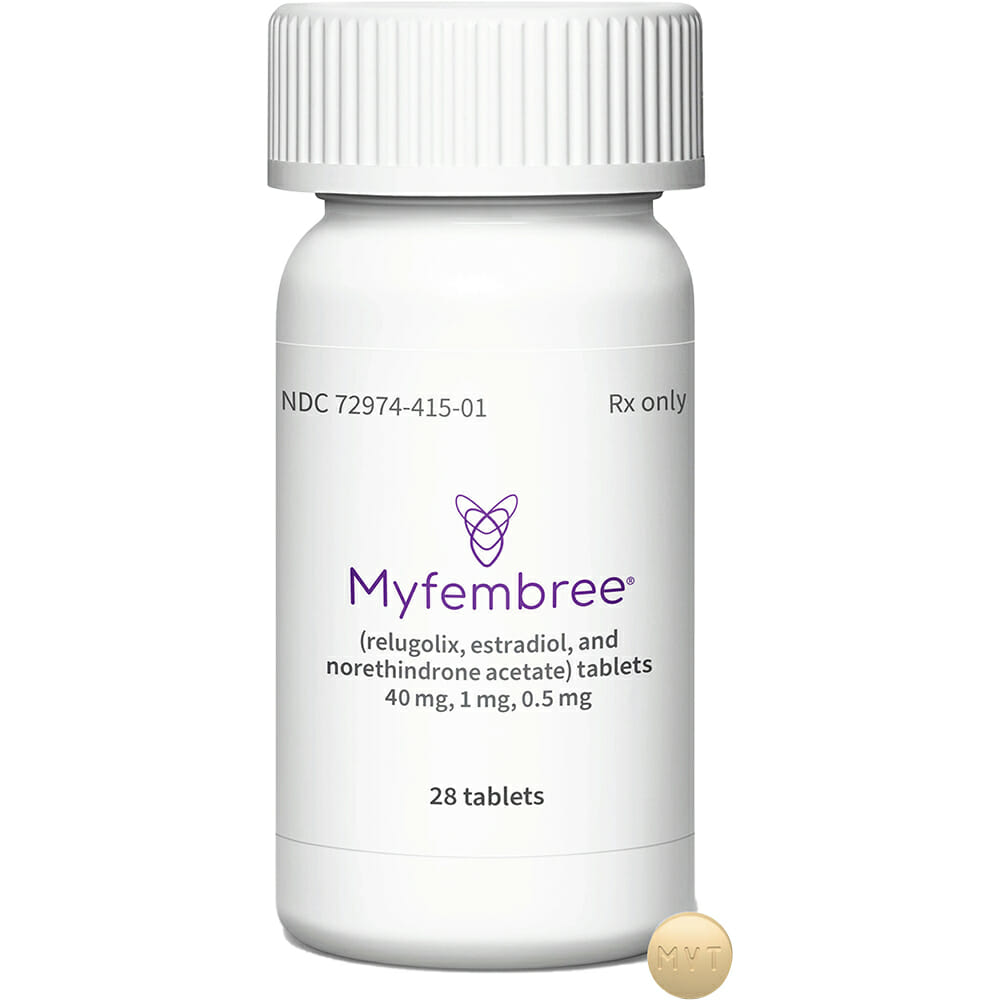
Myfembree
Myfembree
What is Myfembree?
Myfembree is a prescription medication used to manage heavy menstrual bleeding associated with uterine fibroids in premenopausal women. It comprises a combination of relugolix, which reduces the production of estrogen and progesterone, estradiol, and norethindrone acetate to stabilize hormone levels. Myfembree effectively reduces menstrual blood loss while mitigating the risk of bone density loss, commonly associated with other treatments for uterine fibroids.
Side Effects
- Breast lumps, pain, swelling, tenderness, or discharge
- Rapid weight gain, swelling in your hands, ankles, or feet
- Thinning or loss of hair
Warnings
- Your doctor will do lab tests at regular visits to check on the effects of this medicine. Keep all appointments.
- This medicine may cause the following problems:Increased risk of blood clots, heart attack, or strokeLower bone mineral densityIncreased risk of breast cancerChanges in mood or behavior, including thoughts of suicideLiver problemsGallbladder diseaseHigh blood pressureChanges in menstrual bleeding, which may decrease the ability to know if you are pregnantHair lossHigh cholesterol and blood sugar
- Keep all medicine out of the reach of children. Never share your medicine with anyone.
- It is not safe to take this medicine during pregnancy. It could harm an unborn baby. Tell your doctor right away if you become pregnant. This medicine may increase your risk of early pregnancy loss. Your doctor may give you a pregnancy test before you start using this medicine to make sure you are not pregnant. Birth control pills may not work as well to prevent pregnancy when used with this medicine. Use another form of birth control (including condoms or spermicide) during treatment and for at least 1 week after the last dose.
- Tell your doctor if you are breastfeeding, or if you have blood vessel disease, high cholesterol, diabetes, mental problems, gallbladder problems, jaundice (yellow skin or eyes) caused by pregnancy or birth control pills, or a history of fractures. Tell your doctor if you smoke or if you will be having a surgery.
Prescription savings · · · ·
What is Myfembree ?
Myfembree is a prescription medication used to manage heavy menstrual bleeding associated with uterine fibroids in premenopausal women. It comprises a combination of relugolix, which reduces the production of estrogen and progesterone, estradiol, and norethindrone acetate to stabilize hormone levels. Myfembree effectively reduces menstrual blood loss while mitigating the risk of bone density loss, commonly associated with other treatments for uterine fibroids.
- Breast lumps, pain, swelling, tenderness, or discharge
- Rapid weight gain, swelling in your hands, ankles, or feet
- Thinning or loss of hair
- Dry mouth, increased hunger, thirst, or urination
- Sudden or severe headache, problems with vision, speech, or walking
- Stomach pain, nausea, vomiting, lightheadedness
- Light, heavy, or irregular bleeding during monthly periods
- Numbness or weakness in your arm or leg, or on one side of your body, pain in your lower leg (calf)
- Bone pain, decreased height
- Dark urine or pale stools, loss of appetite, yellow skin or eyes
- Chest pain or tightness, trouble breathing, coughing up blood
- Extreme energy or restlessness, confusion, agitation, unusual mood or behavior, thoughts or attempts at killing oneself
- Allergic reaction: Itching or hives, swelling in your face or hands, swelling or tingling in your mouth or throat, chest tightness, trouble breathing
- Your doctor will do lab tests at regular visits to check on the effects of this medicine. Keep all appointments.
- This medicine may cause the following problems:Increased risk of blood clots, heart attack, or strokeLower bone mineral densityIncreased risk of breast cancerChanges in mood or behavior, including thoughts of suicideLiver problemsGallbladder diseaseHigh blood pressureChanges in menstrual bleeding, which may decrease the ability to know if you are pregnantHair lossHigh cholesterol and blood sugar
- Keep all medicine out of the reach of children. Never share your medicine with anyone.
- It is not safe to take this medicine during pregnancy. It could harm an unborn baby. Tell your doctor right away if you become pregnant. This medicine may increase your risk of early pregnancy loss. Your doctor may give you a pregnancy test before you start using this medicine to make sure you are not pregnant. Birth control pills may not work as well to prevent pregnancy when used with this medicine. Use another form of birth control (including condoms or spermicide) during treatment and for at least 1 week after the last dose.
- Tell your doctor if you are breastfeeding, or if you have blood vessel disease, high cholesterol, diabetes, mental problems, gallbladder problems, jaundice (yellow skin or eyes) caused by pregnancy or birth control pills, or a history of fractures. Tell your doctor if you smoke or if you will be having a surgery.
- Make sure any doctor or dentist who treats you knows that you are using this medicine.
Myfembree Coupons & Prices
Myfembree
4 ED medications in one dose
Sildenafil, tadalafil, apomorphine & L-Citrulline · Works in ~15 min · Lasts up to 36 hours
Myfembree prices by dosage
Lowest cash price with a free Rx.com coupon vs. the average retail price.
| Dosage | Quantity | Retail price | Rx.com price |
|---|---|---|---|
| 1 package (28 tablets), 40-1-0.5mg · Disp Pack | 28 | $1,589.99 | $1,236.38 |
Cash prices near ZIP 77433; updated regularly. Actual pharmacy price may vary.
Looking for a Myfembree coupon? Myfembree is a once-daily brand-name tablet (relugolix 40 mg / estradiol 1 mg / norethindrone acetate 0.5 mg) FDA-approved to manage heavy menstrual bleeding from uterine fibroids and moderate to severe endometriosis pain in premenopausal women. There is no generic version yet, so it can be costly. Compare a manufacturer savings card with an Rx.com cash coupon below, and enter your ZIP above to see today's price at pharmacies near you.
What is Myfembree and how does it work?
Myfembree is a single tablet that combines three medicines: relugolix, a gonadotropin-releasing hormone (GnRH) receptor antagonist, plus two "add-back" hormones, the estrogen estradiol and the progestin norethindrone acetate. Relugolix lowers the body's production of estrogen and progesterone, which helps reduce heavy fibroid bleeding and endometriosis pain. The added estradiol and norethindrone acetate help offset side effects of very low estrogen, such as bone loss and hot flashes.
It is taken as one tablet once daily and is FDA-approved for two uses in premenopausal women: managing heavy menstrual bleeding associated with uterine fibroids, and managing moderate to severe pain associated with endometriosis. Because of the risk of continued and possibly irreversible bone loss, treatment is limited to 24 months.
Myfembree cost: manufacturer savings card vs. Rx.com cash coupon
Because Myfembree has no generic, the two main ways to lower your cost are the manufacturer's savings card and an Rx.com cash coupon. The manufacturer offers a copay savings program through its official cost-and-support page, but these cards are generally limited to people with commercial (private) insurance and exclude government plans such as Medicare and Medicaid. Terms, eligibility, and any dollar limits are set by the manufacturer and change over time, so check the official page for current details: Myfembree cost and support.
An Rx.com cash coupon works differently. It is a discount on the cash price, so it can help if you are uninsured, if you have Medicare or Medicaid and cannot use the manufacturer card, or if the manufacturer card is declined at the pharmacy. You cannot combine a cash coupon with your insurance on the same fill, so it pays to compare both. Enter your ZIP above to see today's Rx.com price at pharmacies near you, and check the manufacturer page to see whether you qualify for the copay card.
Myfembree alternatives and related medications
Myfembree belongs to a family of GnRH-based treatments for fibroids and endometriosis. Depending on your diagnosis and what your provider recommends, related options include Orilissa (elagolix) for endometriosis pain and Oriahnn (elagolix with add-back hormones) for fibroid bleeding. The elagolix ingredient itself is listed as elagolix, and the relugolix component of Myfembree is also used in other products such as relugolix and Orgovyx. Older injectable therapy in this class includes Lupron (leuprolide).
These medicines differ in their exact ingredients, indications, and dosing, so they are not interchangeable. This page is for information only and is not medical advice. Talk with your provider about which treatment fits your diagnosis, medical history, and goals.
Myfembree safety and important warnings
Myfembree carries a boxed warning for thromboembolic disorders and vascular events. Estrogen-and-progestin combinations, including Myfembree, can increase the risk of blood clots and serious events such as stroke, heart attack, pulmonary embolism (a clot in the lungs), and deep vein thrombosis. This risk is higher in women over 35 who smoke or who have uncontrolled high blood pressure, and Myfembree should not be used in these patients or in anyone with a current or past clotting event.
Other important risks include bone mineral density loss (which is why use is limited to 24 months), and it must not be used by anyone with known or suspected breast cancer or other estrogen-dependent cancer, undiagnosed abnormal uterine bleeding, known osteoporosis, or a known allergy to any ingredient. It can also raise blood pressure and liver enzymes, affect the gallbladder and liver, and cause mood changes or depression. Myfembree must not be used during pregnancy and may make it harder to recognize an early pregnancy, so effective non-hormonal birth control is advised. This is a summary, not a complete list. Review the full prescribing information and talk with your provider or pharmacist about your personal risks.
This Myfembree information was written and reviewed against authoritative U.S. medical sources — MedlinePlus (U.S. National Library of Medicine), DailyMed, and FDA prescribing information — and checked for accuracy. It is provided for education and is not a substitute for professional medical advice.
Verify the official label: Myfembree on DailyMed (FDA)
Reviewed against FDA labeling · Last reviewed July 2026
Related Drugs
Browse more medications: starting with M · full A-Z directory · by condition · common drugs
Medical disclaimer: This information is provided for general educational purposes only and is not medical advice. It is not a substitute for professional diagnosis or treatment. Always consult a licensed physician, pharmacist, or other qualified healthcare provider before starting, stopping, or changing any medication or treatment. Never disregard professional medical advice or delay seeking it because of something you read here. If you think you may have a medical emergency, call your doctor or 911 immediately.


