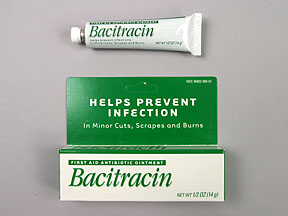
Bacitracin
Bacitracin 14GM of 500UNIT/GM
What is Bacitracin?
Baciguent is a prescription medication used to treat eye infections. The generic version of Baciguent is Bacitracin. The average price of Baciguent is roughly around $124 for a supply of 500 g, 3.5 mg ointment. Use our Rx.com savings offer to get great discounts on Baciguent at participating pharmacies near you.Side Effects
- Allergic reaction: Itching or hives, swelling in your face or hands, swelling or tingling in your mouth or throat, chest tightness, trouble breathing
Warnings
- This medicine is for use only on minor cuts or burns. Do not use it on an animal bite or other puncture wound, a serious burn (with blistering), or a deep cut or skin injury unless directed by your doctor.
- Tell your doctor if you are pregnant or breastfeeding.
- Call your doctor if you see signs of infection near your wound, such as swelling, warmth, redness, or pus.
- Keep all medicine out of the reach of children. Never share your medicine with anyone.
Prescription savings · · · ·
What is Bacitracin ?
Baciguent is a prescription medication used to treat eye infections. The generic version of Baciguent is Bacitracin. The average price of Baciguent is roughly around $124 for a supply of 500 g, 3.5 mg ointment. Use our Rx.com savings offer to get great discounts on Baciguent at participating pharmacies near you.- Allergic reaction: Itching or hives, swelling in your face or hands, swelling or tingling in your mouth or throat, chest tightness, trouble breathing
- This medicine is for use only on minor cuts or burns. Do not use it on an animal bite or other puncture wound, a serious burn (with blistering), or a deep cut or skin injury unless directed by your doctor.
- Tell your doctor if you are pregnant or breastfeeding.
- Call your doctor if you see signs of infection near your wound, such as swelling, warmth, redness, or pus.
- Keep all medicine out of the reach of children. Never share your medicine with anyone.
Bacitracin Coupons & Prices
Bacitracin 14GM of 500UNIT/GM
Weight-loss medication, prescribed online
Licensed U.S. providers · No insurance needed · Shipped to your door
Bacitracin prices by dosage
Lowest cash price with a free Rx.com coupon vs. the average retail price.
| Dosage | Quantity | Retail price | Rx.com price |
|---|---|---|---|
| 14gm of 500unit/gm · Tube Of Ointment | 14 | $14.89 | $6.70 |
| 14.2gm of 500unit/gm · Tube Of Ointment | 14.2 | $19.13 | $6.70 |
| 28.4gm of 500unit/gm · Tube Of Ointment | 28.4 | $13.95 | $6.60 |
| 30gm of 500unit/gm · Tube Of Ointment | 30 | $8.99 | $5.83 |
Cash prices near ZIP 77433; updated regularly. Actual pharmacy price may vary.
Use an Rx.com bacitracin coupon to compare cash prices on bacitracin (bacitracin zinc) at more than 60,000 U.S. pharmacies, then show the coupon at the counter. Bacitracin is a polypeptide antibiotic sold two very different ways: the prescription ophthalmic ointment (500 units per gram) that pharmacies fill for eye infections, and the over-the-counter skin ointment you can buy off the shelf to help prevent infection in minor cuts, scrapes, and burns. Nearly all bacitracin dispensed today is unbranded generic, so it is already an inexpensive drug, but the cash price for the same tube can still differ a lot from one pharmacy to the next. Enter your ZIP code above to see today's price near you, with or without insurance.
What is bacitracin and how does it work?
Bacitracin is a polypeptide antibiotic. It works by blocking bacteria from building their cell walls, which kills susceptible bacteria, mainly gram-positive organisms. Because it can harm the kidneys when it circulates through the body, bacitracin is used almost entirely on the surface of the body rather than swallowed or injected.
Two forms are in normal use in the United States today:
- Bacitracin ophthalmic ointment, 500 units/g (prescription). FDA-indicated to treat superficial infections of the conjunctiva and/or cornea caused by bacitracin-susceptible organisms. This is the form your pharmacy prices and the one a coupon applies to.
- Bacitracin skin ointment, 500 units/g (over the counter). Sold on the shelf as a first-aid antibiotic to help prevent infection in minor cuts, scrapes, and burns. It is not meant to treat an infection that already exists.
Older branded versions such as Baciguent (skin) and AK-Tracin (eye) are discontinued, and bacitracin for injection (BACiiM) was withdrawn from the U.S. market in 2020 at the FDA's request. Bacitracin also appears as one ingredient in combination first-aid ointments.
Bacitracin cost and coupon savings without insurance
Bacitracin is an old, unbranded generic, so it is one of the lower-cost prescriptions on the market. That does not mean every pharmacy charges the same. Cash prices for the identical tube of ophthalmic ointment are set independently by each chain and each location, and the spread between the cheapest and the most expensive pharmacy in one town can be large. Comparing before you fill is the whole game with a drug like this.
Rx.com compares cash prices across more than 60,000 pharmacies nationwide, including big chains, grocery and warehouse pharmacies, and independents. Enter your ZIP code above to see today's price near you, then show the free coupon at the counter. There is no membership, no signup, and no insurance required. If you do have insurance, it is still worth checking: a cash coupon price on a cheap generic sometimes lands below a plan copay. You cannot combine a coupon with insurance on the same fill, so use whichever is lower. There is no manufacturer savings card for bacitracin, because there is no active brand behind it. And if you only need the first-aid skin ointment for a minor cut, remember that version is sold over the counter and does not need a prescription at all.
Bacitracin alternatives and how they compare
If bacitracin is not the right fit, or you have had a reaction to it, several other topical and ophthalmic antibiotics are commonly used. Which one is appropriate depends entirely on where the infection is and what is causing it, so this is a conversation for your prescriber, not a swap you should make on your own.
- Bacitracin zinc is the same active antibiotic in its zinc salt form, and is what most first-aid ointments contain.
- Bacitracin and polymyxin B (the combination sold as Polysporin) adds coverage against certain gram-negative bacteria.
- Neomycin, bacitracin zinc, and polymyxin B is the classic triple-antibiotic first-aid ointment (Neosporin). The neomycin in it is a frequent cause of skin allergy.
- Mupirocin is a prescription skin ointment often chosen for impetigo and staph skin infections.
- Erythromycin ophthalmic ointment is a common alternative for surface eye infections.
- Polymyxin B and trimethoprim eye drops are another option for bacterial conjunctivitis.
- Silver sulfadiazine is a prescription cream used on burn wounds.
All of these are available as generics, and all of them show the same pharmacy-to-pharmacy price spread, so it is worth running a price check on whichever one you are prescribed.
Bacitracin safety, side effects, and warnings
Bacitracin ophthalmic and skin ointments do not carry a boxed warning. The most important issue is allergy. Skin sensitization and allergic contact dermatitis are common with repeated topical use, and rare but serious allergic reactions, including anaphylaxis, have been reported after topical or eye use. Stop using it and get emergency care for a rash, hives, swelling of the face or throat, or trouble breathing. Bacitracin should not be used at all by anyone with a known hypersensitivity to it. Prolonged use can also allow non-susceptible organisms, including fungi, to overgrow, so it is not meant to be used indefinitely.
A few practical limits: the eye ointment is for superficial eye infections only, not for deep-seated eye infections or ones likely to spread through the body, and it can blur your vision for a short time after you apply it. Do not wear contact lenses during an active eye infection. Do not put the first-aid skin ointment in your eyes, nose, or mouth, and do not use it on large or deep wounds, animal bites, or serious burns without seeing a doctor. The injectable form (BACiiM) was withdrawn from the U.S. market in 2020 because it can cause kidney failure and the risk outweighed its limited benefit; it is no longer an option. This page is general information and not medical advice. Talk to your doctor or pharmacist about your own situation.
This Bacitracin information was written and reviewed against authoritative U.S. medical sources — MedlinePlus (U.S. National Library of Medicine), DailyMed, and FDA prescribing information — and checked for accuracy. It is provided for education and is not a substitute for professional medical advice.
Verify the official label: Bacitracin on DailyMed (FDA)
Reviewed against FDA labeling · Last reviewed July 2026
Related Drugs
Browse more medications: starting with B · full A-Z directory · by condition · common drugs
Medical disclaimer: This information is provided for general educational purposes only and is not medical advice. It is not a substitute for professional diagnosis or treatment. Always consult a licensed physician, pharmacist, or other qualified healthcare provider before starting, stopping, or changing any medication or treatment. Never disregard professional medical advice or delay seeking it because of something you read here. If you think you may have a medical emergency, call your doctor or 911 immediately.


