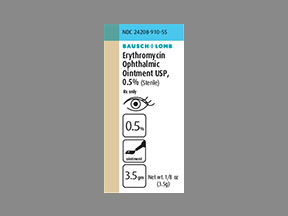
Erythromycin
Erythromycin 3.5GM of 5MG/GM
What is Erythromycin?
Erythromycin is a macrolide antibiotic used to treat a variety of bacterial infections, including respiratory tract infections, skin infections, and sexually transmitted diseases. It works by inhibiting protein synthesis in bacteria, thereby stopping their growth and proliferation. Erythromycin is often recommended for patients who are allergic to penicillin.Side Effects
- Dark urine or pale stools, nausea, vomiting, loss of appetite, stomach pain, yellow skin or eyes
- Sudden and severe stomach pain.
- Nausea, vomiting, loss of appetite, or pain in your upper stomach.
Warnings
- Tell your doctor if you are pregnant or breastfeeding, or if you have kidney disease, liver disease, heart rhythm problems (including QT prolongation), myasthenia gravis (severe muscle weakness), or stomach problems.
- This medicine may cause the following problems:Liver problemsHeart rhythm problemsSerious stomach problem, including infantile hypertrophic pyloric stenosis
- This medicine can cause diarrhea. Call your doctor if the diarrhea becomes severe, does not stop, or is bloody. Do not take any medicine to stop diarrhea until you have talked to your doctor. Diarrhea can occur 2 months or more after you stop taking this medicine.
- Muscle pain, tenderness, or weakness.
- Nausea, vomiting, loss of appetite, or pain in your upper stomach.
Prescription savings · · · ·
What is Erythromycin ?
Erythromycin is a macrolide antibiotic used to treat a variety of bacterial infections, including respiratory tract infections, skin infections, and sexually transmitted diseases. It works by inhibiting protein synthesis in bacteria, thereby stopping their growth and proliferation. Erythromycin is often recommended for patients who are allergic to penicillin.- Dark urine or pale stools, nausea, vomiting, loss of appetite, stomach pain, yellow skin or eyes
- Sudden and severe stomach pain.
- Nausea, vomiting, loss of appetite, or pain in your upper stomach.
- Yellowing of your skin or the whites of your eyes.
- Muscle pain, tenderness, or weakness.
- Severe vomiting, irritability (in children).
- Muscle pain, tenderness, or weakness
- Severe diarrhea, stomach cramps, fever
- Swelling of the face, throat, or lips.
- Fast, slow, pounding, or uneven heartbeat
- Severe diarrhea (watery and may be bloody).
- Lightheadedness, dizziness, or fainting.
- Bloody or cloudy urine, decrease in how much or how often you urinate
- Hearing loss
- Allergic reaction: Itching or hives, swelling in your face or hands, swelling or tingling in your mouth or throat, chest tightness, trouble breathing
- Blistering, peeling, red skin rash
- Tell your doctor if you are pregnant or breastfeeding, or if you have kidney disease, liver disease, heart rhythm problems (including QT prolongation), myasthenia gravis (severe muscle weakness), or stomach problems.
- This medicine may cause the following problems:Liver problemsHeart rhythm problemsSerious stomach problem, including infantile hypertrophic pyloric stenosis
- This medicine can cause diarrhea. Call your doctor if the diarrhea becomes severe, does not stop, or is bloody. Do not take any medicine to stop diarrhea until you have talked to your doctor. Diarrhea can occur 2 months or more after you stop taking this medicine.
- Muscle pain, tenderness, or weakness.
- Nausea, vomiting, loss of appetite, or pain in your upper stomach.
- Severe diarrhea (watery and may be bloody).
- Severe vomiting, irritability (in children).
- Sudden and severe stomach pain.
- Swelling of the face, throat, or lips.
- Yellowing of your skin or the whites of your eyes.
- Do not take this medicine for any other infection. This medicine will not work for colds, flu, or other viral infections.
- Call your doctor if your symptoms do not improve or if they get worse.
- Tell any doctor or dentist who treats you that you are using this medicine. This medicine may affect certain medical test results.
- Your doctor will check your progress and the effects of this medicine at regular visits. Keep all appointments.
- Keep all medicine out of the reach of children. Never share your medicine with anyone.
- Do not take this medicine for any other infection. This medicine will not work for colds, flu, or other viral infections.
Erythromycin Coupons & Prices
Erythromycin 3.5GM of 5MG/GM

4 ED medications in one dose
Sildenafil, tadalafil, apomorphine & L-Citrulline · Works in ~15 min · Lasts up to 36 hours
Looking for an erythromycin coupon? Erythromycin is a long-established macrolide antibiotic that is available as a generic, but the cash price you pay can swing widely from one pharmacy to the next for the exact same prescription. Rx.com compares cash prices at more than 60,000 pharmacies nationwide and gives you a free discount coupon you can show at the counter, with no insurance and no membership required. Enter your ZIP code above to see today's price for your form and quantity and find the lowest-cost pharmacy near you.
What is erythromycin and how does it work?
Erythromycin is a macrolide antibiotic. It works by binding to the 50S subunit of the bacterial ribosome, which blocks bacteria from making the proteins they need to grow and multiply. It is prescribed for infections caused by susceptible bacteria, including upper and lower respiratory tract infections (such as strep throat and tonsillitis, and pneumonia caused by Mycoplasma pneumoniae or Legionnaires' disease), whooping cough, diphtheria (as an adjunct to antitoxin, and to prevent and clear the carrier state), erythrasma, skin and soft-tissue infections, listeriosis, and intestinal amebiasis caused by Entamoeba histolytica (oral forms only; amebiasis outside the intestine requires other medicines). It is also approved for uncomplicated chlamydia of the urethra, cervix, or rectum when a tetracycline cannot be used, nongonococcal urethritis due to Ureaplasma urealyticum, and primary syphilis in people allergic to penicillin. It is approved to help prevent recurrent rheumatic fever in penicillin-allergic patients. The label also covers acute pelvic inflammatory disease caused by N. gonorrhoeae in penicillin-allergic patients, but that regimen begins with intravenous erythromycin lactobionate in a healthcare setting and only then continues with oral erythromycin, so oral tablets alone are not the approved treatment for it. Worth knowing: the chlamydia, gonococcal pelvic inflammatory disease, and syphilis entries are label indications, and current CDC guidelines generally favor other antibiotics for these infections. Your prescriber decides what fits your case.
Erythromycin comes in several salt and ester forms, and the label differs by form: erythromycin base (including delayed-release, enteric-coated tablets), erythromycin ethylsuccinate (E.E.S.), erythromycin stearate, and erythromycin lactobionate for intravenous use. There are also topical and ophthalmic formulations. Because the forms are not interchangeable, always fill and take exactly what your prescriber wrote. Erythromycin is not a controlled substance, and it does nothing for viral illnesses such as colds or the flu; using antibiotics when they aren't needed only helps bacteria become resistant.
Erythromycin coupon: what it costs without insurance
Erythromycin has been available as a generic for decades, but that does not mean it costs the same everywhere. Cash prices for the identical erythromycin prescription can differ substantially between a chain drugstore, a grocery-store pharmacy, and an independent down the street, and they also change depending on the salt form (base vs. ethylsuccinate vs. stearate), the tablet strength, and how many tablets your course calls for. Prices vary by pharmacy, so it pays to compare rather than assume.
There is no manufacturer savings card for generic erythromycin. What you can use is a free discount coupon: enter your ZIP code above, pick your form, strength, and quantity, and Rx.com will show you today's cash price across more than 60,000 pharmacies so you can take the coupon to the cheapest one. The coupon is not insurance, and it cannot be combined with your insurance benefit on the same fill, but you can compare the coupon price against your copay and simply use whichever is lower. If you have insurance, it is always worth checking both.
Erythromycin vs. other antibiotics
Erythromycin is the original macrolide. Azithromycin and clarithromycin are newer macrolides in the same family; they are generally dosed less often and tend to be easier on the stomach, though they are not identical drugs and are not automatically interchangeable. Depending on the infection, a prescriber may instead choose a different class entirely, such as amoxicillin or penicillin VK (penicillins), cephalexin (a cephalosporin), doxycycline (a tetracycline), clindamycin, or metronidazole.
Erythromycin is often a fallback for people with a penicillin allergy, which is why it still appears in labels for strep throat, primary syphilis, and rheumatic fever prophylaxis in penicillin-allergic patients. Keep in mind that a drug being on the label is not the same as it being today's preferred choice: for sexually transmitted infections in particular, current guidelines usually point to other antibiotics. Which antibiotic is right depends on the organism, the site of infection, your allergies, and your other medicines, so this is a conversation for your prescriber, not a swap to make on your own. If you are switched to a different antibiotic, you can compare its cash price here the same way.
Erythromycin safety, side effects, and interactions
Standard oral erythromycin labels do not carry a boxed warning, but there are real risks worth knowing. Erythromycin can prolong the QT interval and, uncommonly, cause serious heart-rhythm problems including torsades de pointes and ventricular arrhythmias; the risk is higher if you have electrolyte abnormalities, existing QT prolongation, or take other QT-prolonging medicines. Erythromycin is a moderate but clinically significant CYP3A4 inhibitor (the FDA classifies erythromycin as a moderate CYP3A inhibitor; clarithromycin is the strong one in this family), so it still interacts with many drugs. It should not be taken with cisapride, pimozide, ergotamine or dihydroergotamine, terfenadine, astemizole, or with lovastatin or simvastatin (risk of rhabdomyolysis). Caution and monitoring are needed with warfarin, colchicine, digoxin, carbamazepine, theophylline, benzodiazepines, and calcium-channel blockers. Give your pharmacist a full list of everything you take, including over-the-counter products and supplements.
The most common side effects are gastrointestinal: nausea, vomiting, stomach pain, diarrhea, and loss of appetite. Less commonly, erythromycin can cause liver injury, including cholestatic hepatitis and, rarely, liver failure. It can also cause Clostridioides difficile-associated diarrhea, which can occur even more than two months after you finish the course, so report severe or persistent watery diarrhea no matter how long ago you took the antibiotic. Infantile hypertrophic pyloric stenosis has been reported in babies under 6 weeks old treated with erythromycin, and erythromycin can worsen myasthenia gravis. Serious allergic reactions and rare severe skin reactions are possible; get medical help right away for trouble breathing, swelling, or a spreading rash. This page is general information, not medical advice, so talk with your doctor or pharmacist about your own situation.
This Erythromycin information was written and reviewed against authoritative U.S. medical sources — MedlinePlus (U.S. National Library of Medicine), DailyMed, and FDA prescribing information — and checked for accuracy. It is provided for education and is not a substitute for professional medical advice.
Verify the official label: Erythromycin on DailyMed (FDA)
Reviewed against FDA labeling · Last reviewed July 2026
Related Drugs
Browse more medications: starting with E · full A-Z directory · by condition · common drugs
Medical disclaimer: This information is provided for general educational purposes only and is not medical advice. It is not a substitute for professional diagnosis or treatment. Always consult a licensed physician, pharmacist, or other qualified healthcare provider before starting, stopping, or changing any medication or treatment. Never disregard professional medical advice or delay seeking it because of something you read here. If you think you may have a medical emergency, call your doctor or 911 immediately.


