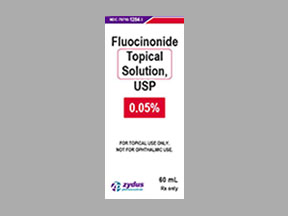
Fluocinonide
Fluocinonide 60GM of 0.05%
What is Fluocinonide?
Fluocinonide is used to treat certain skin conditions, including eczema and psoriasis. Fluocinonide is a generic drug. On average Fluocinonide is priced at about $109 for a 60 grams tube of 0.05% topical ointment. Luckily, you can use our Rx.com savings offer to receive a Fluocinonide discount of up to 80% off the retail price at participating pharmacies near you.Side Effects
- Allergic reaction: Itching or hives, swelling in your face or hands, swelling or tingling in your mouth or throat, chest tightness, trouble breathing
- Itching, flaking, or dryness of treated skin area.
- Severe burning, pain, redness, swelling, or irritation of the treated skin areas.
Warnings
- Make sure your doctor knows if you are pregnant or breastfeeding, or if you have tuberculosis, diabetes, increased pressure in the head, skin infections or problems, or an adrenal problem called Cushing's syndrome.
- You or your child should not use this medicine on your face neck, groin, or underarms unless your doctor told you to do so.
- Using too much of this medicine or using it for a long time may increase your risk of having adrenal gland problems. The risk is greater for children and patients who use large amounts for a long time. Talk to your doctor right away if you or your child have more than one of these symptoms while you are using this medicine: blurred vision; dizziness or fainting; a fast, irregular, or pounding heartbeat; increased thirst or urination; irritability; or unusual tiredness or weakness.
- Stop using this medicine and check with your doctor right away if you or your child have a skin rash, burning, stinging, swelling, or irritation on the skin.
- Call your doctor if your symptoms do not improve or if they get worse.
Prescription savings · · · ·
What is Fluocinonide ?
Fluocinonide is used to treat certain skin conditions, including eczema and psoriasis. Fluocinonide is a generic drug. On average Fluocinonide is priced at about $109 for a 60 grams tube of 0.05% topical ointment. Luckily, you can use our Rx.com savings offer to receive a Fluocinonide discount of up to 80% off the retail price at participating pharmacies near you.- Allergic reaction: Itching or hives, swelling in your face or hands, swelling or tingling in your mouth or throat, chest tightness, trouble breathing
- Itching, flaking, or dryness of treated skin area.
- Severe burning, pain, redness, swelling, or irritation of the treated skin areas.
- Signs of skin infection such as redness, swelling, drainage, or pus.
- Itching and redness around your lips.
- Mild skin redness, stinging, swelling, or hardening.
- Poor healing of the skin.
- Raised spots on the skin.
- Runny or stuffy nose.
- Thinning of the skin or bruising.
- Make sure your doctor knows if you are pregnant or breastfeeding, or if you have tuberculosis, diabetes, increased pressure in the head, skin infections or problems, or an adrenal problem called Cushing's syndrome.
- You or your child should not use this medicine on your face neck, groin, or underarms unless your doctor told you to do so.
- Using too much of this medicine or using it for a long time may increase your risk of having adrenal gland problems. The risk is greater for children and patients who use large amounts for a long time. Talk to your doctor right away if you or your child have more than one of these symptoms while you are using this medicine: blurred vision; dizziness or fainting; a fast, irregular, or pounding heartbeat; increased thirst or urination; irritability; or unusual tiredness or weakness.
- Stop using this medicine and check with your doctor right away if you or your child have a skin rash, burning, stinging, swelling, or irritation on the skin.
- Call your doctor if your symptoms do not improve or if they get worse.
- Your doctor will check your progress and the effects of this medicine at regular visits. Keep all appointments.
- You should not use this medicine for your child without a doctor's approval.
- Topical application routeDo not use this medicine to treat a skin problem your doctor has not examined.
Fluocinonide Coupons & Prices
Fluocinonide 60GM of 0.05%

Weight-loss medication, prescribed online
Licensed U.S. providers · No insurance needed · Shipped to your door
Fluocinonide prices by dosage
Lowest cash price with a free Rx.com coupon vs. the average retail price.
| Dosage | Quantity | Retail price | Rx.com price |
|---|---|---|---|
| 15gm of 0.05% · Tube Of Cream | 60 | $91.89 | $29.06 |
| 30gm of 0.05% · Tube Of Cream | 60 | $210.45 | $27.97 |
| 60gm of 0.05% · Tube Of Cream | 60 | $71.44 | $26.38 |
| 120gm of 0.05% · Tube Of Cream | 60 | $101.99 | $29.06 |
Cash prices near ZIP 77433; updated regularly. Actual pharmacy price may vary.
If you have been handed a prescription for fluocinonide and you are paying cash, a fluocinonide coupon can change what you pay at the counter. Fluocinonide is a high-potency topical corticosteroid used for the itching and inflammation of steroid-responsive skin conditions. The 0.05% strength is available as an FDA-approved generic in cream, emulsified-base cream, gel, ointment, and topical solution forms; the 0.1% cream is sold under the brand name Vanos. Cash prices for the same tube can differ a lot from one pharmacy to the next, even between stores on the same street, so it is worth comparing before you fill. Rx.com compares prices at more than 60,000 pharmacies. Enter your ZIP above to see today's price near you, then show the coupon at the pharmacy counter.
What is fluocinonide and how does it work?
Fluocinonide is a topical corticosteroid, also called a glucocorticoid. It is considered high-potency (generally grouped in the potent Group II to III range, depending on the strength and the base it is mixed into). Applied to the skin, it calms the inflammation and itching that drive many rashes rather than curing the underlying condition.
The FDA-approved use for fluocinonide 0.05% products (cream, emulsified-base cream, gel, ointment, and topical solution) is relief of the inflammatory and pruritic (itchy) manifestations of corticosteroid-responsive dermatoses. The 0.1% cream sold as Vanos is approved for the same thing, but specifically in patients 12 years of age or older. Those indications are written broadly, and in everyday practice prescribers reach for fluocinonide for conditions that fall under that umbrella, such as eczema, plaque psoriasis, contact dermatitis, lichen planus, seborrheic dermatitis, and discoid lupus. Your prescriber chooses the strength and the form (an ointment behaves differently from a solution) based on where the rash is and how thick the skin is there.
What fluocinonide costs without insurance, and how to pay less
The 0.05% strength is available as an FDA-approved generic, which is what most fluocinonide prescriptions are filled with. But generic does not automatically mean the same price everywhere. Pharmacy cash prices for the identical tube, strength, and size vary widely, because each pharmacy sets its own cash price. That variation is the reason comparing is worth your time, and it is why the same coupon can produce very different results at two nearby stores. The 0.1% cream is still a brand product (Vanos), which is a different pricing conversation than the generic.
If you are uninsured or your plan does not cover the strength or form you were prescribed, a cash discount coupon is usually the practical path. If you were prescribed the brand, it is worth checking the manufacturer's website for any current savings program, since those programs come and go and have their own eligibility rules. Rx.com compares prices across more than 60,000 pharmacies. Enter your ZIP above to see today's price near you, print or show the coupon on your phone, and hand it to the pharmacist before they ring you up. Two more honest tips: ask the pharmacist to quote both the cash-coupon price and your insurance copay, since the coupon sometimes wins, and ask whether a different size tube is the better value for the length of treatment your prescriber ordered.
Fluocinonide vs. other topical steroids
Topical steroids are usually chosen by potency, not by brand. Fluocinonide sits in the high-potency range. If you are comparing options, these are the ones prescribers most often weigh alongside it:
- Clobetasol is a super-high-potency option, stronger than fluocinonide, generally reserved for thick, stubborn plaques.
- Triamcinolone and mometasone are medium-potency choices, commonly used when a high-potency steroid is more than the situation needs.
- Betamethasone and fluocinolone come in a range of strengths and bases that can straddle several potency groups.
- Desonide and hydrocortisone are low-potency, and are the kind of thing chosen for delicate skin such as the face or skin folds.
On brands: fluocinonide 0.1% cream is marketed as Vanos by Bausch Health. Among the 0.05% products, the older Lidex and Lidex-E brands, and other names such as Dermacin, Fluonex, and Licon, are not names you should count on finding at a pharmacy today; the generic is what is actually stocked. These products are not interchangeable by potency, so do not swap one for another on your own. Ask your prescriber or pharmacist which is right for your skin and the spot being treated.
Safety information you should know
Fluocinonide has no boxed warning. Its risks are the ones that come with any high-potency topical steroid, and most of them are tied to how much you use, how long you use it, and how much skin you cover. Absorbed steroid can suppress the HPA axis (usually reversibly) and, less often, cause Cushing's syndrome, high blood sugar, or sugar in the urine. This is more likely with high doses, large treated areas, prolonged use, or covered (occluded) skin. Children are at greater risk because they have more skin surface relative to body size, and growth suppression and delayed weight gain have been reported.
Duration limits depend on which product you were given. For Vanos 0.1% cream, the label states that treatment beyond 2 consecutive weeks is not recommended and that the total dosage should not exceed 60 g per week. The 0.05% labels do not set a maximum treatment duration or a weekly gram limit; they direct that the medicine is generally applied as a thin film two to four times daily depending on the severity of the condition. That is not an invitation to keep using it indefinitely, so follow the directions on your own prescription and check with your prescriber before extending treatment. Local reactions can include burning, stinging, itching, folliculitis, acne-like eruptions, skin thinning (atrophy), stretch marks, tiny visible blood vessels, loss of skin color, perioral dermatitis, allergic contact dermatitis, and secondary infection. The Vanos 0.1% label specifically says it should not be used on the face, groin, or axillae (underarms). The 0.05% labels do not carry that instruction, but they do caution that skin thinning can occur on the face and on intertriginous or flexor areas even with short-term use, so ask your prescriber before using it in those spots. Do not bandage, cover, or wrap treated skin unless your prescriber tells you to, and do not use tight-fitting diapers or plastic pants on a child being treated in the diaper area, since those garments act like occlusive dressings and increase how much medicine gets absorbed. Stop and call your prescriber if irritation or infection develops. Vanos 0.1% is for topical use only and is not for ophthalmic, oral, or intravaginal use; the 0.05% products are labeled for external use only and not for ophthalmic use. This is a summary, not medical advice, and not a complete list. Read the label that comes with your prescription and talk with your provider or pharmacist about your own situation.
This Fluocinonide information was written and reviewed against authoritative U.S. medical sources — MedlinePlus (U.S. National Library of Medicine), DailyMed, and FDA prescribing information — and checked for accuracy. It is provided for education and is not a substitute for professional medical advice.
Verify the official label: Fluocinonide on DailyMed (FDA)
Reviewed against FDA labeling · Last reviewed July 2026
Related Drugs
Browse more medications: starting with F · full A-Z directory · by condition · common drugs
Medical disclaimer: This information is provided for general educational purposes only and is not medical advice. It is not a substitute for professional diagnosis or treatment. Always consult a licensed physician, pharmacist, or other qualified healthcare provider before starting, stopping, or changing any medication or treatment. Never disregard professional medical advice or delay seeking it because of something you read here. If you think you may have a medical emergency, call your doctor or 911 immediately.


