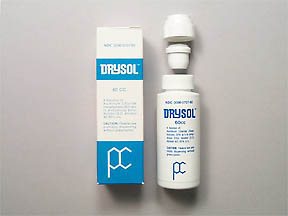
Drysol
Drysol 60ML of 20%
What is Drysol?
Hypercare is a miscellaneous topical agent used to treat patients with excessive sweating. Aluminum chloride hexahydrate is the generic version of Hypercare. Hypercare costs around $10 for a supply of 1, 60 ml of 20% applicator. An easy way to reduce the Hypercare price is to use our free Rx.com Hypercare discount card.Side Effects
- Allergic reaction: Itching or hives, swelling in your face or hands, swelling or tingling in your mouth or throat, chest tightness, trouble breathing
Warnings
- Topical application routeDo not use this medicine to treat a skin problem your doctor has not examined.
Prescription savings · · · ·
What is Drysol ?
Hypercare is a miscellaneous topical agent used to treat patients with excessive sweating. Aluminum chloride hexahydrate is the generic version of Hypercare. Hypercare costs around $10 for a supply of 1, 60 ml of 20% applicator. An easy way to reduce the Hypercare price is to use our free Rx.com Hypercare discount card.- Allergic reaction: Itching or hives, swelling in your face or hands, swelling or tingling in your mouth or throat, chest tightness, trouble breathing
- Topical application routeDo not use this medicine to treat a skin problem your doctor has not examined.
Drysol Coupons & Prices
Drysol 60ML of 20%
Weight-loss medication, prescribed online
Licensed U.S. providers · No insurance needed · Shipped to your door
Drysol prices by dosage
Lowest cash price with a free Rx.com coupon vs. the average retail price.
| Dosage | Quantity | Retail price | Rx.com price |
|---|---|---|---|
| 35ml of 20% · Bottle | 35 | — | $13.98 |
| 37.5ml of 20% · Bottle | 60 | $26.99 | $18.20 |
| 60ml of 20% · Bottle | 60 | $49.99 | $17.26 |
Cash prices near ZIP 77433; updated regularly. Actual pharmacy price may vary.
Drysol is a prescription-strength topical antiperspirant used for hyperhidrosis (excessive sweating), and a Drysol coupon from Rx.com can lower what you pay at the pharmacy counter when you are paying cash. Drysol is aluminum chloride hexahydrate solution; its labeling indicates it for severe, recalcitrant hyperhidrosis. Topical aluminum chloride hexahydrate as an ingredient class is generally the first thing clinicians reach for in primary focal hyperhidrosis, before options like iontophoresis, botulinum toxin injections, oral medicines, or surgery. Prices for the same bottle vary quite a bit from one pharmacy to the next, so it pays to compare. Enter your ZIP above to see today's price near you.
What is Drysol and how does it work?
Drysol is a topical solution of aluminum chloride hexahydrate, an aluminum-salt antiperspirant and astringent. It is applied to the skin to reduce excessive sweating, most often under the arms (axillary hyperhidrosis), and it is also used on the palms and soles. Drysol's own labeling indicates it for severe, recalcitrant hyperhidrosis. It is not a deodorant and it is not a pill; it works on the skin where you apply it.
Drysol has been marketed for many years as a prescription antiperspirant rather than as a product approved under an FDA New Drug Application. Drysol and Drysol Dab-O-Matic are 20% aluminum chloride hexahydrate. Other marketed aluminum chloride hexahydrate products include Hypercare, labeled 15% w/v in its package insert (some drug databases list it as 20%), and Xerac AC at 6.25% — both of which are also prescription products. Strength alone does not determine whether a product needs a prescription: Certain Dri Clinical Strength is sold over the counter, and its Drug Facts label lists aluminum chloride 15% — a higher number than prescription-only Xerac AC. Aluminum chloride hexahydrate as an ingredient is generally regarded as first-line therapy for primary focal hyperhidrosis. In dermatology practice the ingredient is also used for other purposes, such as stopping minor skin bleeding; this page describes the antiperspirant use only. This is general information, not medical advice, so talk with your clinician about what is right for you.
Drysol cost: manufacturer savings card vs. an Rx.com cash coupon
Searches for a Drysol coupon usually turn up two different things. The first is a manufacturer savings card. Drysol is marketed by Person & Covey, and any current savings offer would be posted on that company's own website; we do not link a savings-card page here because those deep links change and break often. Manufacturer cards are generally limited to people with commercial (non-government) insurance, and terms vary, so read the eligibility rules before you count on one. People who are uninsured, or who have Medicare or another government plan, are typically excluded.
The second is a cash discount coupon like the one on this page. An Rx.com cash coupon does not use your insurance, so it works whether you are uninsured, on Medicare, or simply told the manufacturer card was declined at the register. Because Drysol is marketed without an FDA New Drug Application, there is no FDA-approved, AB-rated generic of it that a pharmacist could automatically substitute. Unbranded aluminum chloride hexahydrate listings do appear in pharmacy databases, but whether any of them is an appropriate stand-in for your prescription is a question for your pharmacist and prescriber, not something to assume. You cannot use a cash coupon and your insurance on the same fill, so compare both and use whichever is lower. Prices vary by pharmacy and by strength, so enter your ZIP above to see today's price.
Drysol alternatives and related options
If Drysol is not a fit, several other options are used for excessive sweating. Your clinician decides what is appropriate for your situation.
- Aluminum chloride hexahydrate — the same active ingredient, sold in unbranded listings; ask your pharmacist what is actually stocked and whether it fits your prescription.
- Hypercare — another prescription aluminum chloride hexahydrate solution, labeled 15% w/v in its package insert.
- Xerac AC — a lower, 6.25% strength of the same ingredient. It is also a prescription product, not an over-the-counter one.
- Certain Dri Clinical Strength — an over-the-counter antiperspirant whose Drug Facts label lists aluminum chloride 15%, despite the "prescription protection" wording on the package. The separate, plain Certain Dri Roll-On is labeled aluminum chloride 12%.
- Qbrexza — a medicated cloth containing glycopyrronium, a different approach applied to the skin.
- Glycopyrrolate and oxybutynin chloride — oral anticholinergic medicines sometimes used when topical treatment is not enough.
Beyond medication, iontophoresis, botulinum toxin injections, and surgery are options clinicians consider when a topical antiperspirant like Drysol does not control symptoms.
Drysol safety and how to use it with less irritation
Drysol has no boxed warning. The solution is made with absolute (anhydrous) alcohol and is flammable, so keep it away from fire, flame, and smoking, and let it dry completely before dressing or going to bed. Do not apply it to broken, irritated, or freshly shaved or waxed skin; wait at least 24 to 48 hours after shaving. Keep it away from your eyes and other mucous membranes. It is not for use as a deodorant, and not for the face unless your clinician directs it.
The most common side effects are stinging, burning, itching, prickling, and skin irritation. You can reduce irritation by applying it only to completely dry skin at bedtime, washing it off in the morning, and not covering the area with plastic wrap unless your clinician tells you to. Aluminum chloride can damage or discolor clothing and metal. It should not be used by anyone allergic to aluminum chloride. Stop using it and contact your clinician if you develop severe irritation, a rash, or signs of infection. This is a summary, not medical advice; read the label that comes with your bottle and ask your pharmacist or clinician with any questions.
This Drysol information was written and reviewed against authoritative U.S. medical sources — MedlinePlus (U.S. National Library of Medicine), DailyMed, and FDA prescribing information — and checked for accuracy. It is provided for education and is not a substitute for professional medical advice.
Verify the official label: Drysol on DailyMed (FDA)
Reviewed against FDA labeling · Last reviewed July 2026
Related Drugs
Browse more medications: starting with D · full A-Z directory · by condition · common drugs
Medical disclaimer: This information is provided for general educational purposes only and is not medical advice. It is not a substitute for professional diagnosis or treatment. Always consult a licensed physician, pharmacist, or other qualified healthcare provider before starting, stopping, or changing any medication or treatment. Never disregard professional medical advice or delay seeking it because of something you read here. If you think you may have a medical emergency, call your doctor or 911 immediately.


