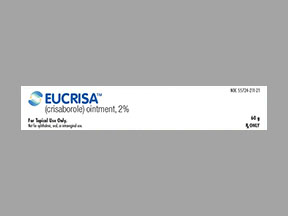
Eucrisa
Eucrisa
What is Eucrisa?
Eucrisa (crisaborole) is a prescription, non-steroidal ointment used to treat mild to moderate eczema (atopic dermatitis) in adults and children. It helps reduce inflammation, itching, and skin irritation without the use of topical corticosteroids.
Side Effects
- Allergic reaction: Itching or hives, swelling in your face or hands, swelling or tingling in your mouth or throat, chest tightness, trouble breathing
- Severe itching, burning, pain, redness, stinging, swelling, or skin irritation where the medicine is applied
Warnings
- Topical application routeDo not use this medicine to treat a skin problem your doctor has not examined.
- Call your doctor if your symptoms do not improve or if they get worse.
- Keep all medicine out of the reach of children. Never share your medicine with anyone.
- Tell your doctor if you are pregnant or breastfeeding.
Prescription savings · · · ·
What is Eucrisa ?
Eucrisa (crisaborole) is a prescription, non-steroidal ointment used to treat mild to moderate eczema (atopic dermatitis) in adults and children. It helps reduce inflammation, itching, and skin irritation without the use of topical corticosteroids.
- Allergic reaction: Itching or hives, swelling in your face or hands, swelling or tingling in your mouth or throat, chest tightness, trouble breathing
- Severe itching, burning, pain, redness, stinging, swelling, or skin irritation where the medicine is applied
- Topical application routeDo not use this medicine to treat a skin problem your doctor has not examined.
- Call your doctor if your symptoms do not improve or if they get worse.
- Keep all medicine out of the reach of children. Never share your medicine with anyone.
- Tell your doctor if you are pregnant or breastfeeding.
Eucrisa Coupons & Prices
Eucrisa
Weight-loss medication, prescribed online
Licensed U.S. providers · No insurance needed · Shipped to your door
Eucrisa prices by dosage
Lowest cash price with a free Rx.com coupon vs. the average retail price.
| Dosage | Quantity | Retail price | Rx.com price |
|---|---|---|---|
| 60gm of 2% · Tube Of Ointment | 60 | $957.09 | $712.85 |
Cash prices near ZIP 77433; updated regularly. Actual pharmacy price may vary.
Looking for a Eucrisa coupon? Eucrisa (crisaborole) is a brand-name 2% ointment used to treat mild-to-moderate atopic dermatitis (eczema), and there is no generic version yet, so cash prices can run high. Enter your ZIP above to see today's Rx.com price at pharmacies near you, then compare it against the manufacturer's savings card to find your lowest out-of-pocket cost.
What is Eucrisa and how does it work?
Eucrisa is the brand name for crisaborole, a topical phosphodiesterase-4 (PDE4) inhibitor. It is FDA-approved to treat mild-to-moderate atopic dermatitis (eczema) in adults and children 3 months of age and older. It comes as a 2% ointment that you apply to affected skin twice a day.
Unlike many older eczema treatments, Eucrisa is nonsteroidal. It works by inhibiting PDE4, an enzyme involved in inflammation, which helps calm the redness, itching, and irritation of eczema. Always follow the directions from your doctor or pharmacist for how and where to apply it.
Eucrisa manufacturer savings card vs. Rx.com cash coupon
The "Eucrisa coupon" search results are usually a mix of the manufacturer's copay savings card and third-party discount cards. These are two different things, and the right one depends on your coverage:
- Manufacturer copay savings card: Pfizer offers a Eucrisa savings card, but manufacturer copay cards are generally limited to people with commercial (private) insurance and typically cannot be used if you have Medicare, Medicaid, or other government coverage. Terms and eligibility vary, so check the official details at eucrisa.com/copay-card-download.
- Rx.com cash coupon: Our free discount coupon is a cash-price option that works even if you are uninsured, on Medicare, or if the manufacturer card is declined. It is not insurance. Enter your ZIP above to see today's price at pharmacies near you.
Because Eucrisa has no generic yet, price shopping between the manufacturer card and a cash coupon is the main way to lower your cost. If you are struggling to afford it, ask your prescriber or pharmacist whether a Pfizer patient-assistance program may be available.
Eucrisa alternatives and related treatments
Eucrisa's active ingredient is crisaborole; there is currently no generic crisaborole on the market. If cost is a concern, your provider may discuss other nonsteroidal eczema options that do have generics, which can be a much bigger savings lever:
- Protopic (tacrolimus) ointment, a topical calcineurin inhibitor.
- Elidel (pimecrolimus) cream, another topical calcineurin inhibitor.
- For moderate-to-severe eczema, Dupixent, an injectable biologic, may be considered.
These medicines work differently and are not interchangeable. Your doctor can help decide which is appropriate for you or your child.
Eucrisa safety and side effects
Eucrisa has no boxed warning. It is for topical (external) use only and should not be used in the eyes, mouth, or vagina. It should not be used by anyone with a known allergy to crisaborole. The most common side effect is pain at the application site, such as burning or stinging.
Serious hypersensitivity (allergic) reactions have occurred, including contact hives (urticaria). Stop using Eucrisa and get medical help right away if you notice signs of a severe allergic reaction, such as trouble breathing; tightness in the throat or chest; feeling faint; swelling of the face, eyelids, lips, mouth, tongue, or throat; or hives. This page is for general information and is not medical advice; talk to your doctor or pharmacist about your specific situation.
This Eucrisa information was written and reviewed against authoritative U.S. medical sources — MedlinePlus (U.S. National Library of Medicine), DailyMed, and FDA prescribing information — and checked for accuracy. It is provided for education and is not a substitute for professional medical advice.
Verify the official label: Eucrisa on DailyMed (FDA)
Reviewed against FDA labeling · Last reviewed July 2026
Related Drugs
Browse more medications: starting with E · full A-Z directory · by condition · common drugs
Medical disclaimer: This information is provided for general educational purposes only and is not medical advice. It is not a substitute for professional diagnosis or treatment. Always consult a licensed physician, pharmacist, or other qualified healthcare provider before starting, stopping, or changing any medication or treatment. Never disregard professional medical advice or delay seeking it because of something you read here. If you think you may have a medical emergency, call your doctor or 911 immediately.


