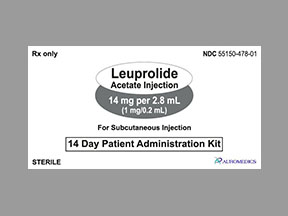
Leuprolide Acetate
Leuprolide Acetate 1 Kit
What is Leuprolide Acetate?
Leuprolide acetate is a synthetic gonadotropin-releasing hormone (GnRH) analogue used to modulate the pituitary gland's release of luteinizing hormone (LH) and follicle-stimulating hormone (FSH). It is commonly prescribed in the treatment of hormone-responsive cancers such as prostate cancer, breast cancer, endometriosis, and uterine fibroids, as well as in controlled ovarian stimulation procedures. By continuously stimulating the GnRH receptors, leuprolide acetate effectively reduces gonadal hormone production, thereby diminishing the influence of hormones on disease progression.Side Effects
- Fast, pounding, or uneven heartbeat
- Depression, mood or behavior changes
- Dark urine or pale stools, loss of appetite, yellow skin or eyes
Warnings
- Your doctor will do lab tests at regular visits to check on the effects of this medicine. Keep all appointments.
- Keep all medicine out of the reach of children. Never share your medicine with anyone.
- It is not safe to take this medicine during pregnancy. It could harm an unborn baby. Tell your doctor right away if you become pregnant. Women who are using this medicine should use birth control that does not contain hormones (including condoms, spermicide).
- Tell your doctor if you have kidney disease, liver disease, heart failure, diabetes, heart or blood vessel disease, heart rhythm problems (including long QT syndrome), problems with your nervous system, or a history of asthma, sinusitis, drug allergy, brain tumor, depression, mental illness, seizures, or stroke.
- Women: Your menstrual periods should stop, but you might have light bleeding or spotting. If you continue to have heavy bleeding or regular periods, call your doctor.
Prescription savings · · · ·
What is Leuprolide Acetate ?
Leuprolide acetate is a synthetic gonadotropin-releasing hormone (GnRH) analogue used to modulate the pituitary gland's release of luteinizing hormone (LH) and follicle-stimulating hormone (FSH). It is commonly prescribed in the treatment of hormone-responsive cancers such as prostate cancer, breast cancer, endometriosis, and uterine fibroids, as well as in controlled ovarian stimulation procedures. By continuously stimulating the GnRH receptors, leuprolide acetate effectively reduces gonadal hormone production, thereby diminishing the influence of hormones on disease progression.- Fast, pounding, or uneven heartbeat
- Depression, mood or behavior changes
- Dark urine or pale stools, loss of appetite, yellow skin or eyes
- Sudden or severe headache, problems with vision, speech, or walking
- Fever, chills, cough, runny or stuffy nose, sore throat, body aches
- Allergic reaction: Itching or hives, swelling in your face or hands, swelling or tingling in your mouth or throat, chest tightness, trouble breathing
- Arm, leg, back, bone, or muscle pain, numbness or tingling in the body
- Blurred or change in vision, eye pain, severe headache, fainting, dizziness, lightheadedness
- Change in how much or how often you urinate, blood in the urine
- Chest pain that may spread, trouble breathing, coughing up blood
- Vaginal bleeding, discharge, itching, or pain
- Unusual or severe bone or back pain
- Numbness or weakness in your arm or leg, or on one side of your body, pain in your lower leg
- Dry mouth, fruit-like breath odor, nausea, vomiting, stomach pain, tiredness
- Seizures
- Your doctor will do lab tests at regular visits to check on the effects of this medicine. Keep all appointments.
- Keep all medicine out of the reach of children. Never share your medicine with anyone.
- It is not safe to take this medicine during pregnancy. It could harm an unborn baby. Tell your doctor right away if you become pregnant. Women who are using this medicine should use birth control that does not contain hormones (including condoms, spermicide).
- Tell your doctor if you have kidney disease, liver disease, heart failure, diabetes, heart or blood vessel disease, heart rhythm problems (including long QT syndrome), problems with your nervous system, or a history of asthma, sinusitis, drug allergy, brain tumor, depression, mental illness, seizures, or stroke.
- Women: Your menstrual periods should stop, but you might have light bleeding or spotting. If you continue to have heavy bleeding or regular periods, call your doctor.
- This medicine may cause the following problems:Changes in mood or behaviorIncreased risk for seizuresHeart rhythm changes, including QT prolongationWeaker bones, which may lead to osteoporosisProblems with the urinary tract or spinal cord (in men)Increased risk of high blood sugar or cholesterol levels (in men)Increased risk of non-alcoholic fatty liver disease (in men)Increased risk of heart attack or stroke (in men)Intracranial hypertension or pseudotumor cerebri (increased pressure in the head) in children
- Talk with your doctor before using this medicine if you plan to have children. Some men who use this medicine have become infertile (unable to have children).
- Your symptoms might get worse when you first start using this medicine, but they should get better as the medicine starts to work. If your condition does not begin to improve after 2 weeks, check with your doctor.
- Tell any doctor or dentist who treats you that you are using this medicine. This medicine may affect certain medical test results.
Leuprolide Acetate Coupons & Prices
Leuprolide Acetate 1 Kit

Weight-loss medication, prescribed online
Licensed U.S. providers · No insurance needed · Shipped to your door
Leuprolide Acetate prices by dosage
Lowest cash price with a free Rx.com coupon vs. the average retail price.
| Dosage | Quantity | Retail price | Rx.com price |
|---|---|---|---|
| 1 kit · Box | 1 | $891.99 | $280.13 |
Cash prices near ZIP 77433; updated regularly. Actual pharmacy price may vary.
A leuprolide acetate coupon from Rx.com can lower what you pay at the pharmacy counter when you are paying cash. Leuprolide acetate is a gonadotropin-releasing hormone (GnRH) agonist, sold under brand names such as Lupron Depot, Eligard and Fensolvi, and it is available as a generic daily subcutaneous injection (1 mg/0.2 mL) used for the palliative treatment of advanced prostate cancer. Because pharmacies set their own cash prices, the amount you are charged for the same prescription can vary a lot from one store to the next, even across the street. Enter your ZIP code above to compare today's price at more than 60,000 participating pharmacies and print, text or email a free coupon to show at the counter.
What is leuprolide acetate and how does it work?
Leuprolide acetate is a GnRH agonist (also called an LHRH agonist). It works on the pituitary gland to shut down the body's production of the hormones that tell the testicles or ovaries to make testosterone or estrogen. After a short initial period, hormone levels drop sharply, which is why the drug is used as androgen-deprivation therapy in prostate cancer and as hormone suppression in certain conditions in women and children.
The FDA-approved uses depend on the exact product. The generic daily injection (1 mg/0.2 mL, given under the skin) is approved for the palliative treatment of advanced prostate cancer. Long-acting depot forms such as Lupron Depot and Eligard are used for advanced prostate cancer. (Camcevi is a related six-month subcutaneous product, but it contains leuprolide mesylate, a different salt, not leuprolide acetate.) Lupron Depot 3.75 mg and 11.25 mg are also approved for managing endometriosis (alone or with norethindrone acetate add-back, as in the Lupaneta Pack) and, given with iron, for preoperative improvement of anemia caused by uterine fibroids. Lupron Depot-Ped and Fensolvi are approved for central precocious puberty in children. Your prescriber chooses the formulation and schedule that matches your diagnosis.
Leuprolide acetate cost without insurance, and how coupons help
There is no single cash price for leuprolide acetate. Pharmacies set their own cash prices independently, so two pharmacies in the same ZIP code can quote very different prices for the identical generic vial, and the difference is not always small. That is why comparing before you fill matters here.
Rx.com is free to use and requires no insurance, no membership and no sign-up. Enter your ZIP code above to see today's price at more than 60,000 participating pharmacies, then take the coupon to the counter and ask the pharmacist to run it. A discount coupon cannot be combined with insurance, but you can always ask the pharmacy to compare the coupon price against your copay and charge you whichever is lower. Depot forms are often administered in a clinic and may be billed through medical benefits instead of a retail pharmacy, so check with your prescriber's office about which route applies to you. There is no manufacturer savings card offered through Rx.com for the generic injection; if you take a brand product, its manufacturer's official website is the place to check for any current program, and terms and eligibility vary.
Leuprolide acetate compared with other hormone-suppressing options
Leuprolide is one of several drugs used to lower testosterone in advanced prostate cancer, and your oncologist or urologist picks among them based on how quickly hormone levels need to fall, dosing interval, and how you tolerate the injection. Other options include:
- Goserelin — another GnRH agonist, given as an implant under the skin of the abdomen.
- Triptorelin — a GnRH agonist given as a long-acting intramuscular injection.
- Degarelix — a GnRH antagonist. Because it blocks the receptor rather than stimulating it first, it does not produce the initial hormone surge that GnRH agonists can cause.
- Bicalutamide — an oral antiandrogen that blocks testosterone at the receptor. Bicalutamide 50 mg is FDA-approved for use in combination with an LHRH analog for stage D2 metastatic prostate cancer; how it is used within that combination is a decision for your care team.
Within leuprolide itself, the choice is mostly about the delivery form: the generic 1 mg/0.2 mL daily subcutaneous injection versus a depot given every one to six months, such as Lupron Depot or Eligard. These are not interchangeable at the pharmacy; only your prescriber can switch you between them. This page is information, not medical advice.
Leuprolide acetate side effects and safety
The generic daily-injection label does not carry a boxed warning. The effect people are most often warned about is the initial hormone surge in the first weeks of treatment: testosterone or estrogen briefly rises before it falls. In prostate cancer this can cause a temporary "tumor flare" with worse bone pain, urinary obstruction or, rarely, spinal cord compression; in women treated with a depot product it can briefly worsen endometriosis or fibroid symptoms and cause vaginal bleeding. Tell your care team right away about new or worsening bone pain, trouble urinating, or numbness or weakness in the legs.
Risks differ by product, so it helps to know which label a given warning comes from. On the generic daily leuprolide acetate injection (1 mg/0.2 mL) — a men's product for palliative treatment of advanced prostate cancer — the labeled warnings and precautions include tumor flare in the first weeks; decreased bone density with long-term hormone suppression; reported cardiovascular events such as heart attack, stroke and sudden cardiac death, and QT/QTc prolongation, with androgen-deprivation therapy; high blood sugar and an increased risk of developing diabetes, so blood glucose or HbA1c should be monitored; and rare cases of pituitary apoplexy. Its only contraindication is hypersensitivity or anaphylaxis to GnRH, GnRH-agonist analogs or the product's ingredients.
The depot products used in women carry their own limits, driven by bone loss. For endometriosis, Lupron Depot 3.75 mg (monthly) or 11.25 mg (every three months) is given for up to six months in an initial course. If symptoms return, a retreatment course of up to six more months may be considered, but only with norethindrone acetate add-back therapy, and total duration of Lupron Depot plus add-back should not exceed 12 months; bone mineral density should be assessed before a second course. For preoperative improvement of anemia caused by uterine fibroids, Lupron Depot is given with iron for up to three months. These women's products can harm a developing baby and are contraindicated in pregnancy, and in undiagnosed abnormal vaginal bleeding — pregnancy should be ruled out before starting, and non-hormonal contraception used during treatment.
Common side effects across leuprolide products include hot flashes, sweating, injection-site reactions, tiredness, lower libido and erectile dysfunction, mood changes or depression, headache, and in women absence of periods and vaginal dryness. This is a summary, not a complete list; talk with your doctor or pharmacist about your own situation and read the labeling for the exact product you were prescribed.
This Leuprolide Acetate information was written and reviewed against authoritative U.S. medical sources — MedlinePlus (U.S. National Library of Medicine), DailyMed, and FDA prescribing information — and checked for accuracy. It is provided for education and is not a substitute for professional medical advice.
Verify the official label: Leuprolide Acetate on DailyMed (FDA)
Reviewed against FDA labeling · Last reviewed July 2026
Related Drugs
Browse more medications: starting with L · full A-Z directory · by condition · common drugs
Medical disclaimer: This information is provided for general educational purposes only and is not medical advice. It is not a substitute for professional diagnosis or treatment. Always consult a licensed physician, pharmacist, or other qualified healthcare provider before starting, stopping, or changing any medication or treatment. Never disregard professional medical advice or delay seeking it because of something you read here. If you think you may have a medical emergency, call your doctor or 911 immediately.


