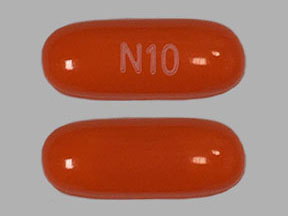
Nifedipine
NIFEdipine 10MG
What is Nifedipine?
Nifedipine is a prescription medication commonly used to treat high blood pressure and certain types of angina. It works by relaxing blood vessels, improving blood flow, and reducing the heart's workload. Side effects may include flushing, dizziness, and headache. For easy access, you can use Rx.com for cost savings, prescription refills, or to connect with a licensed provider.Side Effects
- Fast, pounding, or uneven heartbeat
- Stomach pain or bloating, nausea, vomiting, weight loss
- Lightheadedness, dizziness, or fainting
Warnings
- Keep all medicine out of the reach of children. Never share your medicine with anyone.
- Your doctor will do lab tests at regular visits to check on the effects of this medicine. Keep all appointments.
- Tell any doctor or dentist who treats you that you are using this medicine. You may need to stop using this medicine several days before you have surgery or medical tests.
- Tell any doctor or dentist who treats you that you are using this medicine. This medicine may affect certain medical test results.
- This medicine may cause the following problems: Heart failureWorsening chest pain or increased risk of heart attackStomach or bowel blockage or ulcers
Prescription savings · · · ·
What is Nifedipine ?
Nifedipine is a prescription medication commonly used to treat high blood pressure and certain types of angina. It works by relaxing blood vessels, improving blood flow, and reducing the heart's workload. Side effects may include flushing, dizziness, and headache. For easy access, you can use Rx.com for cost savings, prescription refills, or to connect with a licensed provider.- Fast, pounding, or uneven heartbeat
- Stomach pain or bloating, nausea, vomiting, weight loss
- Lightheadedness, dizziness, or fainting
- Rapid weight gain, swelling in your hands, ankles, or feet
- Allergic reaction: Itching or hives, swelling in your face or hands, swelling or tingling in your mouth or throat, chest tightness, trouble breathing
- Chest pain that may spread, trouble breathing, nausea, unusual sweating, fainting
- Blistering, peeling, red skin rash
- Keep all medicine out of the reach of children. Never share your medicine with anyone.
- Your doctor will do lab tests at regular visits to check on the effects of this medicine. Keep all appointments.
- Tell any doctor or dentist who treats you that you are using this medicine. You may need to stop using this medicine several days before you have surgery or medical tests.
- Tell any doctor or dentist who treats you that you are using this medicine. This medicine may affect certain medical test results.
- This medicine may cause the following problems: Heart failureWorsening chest pain or increased risk of heart attackStomach or bowel blockage or ulcers
- Do not stop using this medicine without asking your doctor, even if you feel well. This medicine will not cure high blood pressure, but it will help keep it in normal range. You may have to take blood pressure medicine for the rest of your life.
- This medicine could lower your blood pressure too much, especially when you first use it or if you are dehydrated. Stand or sit up slowly if you feel lightheaded or dizzy.
- Tell your doctor if you are pregnant or breastfeeding, or if you have stomach problems, heart failure, coronary artery disease, or recently had a heart attack.
Nifedipine Coupons & Prices
NIFEdipine 10MG

4 ED medications in one dose
Apomorphine, sildenafil, tadalafil & vardenafil · One sublingual dose · Free express shipping
Nifedipine prices by dosage
Lowest cash price with a free Rx.com coupon vs. the average retail price.
| Dosage | Quantity | Retail price | Rx.com price |
|---|---|---|---|
| 10mg · Capsule | 30 | $32.09 | $14.48 |
| 20mg · Capsule | 30 | $58.80 | $24.02 |
Cash prices near ZIP 77433; updated regularly. Actual pharmacy price may vary.
A nifedipine coupon from Rx.com can lower what you pay at the pharmacy counter, whether you are filling extended-release tablets or immediate-release capsules. Nifedipine is a calcium channel blocker used for high blood pressure and certain kinds of angina, and it is available as a generic in both the immediate-release capsule and extended-release tablet forms. Even so, the cash price for the same prescription can differ a lot from one pharmacy to the next, sometimes across the same street. Rx.com compares prices at more than 60,000 pharmacies, so you can see what today's price looks like near you before you go. Enter your ZIP code above to see today's price and print, text, or email your free coupon.
What is nifedipine and how does it work?
Nifedipine is a dihydropyridine calcium channel blocker, sometimes called a calcium ion influx inhibitor or slow-channel blocker. It works by relaxing the muscle in blood vessel walls, which widens the vessels, lowers blood pressure, and improves blood flow to the heart. It is widely available as a generic, and it has also been sold under brand names including Procardia XL, Adalat CC, Nifedical XL, and Afeditab CR. Brand availability changes over time, and some of these brands are reported to be discontinued in the United States even though their generic equivalents remain on the market. Your pharmacist can tell you which product your prescription can actually be filled with.
The FDA-approved uses depend on the specific product, not just on whether it is extended-release. Extended-release nifedipine comes in more than one delivery system, and the approved uses are not the same across them:
- GITS/XL-type extended-release tablets (Procardia XL and its generics) are approved for high blood pressure (to lower blood pressure), for vasospastic angina (also called Prinzmetal's or variant angina) when confirmed by a rest pattern of angina with ST segment elevation, ergonovine-provoked spasm, or angiographically demonstrated spasm, and for chronic stable (effort-associated) angina without evidence of vasospasm in people who remain symptomatic despite adequate doses of beta blockers and/or nitrates or who cannot tolerate those medicines.
- CC-type extended-release tablets (Adalat CC, Nifediac CC, Afeditab CR, and their generics) are approved only for the treatment of hypertension, alone or in combination with other antihypertensive agents. Angina is not an approved use for these products.
- Immediate-release capsules are approved for angina.
Your prescriber decides which form, which product, and which strength fits your situation.
How much does nifedipine cost without insurance?
Nifedipine is available as a generic. If you are paying cash, the honest picture is that there is no single price. What one pharmacy charges for a 30-day supply of extended-release nifedipine can be quite different from what the pharmacy a mile away charges for the exact same tablets, same strength, same quantity. Your price also shifts with the form you are filling, the strength, and the day's supply on the prescription.
That variation is the whole reason comparing matters. Rx.com checks cash prices across more than 60,000 pharmacies and shows you a free discount coupon you can hand to the pharmacist. There is no membership and no fee to use it. Enter your ZIP code above to see today's price at pharmacies near you. If you have insurance, it is still worth checking both ways, because a coupon price is sometimes lower than a copay, though a coupon and insurance cannot be combined on the same fill. If you were prescribed a brand-name version, it is worth asking your pharmacist whether the manufacturer currently offers any patient savings program, since those programs come and go.
Nifedipine compared with other calcium channel blockers
Nifedipine belongs to the dihydropyridine group of calcium channel blockers, which mainly relax blood vessels. Other dihydropyridines your prescriber might consider include amlodipine, felodipine, nicardipine, and isradipine. These are not interchangeable with each other; they differ in how long they last, how they are dosed, and how they are tolerated.
There is also a second group of calcium channel blockers, the non-dihydropyridines, which act more on the heart's rate and conduction as well as the vessels. Diltiazem and verapamil are the two in that group. If you were prescribed a specific brand of extended-release nifedipine, you can also look at Procardia XL and Adalat CC. Never switch between any of these on your own. Ask your prescriber or pharmacist, and if cost is the reason you are considering a change, say so directly, because they can often help.
Nifedipine safety, side effects, and grapefruit
Nifedipine has no boxed warning. Contraindications depend on which nifedipine product you are taking. The Procardia XL label lists known hypersensitivity to nifedipine as its contraindication. The CC-type extended-release labeling, such as Adalat CC, lists three: taking a strong P450 inducer such as rifampin at the same time (contraindicated because the efficacy of nifedipine tablets could be significantly reduced), cardiogenic shock (nifedipine must not be used in cases of cardiogenic shock), and known hypersensitivity to any component of the tablet. Make sure your prescriber and pharmacist know every medicine you take and your full heart history.
The most common side effects are swelling in the ankles or feet (peripheral edema), headache, dizziness, flushing, and constipation. Blood pressure can drop too far when you first start or when your dose is raised, especially if you also take a beta blocker. Rarely, some people get more frequent, longer, or more severe angina, or a heart attack, when starting nifedipine or increasing the dose. Nifedipine does not prevent beta blocker withdrawal syndrome, so a beta blocker should be tapered gradually under your prescriber's direction. Heart failure has been reported rarely, mostly in people also taking beta blockers or who have tight aortic stenosis. Tell your surgical team you take nifedipine, since a serious interaction is possible with high-dose fentanyl anesthesia.
Do not crush, chew, or split extended-release tablets. The extended-release GITS tablets have been linked to serious gastrointestinal blockage, including bezoar formation that has sometimes required surgery, and to cases where the tablet stuck to the GI wall and caused an ulcer, so caution is needed if you have severe narrowing or strictures in your GI tract. Avoid grapefruit and grapefruit juice, which raise nifedipine levels in your blood. Cimetidine also raises nifedipine levels; a study in six healthy volunteers showed an 80% increase in peak nifedipine plasma levels. Drugs and supplements that speed up nifedipine's breakdown can push its levels down instead, and with CC-type products a strong inducer such as rifampin is not just a caution but a contraindication, so never add or stop anything, including over-the-counter products and herbal supplements like St. John's wort, without checking with your pharmacist first. Immediate-release nifedipine capsules appear on the Beers Criteria as potentially inappropriate for older adults and should not be used to bring blood pressure down quickly. Do not stop nifedipine suddenly without medical guidance. This page is information, not medical advice; talk with your doctor or pharmacist about your own care.
This Nifedipine information was written and reviewed against authoritative U.S. medical sources — MedlinePlus (U.S. National Library of Medicine), DailyMed, and FDA prescribing information — and checked for accuracy. It is provided for education and is not a substitute for professional medical advice.
Verify the official label: Nifedipine on DailyMed (FDA)
Reviewed against FDA labeling · Last reviewed July 2026
Related Drugs
Browse more medications: starting with N · full A-Z directory · by condition · common drugs
Medical disclaimer: This information is provided for general educational purposes only and is not medical advice. It is not a substitute for professional diagnosis or treatment. Always consult a licensed physician, pharmacist, or other qualified healthcare provider before starting, stopping, or changing any medication or treatment. Never disregard professional medical advice or delay seeking it because of something you read here. If you think you may have a medical emergency, call your doctor or 911 immediately.


