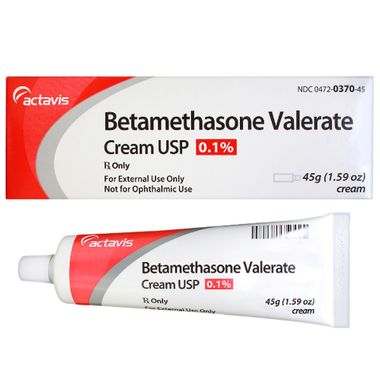
Betamethasone Valerate
Betamethasone Valerate
What is Betamethasone Valerate?
Betamethasone Valerate is used to treat different inflammatory conditions in the body, including itching, swelling, and allergies. Betamethasone Valerate is a generic drug. On average Betamethasone Valerate is priced at about $51 for a supply of 15gm of 0.1% injectable suspension. Luckily, you can use our Rx.com savings offer to receive a Betamethasone Valerate discount of up to 80% off the retail price at participating pharmacies near you.
Side Effects
- Allergic reaction: Itching or hives, swelling in your face or hands, swelling or tingling in your mouth or throat, chest tightness, trouble breathing
- Bulging of the soft spot on your baby's head
- Headaches and problems with vision
Warnings
- Keep all medicine out of the reach of children. Never share your medicine with anyone.
- Children may be more likely to have side effects from this medicine. This medicine may also slow your child's growth. If you think your child is not growing properly while he is using this medicine, talk with your doctor.
- Topical application routeDo not use this medicine to treat a skin problem your doctor has not examined.
- Call your doctor if your symptoms do not improve or if they get worse.
- Tell your doctor if you are pregnant or breastfeeding.
Prescription savings · · · ·
What is Betamethasone Valerate ?
Betamethasone Valerate is used to treat different inflammatory conditions in the body, including itching, swelling, and allergies. Betamethasone Valerate is a generic drug. On average Betamethasone Valerate is priced at about $51 for a supply of 15gm of 0.1% injectable suspension. Luckily, you can use our Rx.com savings offer to receive a Betamethasone Valerate discount of up to 80% off the retail price at participating pharmacies near you.
- Allergic reaction: Itching or hives, swelling in your face or hands, swelling or tingling in your mouth or throat, chest tightness, trouble breathing
- Bulging of the soft spot on your baby's head
- Headaches and problems with vision
- Signs of skin infection, such as swelling, redness, warmth, pus, or oozing
- Weight gain around your neck, upper back, breast, face, or waist
- Keep all medicine out of the reach of children. Never share your medicine with anyone.
- Children may be more likely to have side effects from this medicine. This medicine may also slow your child's growth. If you think your child is not growing properly while he is using this medicine, talk with your doctor.
- Topical application routeDo not use this medicine to treat a skin problem your doctor has not examined.
- Call your doctor if your symptoms do not improve or if they get worse.
- Tell your doctor if you are pregnant or breastfeeding.
- Tell your doctor if you have diabetes. This medicine may raise the levels of sugar in your blood or urine.
Betamethasone Valerate Coupons & Prices
Betamethasone Valerate

4 ED medications in one dose
Sildenafil, tadalafil, apomorphine & L-Citrulline · Works in ~15 min · Lasts up to 36 hours
Betamethasone Valerate prices by dosage
Lowest cash price with a free Rx.com coupon vs. the average retail price.
| Dosage | Quantity | Retail price | Rx.com price |
|---|---|---|---|
| 15gm of 0.1% · Tube Of Cream | 15 | $29.99 | $13.27 |
| 45gm of 0.1% · Tube Of Cream | 45 | $40.99 | $27.21 |
Cash prices near ZIP 77433; updated regularly. Actual pharmacy price may vary.
A betamethasone valerate coupon from Rx.com can lower what you pay at the pharmacy counter for this topical steroid, which is used to calm the redness, swelling, and itching of corticosteroid-responsive skin conditions like eczema, contact dermatitis, and psoriasis. Betamethasone valerate is dispensed almost entirely as a generic today (cream, ointment, lotion, and 0.12% scalp foam), and it is applied to the skin as directed by your prescriber, generally one to three times a day for the cream and ointment and twice daily for the foam and lotion. Cash prices for the very same tube can differ a lot from one pharmacy to the next, so it pays to compare. Enter your ZIP code above to check today's price across more than 60,000 participating pharmacies and print, text, or email a free coupon to show at the counter.
What is betamethasone valerate and how does it work?
Betamethasone valerate is a topical corticosteroid, also called a glucocorticoid. It is the 17-valerate ester of betamethasone. On the seven-step topical steroid potency scale, where Class I is strongest and Class VII is weakest, betamethasone valerate lands roughly in Class III to V depending on the vehicle: the 0.1% ointment is usually charted as upper-mid strength (about Class III), while the 0.1% cream and lotion and the 0.12% foam are charted in the medium range (about Class IV to V). Applied to the skin, it quiets the inflammatory chemicals that make a rash red, swollen, and itchy. It treats the inflammation; it does not cure the underlying condition, which is why rashes can return after you stop.
The FDA-approved use of the cream, ointment, and lotion is relief of the inflammatory and pruritic (itchy) manifestations of corticosteroid-responsive dermatoses. The 0.12% aerosol foam is approved specifically for corticosteroid-responsive dermatoses of the scalp. In everyday practice these products are used for rashes such as eczema and atopic dermatitis, contact dermatitis, plaque psoriasis including scalp psoriasis, seborrheic dermatitis, and lichen planus. Dosing is set by your prescriber: the label for the cream and ointment says to apply a thin film to the affected skin areas one to three times a day (once or twice a day is often effective), the lotion is applied twice daily (morning and night, then once daily after improvement), and the foam is applied twice daily. The label states that these products are for dermatologic use only and not for ophthalmic use, so keep the medicine out of your eyes, and follow the directions your own prescriber and pharmacist give you.
What betamethasone valerate costs without insurance, and how a coupon helps
Betamethasone valerate is an older medicine and is now dispensed almost exclusively as a generic, so a brand-name manufacturer copay card is not a practical option for most people filling it. What matters instead is the cash price, and that is set pharmacy by pharmacy. The spread between the cheapest and the most expensive pharmacy in one town can be large for an identical tube or bottle. Size and form matter too: a large tube of cream is priced differently from a small one, and the 0.12% foam is priced differently from the cream, ointment, and lotion. Prices also change over time, so what was lowest last year may not be lowest today.
That variation is exactly what a discount coupon is for. Rx.com compares cash prices across more than 60,000 participating pharmacies, so you can see which nearby pharmacy is lowest today for the exact strength, form, and size on your prescription. The Rx.com coupon is free, requires no membership, and can be used whether or not you have insurance. If you do have coverage, it is worth checking both ways, because a cash coupon price sometimes beats a plan copay. Enter your ZIP code above to see today's price near you.
How betamethasone valerate compares with other topical steroids
Topical steroids are chosen mainly by potency and by where on the body they will be used. Stronger is not automatically better: thin skin (face, eyelids, groin, underarms) absorbs more and is more prone to thinning and stretch marks, so lower-potency products are generally preferred there, while thick skin (palms, soles, scaly plaques) often needs something stronger. Your prescriber picks the class that fits the rash, the site, and how long you will need it.
- Hydrocortisone — low potency; the mildest common option, often used on the face or in children under a clinician's direction.
- Triamcinolone acetonide — medium potency, in the same general range as betamethasone valerate and frequently used for the same kinds of body rashes.
- Mometasone furoate — the 0.1% cream and lotion are charted in a medium-potency range similar to betamethasone valerate, but the 0.1% ointment is charted higher, so the two are only loosely comparable and the vehicle matters.
- Betamethasone dipropionate — a different ester of the same parent steroid and a stronger product than the valerate; the two are not interchangeable.
- Fluocinonide — high potency, used for tougher, thicker plaques.
- Clobetasol propionate — super-high potency, reserved for short courses on resistant, thick-skinned areas.
Formulation matters as much as the drug itself. Ointments are greasier and generally more potent than creams at the same strength; lotions and the 0.12% foam spread easily through hair, which is why the foam is the scalp form. A stronger steroid is not necessarily a more expensive one, and prices vary by pharmacy in any case, so if your prescriber says more than one option is medically reasonable, it is fair to ask which one is cheapest to fill and to compare that specific product on Rx.com.
Safety information you should know
Betamethasone valerate has no boxed warning. The main concern with any topical steroid is that enough of it can be absorbed through the skin to affect the whole body, which can suppress the hypothalamic-pituitary-adrenal (HPA) axis and, less commonly, cause Cushing's syndrome, high blood sugar, or sugar in the urine. That risk goes up when the drug is used over a large area, used for a long time, or covered with an occlusive dressing or bandage. Children are more susceptible because they have more skin surface relative to their body size, and in children this absorption has been linked to slowed growth, delayed weight gain, and increased pressure inside the skull. Do not bandage, wrap, or cover the treated area unless your prescriber tells you to, and do not use the medicine longer or more often than directed. If HPA suppression is suspected, a clinician may test for it and will taper the steroid rather than stop it abruptly.
Local side effects can include burning, itching, irritation, dryness, folliculitis, extra hair growth, acne-like eruptions, lightening of the skin, allergic contact dermatitis, thinning of the skin, stretch marks, tiny visible blood vessels, and prickly heat. The label says these products are for dermatologic use only and not for ophthalmic use, so keep the medicine out of your eyes; as a practical matter, do not put it in your mouth or use it internally either. Avoid the face, groin, and underarms unless your prescriber specifically directs it. If a skin infection develops or the rash is not improving, tell your prescriber, since an antimicrobial may be needed or the steroid may need to be stopped. The 0.12% foam contains alcohol and is flammable, so stay away from fire, flame, and smoking while applying it and right afterward. This page is general information, not medical advice; talk with your doctor or pharmacist about your own situation, including if you are pregnant, nursing, or treating a child.
This Betamethasone Valerate information was written and reviewed against authoritative U.S. medical sources — MedlinePlus (U.S. National Library of Medicine), DailyMed, and FDA prescribing information — and checked for accuracy. It is provided for education and is not a substitute for professional medical advice.
Verify the official label: Betamethasone Valerate on DailyMed (FDA)
Reviewed against FDA labeling · Last reviewed July 2026
Related Drugs
Browse more medications: starting with B · full A-Z directory · by condition · common drugs
Medical disclaimer: This information is provided for general educational purposes only and is not medical advice. It is not a substitute for professional diagnosis or treatment. Always consult a licensed physician, pharmacist, or other qualified healthcare provider before starting, stopping, or changing any medication or treatment. Never disregard professional medical advice or delay seeking it because of something you read here. If you think you may have a medical emergency, call your doctor or 911 immediately.


