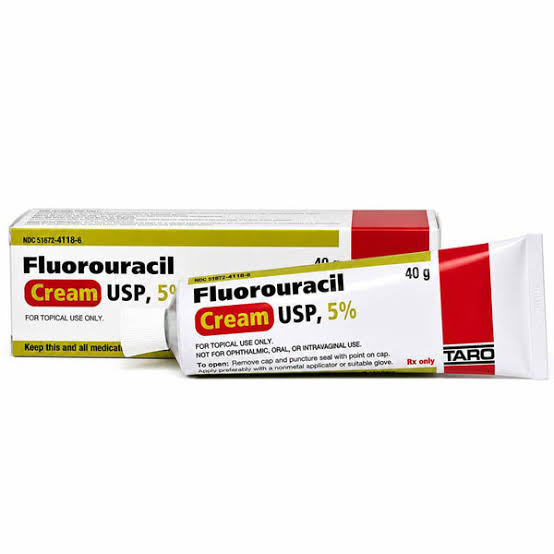
Fluorouracil
Fluorouracil
What is Fluorouracil?
Fluorouracil (5-FU) is a prescription topical medication used to treat actinic keratoses and certain types of superficial skin cancer, including superficial basal cell carcinoma. It works by destroying abnormal skin cells, allowing healthier skin to regenerate over time.
Side Effects
- Allergic reaction: Itching or hives, swelling in your face or hands, swelling or tingling in your mouth or throat, chest tightness, trouble breathing
- Diarrhea that contains blood, stomach pain, vomiting
- Fever, chills, cough, sore throat, body aches
Warnings
- It is not safe to take this medicine during pregnancy. It could harm an unborn baby. Tell your doctor right away if you become pregnant.
- Tell your doctor if you are breastfeeding or if you have other skin problems.
- This medicine may make your skin more sensitive to sunlight. Wear sunscreen. Do not use sunlamps or tanning beds.
- Keep all medicine out of the reach of children. Never share your medicine with anyone.
Prescription savings · · · ·
What is Fluorouracil ?
Fluorouracil (5-FU) is a prescription topical medication used to treat actinic keratoses and certain types of superficial skin cancer, including superficial basal cell carcinoma. It works by destroying abnormal skin cells, allowing healthier skin to regenerate over time.
- Allergic reaction: Itching or hives, swelling in your face or hands, swelling or tingling in your mouth or throat, chest tightness, trouble breathing
- Diarrhea that contains blood, stomach pain, vomiting
- Fever, chills, cough, sore throat, body aches
- Swelling, blistering, redness, or peeling of the skin
- Unusual bleeding, bruising, or weakness
- Swelling, blistering, redness, or peeling of skin.
- It is not safe to take this medicine during pregnancy. It could harm an unborn baby. Tell your doctor right away if you become pregnant.
- Tell your doctor if you are breastfeeding or if you have other skin problems.
- This medicine may make your skin more sensitive to sunlight. Wear sunscreen. Do not use sunlamps or tanning beds.
- Keep all medicine out of the reach of children. Never share your medicine with anyone.
Fluorouracil Coupons & Prices
Fluorouracil

4 ED medications in one dose
Sildenafil, tadalafil, apomorphine & L-Citrulline · Works in ~15 min · Lasts up to 36 hours
Fluorouracil prices by dosage
Lowest cash price with a free Rx.com coupon vs. the average retail price.
| Dosage | Quantity | Retail price | Rx.com price |
|---|---|---|---|
| 10ml of 500mg/10ml · Vial | 160 | $127.29 | $43.25 |
| 20ml of 1gm/20ml · Vial | 160 | $239.52 | $32.09 |
| 50ml of 2.5gm/50ml · Vial | 50 | $25.99 | $16.08 |
| 100ml of 5gm/100ml · Vial | 200 | $147.50 | $60.02 |
Cash prices near ZIP 77433; updated regularly. Actual pharmacy price may vary.
Looking for a fluorouracil coupon? Fluorouracil (also called 5-FU) is available as a lower-cost generic, so you don't need a brand-name prescription to save. Because cash prices for the same generic can vary widely from one pharmacy to the next, comparing before you fill matters. Rx.com checks prices across more than 60,000 pharmacies so you can find a low price near you. Enter your ZIP above to see today's price on fluorouracil at pharmacies in your area.
What is fluorouracil and how does it work?
Fluorouracil is an antimetabolite (a pyrimidine analog) that works as a thymidylate synthase inhibitor. In simple terms, it interferes with the way fast-growing cells make and repair their DNA, which slows or stops their growth. It comes in two very different forms. Topical fluorouracil (cream or solution, sold under brand names such as Efudex, Carac, Tolak, and Fluoroplex) is applied to the skin to treat actinic (solar) keratoses and superficial basal cell carcinoma when other treatments are impractical. Injectable fluorouracil (5-FU, brand Adrucil) is given as part of combination chemotherapy regimens for colorectal, breast, pancreatic, and stomach (gastric) cancers.
Fluorouracil is also used off-label on the skin for warts and other keratotic conditions. Your prescriber decides which form and strength is right for your situation.
Fluorouracil cost without insurance and how to save
Fluorouracil is available as a generic, which is generally the most affordable way to fill this prescription. Even so, the cash price for the same generic can differ a lot depending on which pharmacy you choose, so it pays to compare rather than assume every pharmacy charges the same. A Rx.com discount can be used whether or not you have insurance, and sometimes the discounted cash price beats an insurance copay.
There is no manufacturer savings card for generic fluorouracil. To see what you'd actually pay near you, enter your ZIP above and compare today's prices across pharmacies before you fill.
Fluorouracil vs. related treatments
The topical brand versions of fluorouracil are the same active ingredient in different formulations and strengths: Efudex, Carac, and Tolak. If your prescriber wrote for a brand, the generic fluorouracil is often a lower-cost equivalent worth comparing.
For actinic keratoses, prescribers sometimes choose a different topical medicine instead, such as imiquimod or diclofenac gel. For certain cancers, an oral chemotherapy called capecitabine is converted to fluorouracil in the body and may be used as an alternative to injectable 5-FU. These are not interchangeable choices you can make on your own; which one fits depends on your diagnosis and your provider's judgment.
Fluorouracil safety and side effects
Topical fluorouracil commonly causes marked local skin reactions where it's applied, including redness, burning, erosion, and pain. This is expected as the medicine works, but avoid covering the area (occlusion) and protect the skin from sun exposure. Both topical and injectable forms are contraindicated in pregnancy because of the risk of fetal harm, and in people with dihydropyrimidine dehydrogenase (DPD) deficiency.
Injectable 5-FU carries an FDA Boxed Warning for severe or fatal toxicity in people with DPD deficiency; DPYD genotype testing is recommended before treatment, and it should not be given to those with complete DPD deficiency. Serious toxicities can include life-threatening mucositis, diarrhea, low blood counts (neutropenia/myelosuppression), and effects on the nerves and heart, as well as hand-foot syndrome. This information is not medical advice. Talk with your doctor or pharmacist about your full health history, and get medical help right away if you develop severe mouth sores, diarrhea, fever, or unusual bleeding.
This Fluorouracil information was written and reviewed against authoritative U.S. medical sources — MedlinePlus (U.S. National Library of Medicine), DailyMed, and FDA prescribing information — and checked for accuracy. It is provided for education and is not a substitute for professional medical advice.
Verify the official label: Fluorouracil on DailyMed (FDA)
Reviewed against FDA labeling · Last reviewed July 2026
Related Drugs
Browse more medications: starting with F · full A-Z directory · by condition · common drugs
Medical disclaimer: This information is provided for general educational purposes only and is not medical advice. It is not a substitute for professional diagnosis or treatment. Always consult a licensed physician, pharmacist, or other qualified healthcare provider before starting, stopping, or changing any medication or treatment. Never disregard professional medical advice or delay seeking it because of something you read here. If you think you may have a medical emergency, call your doctor or 911 immediately.


