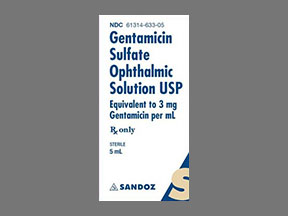
Gentamicin Sulfate
Gentamicin Sulfate 5ML of 0.3%
What is Gentamicin Sulfate?
If you are diagnosed with a bacterial infection, your doctor might prescribe gentamicin. This drug can be given by vein, muscle injection, eye drops, or cream/ointment. Side effects of gentamicin include ear and kidney problems.Side Effects
- Blurred vision is common for the first few minutes after using. If it continues, talk with your doctor.
- Eye irritation that was not there before using the medicine
Warnings
- Check with your doctor if your condition gets worse or does not get better while using gentamicin.
Prescription savings · · · ·
What is Gentamicin Sulfate ?
If you are diagnosed with a bacterial infection, your doctor might prescribe gentamicin. This drug can be given by vein, muscle injection, eye drops, or cream/ointment. Side effects of gentamicin include ear and kidney problems.- Blurred vision is common for the first few minutes after using. If it continues, talk with your doctor.
- Eye irritation that was not there before using the medicine
- Check with your doctor if your condition gets worse or does not get better while using gentamicin.
Gentamicin Sulfate Coupons & Prices
Gentamicin Sulfate 5ML of 0.3%
4 ED medications in one dose
Sildenafil, tadalafil, apomorphine & L-Citrulline · Works in ~15 min · Lasts up to 36 hours
Gentamicin Sulfate prices by dosage
Lowest cash price with a free Rx.com coupon vs. the average retail price.
| Dosage | Quantity | Retail price | Rx.com price |
|---|---|---|---|
| 1gm of · Bottle | 1 | $52.95 | $39.89 |
| 5ml of 0.3% · Bottle | 5 | $19.99 | $12.51 |
| 5gm of · Bottle | 5 | $181.05 | $179.45 |
| 25gm of · Bottle | 5 | — | $35.04 |
| 100gm of · Bottle | 300 | — | $2,865.65 |
| 500gm of · Bottle | 60 | — | $2,098.41 |
| 1000gm of · Bottle | 120 | — | $1,149.26 |
Cash prices near ZIP 77433; updated regularly. Actual pharmacy price may vary.
A gentamicin sulfate coupon from Rx.com can be used at the pharmacy counter when you are paying cash instead of using insurance. Gentamicin sulfate is an aminoglycoside antibiotic available only as a generic in the United States, and it comes in very different forms — injection, eye drops and ointment, and skin cream — so the price depends on which form and quantity your prescription is for. Cash prices for the same prescription can vary a lot from one pharmacy to the next, which is why it is worth comparing before you fill. Enter your ZIP above to see today's price at pharmacies near you; Rx.com compares prices across more than 60,000 pharmacies nationwide.
What is gentamicin sulfate and how does it work?
Gentamicin sulfate is an aminoglycoside antibiotic. It is bactericidal, meaning it kills bacteria rather than just slowing them down, and it does this by binding to the 30S subunit of the bacterial ribosome and blocking the bacteria from making the proteins they need to survive. It is used mainly against gram-negative bacteria such as Pseudomonas aeruginosa, Proteus, E. coli, Klebsiella, Enterobacter, Serratia and Citrobacter, and against certain staphylococci.
Because gentamicin is not absorbed well from the stomach, there is no oral tablet. The approved uses depend on the form your prescription is for:
- Injection (IV or IM): serious bacterial infections, including bacterial septicemia, neonatal sepsis, central nervous system infections such as meningitis, and serious infections of the urinary tract, respiratory tract, bones, joints, skin, soft tissue and burns, and intra-abdominal infections including peritonitis. It is also indicated for serious staphylococcal infections when penicillins or other less potentially toxic drugs cannot be used, and is often paired with a beta-lactam antibiotic for added effect.
- Ophthalmic solution or ointment: superficial eye infections such as bacterial conjunctivitis, blepharitis and keratitis.
- Topical cream or ointment: primary and secondary skin infections such as impetigo, infected dermatoses and infected burns.
Gentamicin sulfate cost without insurance
Gentamicin sulfate is generic-only in the United States. The original injectable brand, Garamycin, is no longer marketed here. Today the products on the market are made by generic manufacturers including Fresenius Kabi, Hospira/Pfizer, B. Braun, Perrigo and Bausch & Lomb, along with ophthalmic brands such as Gentak and Genoptic and premixed gentamicin sulfate in sodium chloride bags for IV use. There is no manufacturer savings card or copay program for gentamicin sulfate, because there is no brand sponsor left to run one.
That does not mean every pharmacy charges the same thing. Cash prices for the identical generic prescription can differ widely between pharmacies in the same town, and the form matters too — eye drops, skin cream and injectable vials are priced very differently. If you are paying without insurance, or your plan's copay is higher than the cash price, comparing pharmacies is the single most useful thing you can do. Enter your ZIP above to see today's price near you and bring the coupon to the counter. Note that injectable gentamicin is usually given in a hospital or infusion setting rather than picked up at a retail pharmacy, so a retail coupon most often applies to the eye or skin forms.
Gentamicin sulfate compared with other antibiotics
Gentamicin belongs to the same family as tobramycin, amikacin and neomycin. These aminoglycosides work the same way and share the same general safety concerns, and there can be cross-sensitivity between them. Which one a prescriber chooses depends on the organism, the site of infection and local resistance patterns. Gentamicin is the same active ingredient described under its shorter name.
For serious infections, gentamicin is also sometimes compared with or combined with drugs from other classes, such as vancomycin, ciprofloxacin or polymyxin B. These are not interchangeable with gentamicin, and several of them (including vancomycin and polymyxin B) are on the list of drugs that should generally not be given at the same time as an aminoglycoside because of added kidney and nerve toxicity. Only your prescriber can decide which antibiotic fits your infection — never substitute one for another on your own.
Safety information you should know
Injectable gentamicin sulfate carries an FDA boxed warning. The label warns about kidney damage (nephrotoxicity), with the greatest risk in people who already have reduced kidney function or who receive high doses or long courses. It also warns about damage to the eighth cranial nerve — both balance and hearing can be affected, causing dizziness, vertigo, ringing or roaring in the ears, and hearing loss. This damage is usually irreversible. Because of that, kidney function and hearing must be closely watched during treatment, and blood levels are monitored so that peak concentrations stay at or below 12 mcg/mL and troughs do not stay above 2 mcg/mL for long. The label also warns against using other kidney- or nerve-toxic drugs at the same time or one after the other (including other aminoglycosides, cisplatin, amphotericin B, cephaloridine, vancomycin, viomycin, polymyxin B and colistin) and against potent diuretics such as ethacrynic acid and furosemide, which can themselves harm hearing and can raise gentamicin blood levels. Neuromuscular blockade and respiratory paralysis can occur, particularly with anesthetics or neuromuscular blocking agents, or in people with myasthenia gravis, parkinsonism or low blood calcium. Aminoglycosides can harm a developing baby, and congenital deafness has been reported with related drugs in this class. Older adults and anyone who is dehydrated are at higher risk, so staying well hydrated matters.
The eye and skin forms do not carry a boxed warning, but they can cause local irritation, and applying the topical form over large areas of damaged skin can let enough drug into the bloodstream to raise the same toxicity concerns. Ophthalmic gentamicin is for use on the surface of the eye and must never be injected into the eye. Other reported problems across forms include allergic reactions and cross-sensitivity with other aminoglycosides, C. difficile-associated diarrhea, and electrolyte disturbances such as low magnesium, potassium or calcium. This page is general information, not medical advice — talk with your doctor or pharmacist about your own situation, and tell them about every other medicine you take.
This Gentamicin Sulfate information was written and reviewed against authoritative U.S. medical sources — MedlinePlus (U.S. National Library of Medicine), DailyMed, and FDA prescribing information — and checked for accuracy. It is provided for education and is not a substitute for professional medical advice.
Verify the official label: Gentamicin Sulfate on DailyMed (FDA)
Reviewed against FDA labeling · Last reviewed July 2026
Related Drugs
Browse more medications: starting with G · full A-Z directory · by condition · common drugs
Medical disclaimer: This information is provided for general educational purposes only and is not medical advice. It is not a substitute for professional diagnosis or treatment. Always consult a licensed physician, pharmacist, or other qualified healthcare provider before starting, stopping, or changing any medication or treatment. Never disregard professional medical advice or delay seeking it because of something you read here. If you think you may have a medical emergency, call your doctor or 911 immediately.


