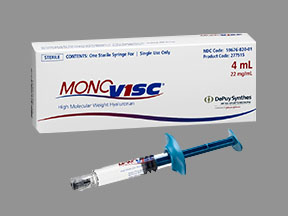
Monovisc
Monovisc 4ML of 88MG/4ML
What is Monovisc?
Monovisc is used to relieve knee pain caused by osteoarthritis. There is currently no generic version of Monovisc injectable available in the United States. On average, a supply of 4 ml 22 mg/ml Monovisc syringe cost about $1,460. Get savings of up to 80% when you use our free prescription coupon card at any participating pharmacy near you.Side Effects
- Allergic reaction: Itching or hives, swelling in your face or hands, swelling or tingling in your mouth or throat, chest tightness, trouble breathing
- Pain, redness, or swelling where the medicine is injected
Warnings
- Tell your doctor if you are pregnant or breastfeeding, or if you have any allergies, including to birds, feathers, or eggs.
- Rest your knee for 48 hours after you receive an injection. Do not do strenuous, weightbearing activities, such as jogging or tennis. Avoid activities that keep you standing for longer than 1 hour.
Prescription savings · · · ·
What is Monovisc ?
Monovisc is used to relieve knee pain caused by osteoarthritis. There is currently no generic version of Monovisc injectable available in the United States. On average, a supply of 4 ml 22 mg/ml Monovisc syringe cost about $1,460. Get savings of up to 80% when you use our free prescription coupon card at any participating pharmacy near you.- Allergic reaction: Itching or hives, swelling in your face or hands, swelling or tingling in your mouth or throat, chest tightness, trouble breathing
- Pain, redness, or swelling where the medicine is injected
- Tell your doctor if you are pregnant or breastfeeding, or if you have any allergies, including to birds, feathers, or eggs.
- Rest your knee for 48 hours after you receive an injection. Do not do strenuous, weightbearing activities, such as jogging or tennis. Avoid activities that keep you standing for longer than 1 hour.
Monovisc Coupons & Prices
Monovisc 4ML of 88MG/4ML
4 ED medications in one dose
Sildenafil, tadalafil, apomorphine & L-Citrulline · Works in ~15 min · Lasts up to 36 hours
Monovisc prices by dosage
Lowest cash price with a free Rx.com coupon vs. the average retail price.
| Dosage | Quantity | Retail price | Rx.com price |
|---|---|---|---|
| 4ml of 88mg/4ml · Syringe | 4 | $2,330.99 | $1,472.00 |
Cash prices near ZIP 77433; updated regularly. Actual pharmacy price may vary.
A Monovisc coupon from Rx.com can lower what you pay out of pocket for Monovisc (cross-linked sodium hyaluronate), the single-injection viscosupplement given into the knee for osteoarthritis pain. Monovisc has no generic version, and what you pay can differ a great deal depending on the pharmacy and whether your plan treats it as a pharmacy benefit or a medical (in-office) benefit. Enter your ZIP above to see today's price at pharmacies near you, then show the coupon at the counter.
What is Monovisc and how does it work?
Monovisc is a viscosupplement made of high molecular weight, cross-linked sodium hyaluronate. Its hyaluronan is not sourced from animals; it is derived from bacterial fermentation (Streptococcus equi). That does not make an allergic reaction impossible: the label contraindicates Monovisc in anyone with a known hypersensitivity to gram positive bacterial proteins. Hyaluronan is a substance normally found in the fluid that cushions and lubricates your joints; in osteoarthritis, that fluid breaks down. Monovisc adds hyaluronan back into the knee joint to help cushion it and ease pain. It is given by a healthcare professional as a single 4 mL injection directly into the knee (88 mg of cross-linked sodium hyaluronate at 22 mg/mL) — not as a pill and not something you inject yourself.
In the United States, Monovisc is manufactured by Anika Therapeutics in Bedford, Massachusetts, and commercialized by Johnson & Johnson MedTech; the instructions for use list the distributor as DePuy Mitek, Inc. It is worth knowing that the FDA regulates Monovisc as a Class III medical device, approved in February 2014 under PMA P090031, rather than as a drug approved under an NDA. It is still prescription-only, and because it is dispensed through retail and specialty pharmacies with an NDC-style identifier, it shows up in pharmacy pricing and can be bought with a cash coupon. The label indication is treatment of pain in osteoarthritis of the knee in patients who have failed to respond adequately to conservative non-pharmacologic therapy and simple analgesics (for example, acetaminophen).
It is worth being straight with you about what the approval studies actually showed. In the pivotal 0702 trial, 369 patients were randomized to Monovisc or a saline injection and were followed for 26 weeks — but 26 weeks is how long patients were followed, not a demonstrated duration of benefit. Monovisc did not meet its primary endpoint: it was not shown to be superior to saline for improvement in the WOMAC pain score through Week 12 (p=0.145). Approval instead rested on a non-inferiority comparison against Anika's own Orthovisc, using a historical dataset from Orthovisc's earlier approval (PMA P030019). In that analysis Monovisc was non-inferior to some of the three-injection Orthovisc groups, but it was not shown to be non-inferior to the four-injection Orthovisc regimen, and non-inferiority was not demonstrated against the O3 group at the chosen margin.
Manufacturer savings programs vs. the Rx.com cash coupon
There is no manufacturer savings card for Monovisc that we can point you to. Manufacturer copay cards in general are limited to people with commercial (employer or marketplace) insurance and exclude anyone with Medicare, Medicaid, TRICARE, or no insurance at all, and their terms vary and change. Because a Johnson & Johnson company commercializes Monovisc in the US, some patients ask about the Johnson & Johnson Patient Assistance Foundation. That program provides J&J and Janssen prescription medicines to people who qualify; Monovisc is a Class III medical device rather than a prescription drug, and device products like it are generally not covered by that foundation, so we would not send you down that path expecting help.
The Rx.com cash coupon works differently. It is a discount price you can use whether you are uninsured, on Medicare, or simply told that your plan will not cover Monovisc. You do not enroll and there is no income test. One important practical note: Monovisc is often billed through the doctor's office under your medical benefit instead of being picked up at a pharmacy. A cash coupon only helps on the pharmacy-dispensed route, where you fill the prescription and bring the syringe to your appointment (a "brown bag" fill). Ask your clinic which way they handle it before you fill anything. Prices vary by pharmacy, so it is worth comparing — enter your ZIP above to see today's price near you.
Monovisc vs. other knee injections
Monovisc's main selling point is that it is a single injection, where several older hyaluronic acid products require a series of weekly shots. Orthovisc is Anika's non-cross-linked product and is given as a course of injections rather than one. Euflexxa and Supartz FX are also multi-injection courses. Synvisc-One, Gel-One, and Durolane are other single-injection options, while Synvisc and Gelsyn-3 are given as multiple injections. These products differ in source material, molecular weight, and whether the hyaluronan is cross-linked; head-to-head evidence showing one is clearly better than another is limited, so the choice often comes down to what your insurance covers and what your clinic stocks.
Injections are not the only path. A corticosteroid injection such as triamcinolone acetonide is a common and usually much less costly option that tends to work faster but for a shorter time. Oral anti-inflammatories like meloxicam or diclofenac are also widely used for knee osteoarthritis. It is only fair to tell you that the value of hyaluronic acid viscosupplementation is genuinely debated: the American College of Rheumatology's 2019 guideline and the AAOS recommend against or do not recommend routine use for knee osteoarthritis, while some other bodies consider it a reasonable option. Monovisc's own pivotal trial did not show it beat a saline injection on the study's primary pain endpoint. Talk this through with your orthopedist before spending money on it.
Safety, side effects, and what to expect
Monovisc is a device, not a drug, so it does not carry a boxed warning. Its instructions for use list four contraindications. Do not use it if you have a known hypersensitivity (allergy) to hyaluronate preparations; if you have a known hypersensitivity (allergy) to gram positive bacterial proteins — this one matters, because the hyaluronan in Monovisc is derived from bacterial fermentation (Streptococcus equi), so "not sourced from animals" does not mean there is no allergy risk; if you have an infection or skin disease in the area of the injection site or joint; or if you have a known systemic bleeding disorder.
The labeled warnings are that disinfectants containing quaternary ammonium salts should not be used for skin preparation, because hyaluronan can precipitate in their presence, and that transient increases in inflammation in the injected knee have been reported in some patients with inflammatory osteoarthritis. Among the precautions: strict aseptic technique is required, any joint effusion should be removed before injecting, safety and effectiveness in joints other than the knee have not been demonstrated, and effectiveness has not been established for more than one course of treatment. Safety and effectiveness have not been tested in pregnant women, in nursing mothers, or in pediatric patients.
The most common reported device-related adverse events with Monovisc are arthralgia (joint pain), joint swelling, and injection site pain. The labeling also notes that incidences of rash, headache, dizziness, chills, hives, itching, nausea, muscle cramps, peripheral edema, and malaise have been reported in association with intra-articular injections. In the pivotal trial these events were mild or moderate and considered typical of viscosupplementation. If you develop sudden intense pain, swelling, and heat in the knee after your shot, contact your provider so infection can be ruled out. As with any invasive joint procedure, plan to avoid strenuous or prolonged (more than one hour) weight-bearing activity such as running or tennis for 48 hours afterward. This information is a summary and is not medical advice; your doctor or pharmacist can tell you what applies to your situation.
This Monovisc information was written and reviewed against authoritative U.S. medical sources — MedlinePlus (U.S. National Library of Medicine), DailyMed, and FDA prescribing information — and checked for accuracy. It is provided for education and is not a substitute for professional medical advice.
Verify the official label: Monovisc on DailyMed (FDA)
Reviewed against FDA labeling · Last reviewed July 2026
Related Drugs
Browse more medications: starting with M · full A-Z directory · by condition · common drugs
Medical disclaimer: This information is provided for general educational purposes only and is not medical advice. It is not a substitute for professional diagnosis or treatment. Always consult a licensed physician, pharmacist, or other qualified healthcare provider before starting, stopping, or changing any medication or treatment. Never disregard professional medical advice or delay seeking it because of something you read here. If you think you may have a medical emergency, call your doctor or 911 immediately.


