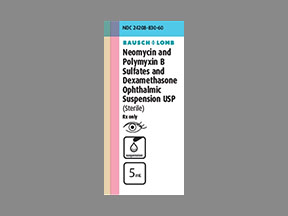
Neomycin-Polymyxin-Dexameth
Neomycin-Polymyxin-Dexameth 5ML of 3.5-10000-0.1
What is Neomycin-Polymyxin-Dexameth?
If you have eye inflammation, your doctor might prescribe neomycin/polymyxin/dexamethasone. Different parts of the eye or eyelid may be inflamed or infected and can be treated with neomycin/polymyxin/dexamethasone. The medication is applied as eye drops.Side Effects
- Redness, pain, swelling, or itching in the eye
- Trouble seeing or other vision changes
- Allergic reaction: Itching or hives, swelling in your face or hands, swelling or tingling in your mouth or throat, chest tightness, trouble breathing
Warnings
- Call your doctor if your symptoms do not improve or if they get worse.
- Keep all medicine out of the reach of children. Never share your medicine with anyone.
- Ophthalmic routeIf you hurt your eye, develop an eye infection, or need to have eye surgery, talk with your doctor right away. You may need to change your medicine or stop using it.
- Tell your doctor if you are pregnant or breastfeeding, or if you have glaucoma, cataracts, or other eye problems (including ulcers in the cornea).
- This medicine may cause blurred vision. Do not drive or do anything else that could be dangerous until you know how this medicine affects you.
Prescription savings · · · ·
What is Neomycin-Polymyxin-Dexameth ?
If you have eye inflammation, your doctor might prescribe neomycin/polymyxin/dexamethasone. Different parts of the eye or eyelid may be inflamed or infected and can be treated with neomycin/polymyxin/dexamethasone. The medication is applied as eye drops.- Redness, pain, swelling, or itching in the eye
- Trouble seeing or other vision changes
- Allergic reaction: Itching or hives, swelling in your face or hands, swelling or tingling in your mouth or throat, chest tightness, trouble breathing
- Call your doctor if your symptoms do not improve or if they get worse.
- Keep all medicine out of the reach of children. Never share your medicine with anyone.
- Ophthalmic routeIf you hurt your eye, develop an eye infection, or need to have eye surgery, talk with your doctor right away. You may need to change your medicine or stop using it.
- Tell your doctor if you are pregnant or breastfeeding, or if you have glaucoma, cataracts, or other eye problems (including ulcers in the cornea).
- This medicine may cause blurred vision. Do not drive or do anything else that could be dangerous until you know how this medicine affects you.
- You will need to have your eyes checked regularly if you use the medicine for 10 days or longer. Be sure to keep all appointments.
Neomycin-Polymyxin-Dexameth Coupons & Prices
Neomycin-Polymyxin-Dexameth 5ML of 3.5-10000-0.1
4 ED medications in one dose
Apomorphine, sildenafil, tadalafil & vardenafil · One sublingual dose · Free express shipping
Neomycin-Polymyxin-Dexameth prices by dosage
Lowest cash price with a free Rx.com coupon vs. the average retail price.
| Dosage | Quantity | Retail price | Rx.com price |
|---|---|---|---|
| 5ml of 3.5-10000-0.1 · Bottle | 5 | $24.99 | $10.47 |
| 5ml of 0.1% · Bottle | 5 | $14.99 | $14.84 |
Cash prices near ZIP 77433; updated regularly. Actual pharmacy price may vary.
A neomycin-polymyxin-dexameth coupon from Rx.com can lower what you pay at the pharmacy counter for generic neomycin sulfate / polymyxin B sulfate / dexamethasone ophthalmic suspension and ointment, the prescription eye medicine sold under brand names such as Maxitrol. A generic version is available, but the cash price is not the same everywhere: what one pharmacy charges for the same bottle or tube can be very different from the pharmacy across the street. Rx.com compares prices across more than 60,000 U.S. pharmacies, so enter your ZIP code above to see today's price near you and bring the free coupon with you when you fill it.
What is neomycin, polymyxin B, and dexamethasone ophthalmic?
This is a combination eye medicine that puts three ingredients in one drop or ointment. Dexamethasone is a corticosteroid, which calms swelling, redness, and inflammation in the eye. Neomycin is an aminoglycoside antibiotic and polymyxin B is a polypeptide antibiotic; together they cover a range of bacteria that can infect the eye, including Staphylococcus aureus, Escherichia coli, Haemophilus influenzae, Klebsiella and Enterobacter species, Neisseria species, and Pseudomonas aeruginosa. The label is clear that this product does not provide adequate coverage against Serratia marcescens or streptococci, including Streptococcus pneumoniae.
The FDA-approved use is for steroid-responsive inflammatory conditions of the eye where a corticosteroid is called for and a bacterial eye infection, or the risk of one, also exists. In the label's own words, ocular steroids are indicated in inflammatory conditions of the palpebral and bulbar conjunctiva, cornea, and anterior segment of the globe where the inherent risk of steroid use in certain infective conjunctivitides is accepted to obtain a diminution in edema and inflammation. The label also lists chronic anterior uveitis and corneal injury from chemical, radiation or thermal burns, or penetration of foreign bodies. That is the whole approved list; the product is for use in the eye only, and it is never to be injected. Your prescriber decides whether this combination is right for your specific eye problem.
What neomycin-polymyxin-dexamethasone costs without insurance, and why a coupon helps
Both the suspension (drops) and the ointment are available as a generic, and most people filling this prescription with cash use the generic. The important thing to understand is that there is no single cash price for it. Pharmacies set their own cash prices, and for the very same size bottle or tube the price can swing widely between a chain, a grocery store pharmacy, and an independent down the road. That is exactly why comparing before you fill matters more than assuming any one pharmacy is the cheap one.
There is no manufacturer savings card for this generic. If you are paying cash or have a high deductible, a discount coupon is usually the practical route. Enter your ZIP code above to see today's price at pharmacies near you, pick the one that works for you, and show the free Rx.com coupon to the pharmacist. If you do have insurance, ask the pharmacy to run both your plan and the coupon and use whichever comes out lower; the coupon and insurance cannot be combined on the same fill. Also worth knowing: the label says the prescription should not be refilled without further evaluation of your eye, so plan on a follow-up rather than an open-ended refill.
Alternatives and related eye medicines
Neomycin-polymyxin B-dexamethasone is sold under brand names including Maxitrol, along with names such as Dexacidin, Dexasporin, Methadex, and Poly-Dex. Brand availability for this older combination changes over time, so ask your pharmacist what is actually stocked. Because the generic and the brand contain the same three ingredients, it is worth checking the price of both.
Other steroid-plus-antibiotic eye products your prescriber may consider include TobraDex and its generic, tobramycin-dexamethasone, which is a common choice for people who react to neomycin, and sulfacetamide-prednisolone. Where only inflammation needs treating, a steroid alone such as dexamethasone or prednisolone acetate may be used. Where only a bacterial infection needs treating, an antibiotic-only drop such as polymyxin B-trimethoprim or gentamicin ophthalmic may be used instead. These are not interchangeable with each other; only your eye doctor or prescriber can decide which one fits your diagnosis, and prices differ, so it is fine to compare once you have a prescription in hand.
Safety information you should know
This product has no boxed warning, but it does carry real cautions. It is not for injection and must never be injected under the conjunctiva or into the eye. It should not be used in most viral diseases of the cornea and conjunctiva (including epithelial herpes simplex or dendritic keratitis, vaccinia, and varicella), in mycobacterial eye infection, in fungal disease of the eye, or by anyone with a known or suspected allergy to any ingredient. Steroids can mask or worsen an existing infection, delay corneal wound healing, and make secondary bacterial, viral, or fungal infections more likely. In eyes with corneal or scleral thinning, perforation has happened with topical steroids. If a corneal ulcer will not clear, fungal invasion should be considered.
Longer courses add risk: prolonged corticosteroid use can raise pressure inside the eye, leading to glaucoma, optic nerve damage, and loss of visual sharpness or visual field, and it can cause posterior subcapsular cataracts. If you use it for 10 days or longer, your eye pressure should be checked routinely, and that applies to children too. On neomycin, the label says products containing neomycin sulfate may cause cutaneous sensitization, that hypersensitivity to the antibiotic component happens at a higher rate than to the other components, and that the precise incidence is not known; it typically shows up as itching, swelling, and redness of the conjunctiva. Cutaneous and anaphylactoid reactions have been reported, and cross-sensitivity to other aminoglycosides is possible. The labels do not give contact lens instructions, but it is generally sensible to keep lenses out while an eye infection or inflammation is being treated, so ask your prescriber when you can wear them again. The medicine may blur your vision for a short time, so take care driving. Call your prescriber if pain or inflammation lasts beyond 48 hours or gets worse. This is general information, not medical advice; talk to your doctor or pharmacist about your own situation.
This Neomycin-Polymyxin-Dexameth information was written and reviewed against authoritative U.S. medical sources — MedlinePlus (U.S. National Library of Medicine), DailyMed, and FDA prescribing information — and checked for accuracy. It is provided for education and is not a substitute for professional medical advice.
Verify the official label: Neomycin-Polymyxin-Dexameth on DailyMed (FDA)
Reviewed against FDA labeling · Last reviewed July 2026
Related Drugs
Browse more medications: starting with N · full A-Z directory · by condition · common drugs
Medical disclaimer: This information is provided for general educational purposes only and is not medical advice. It is not a substitute for professional diagnosis or treatment. Always consult a licensed physician, pharmacist, or other qualified healthcare provider before starting, stopping, or changing any medication or treatment. Never disregard professional medical advice or delay seeking it because of something you read here. If you think you may have a medical emergency, call your doctor or 911 immediately.


