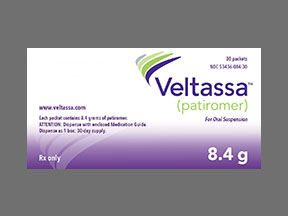
Veltassa
Veltassa 30 Packet
What is Veltassa?
Veltassa is used to treat high levels of potassium in your blood. There is no generic version of Veltassa currently available. The average cost for Veltassa is $886 for a supply of 30, 16.8 gm oral powder. You can use our Rx.com savings offer to get a Veltassa discount of 80% or less off of the retail price at participating pharmacies near you.Side Effects
- Allergic reaction: Itching or hives, swelling in your face or hands, swelling or tingling in your mouth or throat, chest tightness, trouble breathing
- Nausea, vomiting, unusual tiredness or weakness, muscle cramps, confusion
- Severe stomach pain, swelling of the stomach, bloated or full feeling
Warnings
- Keep all medicine out of the reach of children. Never share your medicine with anyone.
- Tell your doctor if you are pregnant or breastfeeding, or if you have kidney disease, bowel blockage, or other bowel movement problems (including constipation or impaction). Tell your doctor if you have had surgery for a bowel movement disorder.
- Your doctor will do lab tests at regular visits to check on the effects of this medicine. Keep all appointments.
- Keep all medicine out of the reach of children. Never share your medicine with anyone.
Prescription savings · · · ·
What is Veltassa ?
Veltassa is used to treat high levels of potassium in your blood. There is no generic version of Veltassa currently available. The average cost for Veltassa is $886 for a supply of 30, 16.8 gm oral powder. You can use our Rx.com savings offer to get a Veltassa discount of 80% or less off of the retail price at participating pharmacies near you.- Allergic reaction: Itching or hives, swelling in your face or hands, swelling or tingling in your mouth or throat, chest tightness, trouble breathing
- Nausea, vomiting, unusual tiredness or weakness, muscle cramps, confusion
- Severe stomach pain, swelling of the stomach, bloated or full feeling
- Keep all medicine out of the reach of children. Never share your medicine with anyone.
- Tell your doctor if you are pregnant or breastfeeding, or if you have kidney disease, bowel blockage, or other bowel movement problems (including constipation or impaction). Tell your doctor if you have had surgery for a bowel movement disorder.
- Your doctor will do lab tests at regular visits to check on the effects of this medicine. Keep all appointments.
- Keep all medicine out of the reach of children. Never share your medicine with anyone.
Veltassa Coupons & Prices
Veltassa 30 Packet
Weight-loss medication, prescribed online
Licensed U.S. providers · No insurance needed · Shipped to your door
Veltassa prices by dosage
Lowest cash price with a free Rx.com coupon vs. the average retail price.
| Dosage | Quantity | Retail price | Rx.com price |
|---|---|---|---|
| 4 packet · Box | 4 | $255.95 | $178.05 |
| 30 packet · Box | 30 | $1,255.99 | $976.35 |
| 60 packet · Box | 30 | $395.44 | $226.42 |
Cash prices near ZIP 77433; updated regularly. Actual pharmacy price may vary.
If you are looking for a Veltassa coupon, you are in the right place. Veltassa (patiromer, also written patiromer sorbitex calcium) is a brand-only prescription medicine used to treat hyperkalemia, or high potassium in the blood. There is no FDA-approved generic version of Veltassa in the United States, so the cash price at the pharmacy counter can be a real burden. Enter your ZIP code above to see today's price at pharmacies near you and to pull up a free Rx.com discount coupon you can show at the counter. Our coupon is a cash-price discount, which means it can be used whether you have no insurance, have Medicare, or have a plan that will not cover Veltassa.
What is Veltassa (patiromer) and how does it work?
Veltassa is FDA-approved to treat hyperkalemia (high blood potassium) in adults and in children 12 years and older. It is a non-absorbed polymer, which means it is not taken up into your bloodstream. Instead, it stays in your digestive tract and binds potassium in the lumen of the colon, so more potassium leaves your body in the stool and the potassium level in your blood goes down. It belongs to a group of medicines MedlinePlus calls potassium removing agents, and it is sometimes described as a potassium binder or cation-exchange polymer.
Veltassa comes as a powder for oral suspension in packets. The packet sizes include 8.4 g, 16.8 g, and 25.2 g (a 1 g packet also exists). For adults, the recommended starting dose is 8.4 g once daily. For patients 12 to 17 years of age, the label specifies a lower starting dose of 4 g once daily, adjusted in 4 g steps. In both cases, your prescriber may adjust the dose at intervals of at least one week based on your blood potassium levels. Veltassa can be taken with or without food. The label carries a specific limitation of use: Veltassa should not be used as an emergency treatment for life-threatening hyperkalemia, because it takes time to work. Do not take the powder dry, do not heat it in a microwave, and do not add it to heated foods. This page is general information, not medical advice; follow the directions your prescriber and pharmacist give you.
Veltassa cost: manufacturer savings card vs. the Rx.com cash coupon
There are two very different ways people pay less for Veltassa, and it helps to know which one applies to you. The manufacturer of Veltassa runs an official savings and affordability program, which you can read about on the manufacturer's own Veltassa website. Programs like this are generally limited to people with commercial (employer or marketplace) insurance, and they typically exclude people with Medicare, Medicaid, or other government coverage. Eligibility rules and terms vary and can change, so check the manufacturer's current terms before you count on it. Many manufacturers also run a patient assistance program for people who qualify based on income and insurance status; if you are struggling to afford Veltassa, ask your prescriber's office or the manufacturer's program directly whether assistance is available to you.
The Rx.com coupon works differently. It is a cash-price discount, not insurance and not a manufacturer card, so it is the option that still works when you are uninsured, when you have Medicare, or when a savings card is declined at the counter. Prices for Veltassa vary quite a bit from pharmacy to pharmacy, even within the same town, so it is worth comparing before you fill. Enter your ZIP above to see today's price near you, then show the coupon to the pharmacist. You cannot combine a cash coupon with your insurance on the same fill, so ask the pharmacist to run whichever comes out lower for you.
Veltassa alternatives and related medications
Veltassa is the brand name for patiromer, and there is currently no FDA-approved, marketed generic patiromer you can substitute at the pharmacy, so the usual "ask for the generic" savings lever is not available here. If cost is the barrier, the more realistic conversation is with your prescriber about whether a different potassium binder fits your situation. Other medicines used for high potassium include Lokelma (sodium zirconium cyclosilicate) and the older Kayexalate / sodium polystyrene sulfonate. These are not identical to Veltassa in how they are dosed or in their side effects, and only your prescriber can decide whether a switch makes sense for you.
Many people who are prescribed Veltassa are also taking medicines that can raise potassium, such as ACE inhibitors like lisinopril, ARBs like losartan, or the mineralocorticoid receptor antagonist spironolactone. Diuretics such as furosemide are also common in people with kidney disease or heart failure. Never stop or change the dose of any of these on your own because of a potassium result. That decision belongs to your care team.
Veltassa safety: what to know before you take it
Veltassa does not carry a boxed warning. The original boxed warning about separating Veltassa from other medicines was removed by the FDA in 2016 and replaced with a standard drug-interaction warning. The most important points from the current label are: take Veltassa at least 3 hours before or at least 3 hours after any other medicine you take by mouth, because patiromer can bind other drugs and reduce how much of them your body absorbs. Veltassa is not for emergency or life-threatening hyperkalemia, since its onset is delayed (roughly 7 hours). The label is directive about the gut: avoid use of Veltassa if you have severe constipation, bowel obstruction or impaction, including abnormal post-operative bowel motility disorders, because Veltassa may be ineffective and may worsen those gastrointestinal conditions. People with a history of bowel obstruction or major gastrointestinal surgery, severe gastrointestinal disorders, or swallowing disorders were not included in the clinical studies, so tell your prescriber if any of that applies to you.
Your prescriber should also monitor your blood work. Low magnesium (hypomagnesemia) occurred in about 5.3% of patients, so magnesium levels are checked and a supplement may be recommended. Potassium is monitored too, since it is possible to lower it too far. Patiromer sorbitex calcium contains a calcium-sorbitol counterion, so calcium is part of the molecule; the US prescribing information does not state an amount of calcium per dose or carry a warning about high calcium, so ask your prescriber or pharmacist if you have questions about calcium and your own health history. Veltassa should not be used by anyone with a hypersensitivity to patiromer or any of its ingredients. The most common side effects reported in 2% or more of patients were constipation (7.2%), low magnesium (5.3%), diarrhea (4.8%), nausea (2.3%), abdominal discomfort (2.0%), and gas (2.0%). This is a summary, not a complete list, and not medical advice. Talk with your doctor or pharmacist about your own situation and report any side effects that concern you.
This Veltassa information was written and reviewed against authoritative U.S. medical sources — MedlinePlus (U.S. National Library of Medicine), DailyMed, and FDA prescribing information — and checked for accuracy. It is provided for education and is not a substitute for professional medical advice.
Verify the official label: Veltassa on DailyMed (FDA)
Reviewed against FDA labeling · Last reviewed July 2026
Related Drugs
Browse more medications: starting with V · full A-Z directory · by condition · common drugs
Medical disclaimer: This information is provided for general educational purposes only and is not medical advice. It is not a substitute for professional diagnosis or treatment. Always consult a licensed physician, pharmacist, or other qualified healthcare provider before starting, stopping, or changing any medication or treatment. Never disregard professional medical advice or delay seeking it because of something you read here. If you think you may have a medical emergency, call your doctor or 911 immediately.


