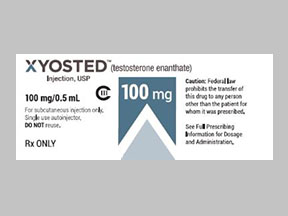
Xyosted
Xyosted 0.5ML of 100MG/0.5ML
What is Xyosted?
Xyosted (testosterone enanthate) is a prescription medication used in adult men to treat conditions associated with a deficiency or absence of endogenous testosterone (primary hypogonadism or hypogonadotropic hypogonadism). It is administered through subcutaneous injection and provides a steady release of testosterone, offering a convenient alternative to traditional intramuscular testosterone injections. Side effects may include increased blood pressure, mood swings, and potential increases in red blood cell count.Side Effects
- Swelling in your hands, ankles, or feet
- Unusual bleeding, bruising, or weakness
- Allergic reaction: Itching or hives, swelling in your face or hands, swelling or tingling in your mouth or throat, chest tightness, trouble breathing
Warnings
- It is not safe to take this medicine during pregnancy. It could harm an unborn baby. Tell your doctor right away if you become pregnant.
- Tell your doctor if you have kidney disease, liver disease, lung disease, diabetes, an enlarged prostate, blood vessel or heart disease, heart failure, high cholesterol, lung disease, obesity, sleep apnea, or a history of heart attack or stroke.
- This medicine may cause the following problems:High blood pressureSerious lung reaction called pulmonary oil embolism (may be life-threatening)Increased risk of prostate cancerIncreased number of red blood cellsBlood clot in your leg or lungSlow growth in childrenIncreased risk of heart attack or strokeLiver problemsChanges in mood or behavior
- This medicine can be habit-forming. Do not use more than your prescribed dose. Call your doctor if you think your medicine is not working.
- This medicine may lower your sperm count (with large doses). Talk with your doctor before using this medicine if you plan to have children. Some men who use this medicine have become infertile (unable to have children).
Prescription savings · · · ·
What is Xyosted ?
Xyosted (testosterone enanthate) is a prescription medication used in adult men to treat conditions associated with a deficiency or absence of endogenous testosterone (primary hypogonadism or hypogonadotropic hypogonadism). It is administered through subcutaneous injection and provides a steady release of testosterone, offering a convenient alternative to traditional intramuscular testosterone injections. Side effects may include increased blood pressure, mood swings, and potential increases in red blood cell count.- Swelling in your hands, ankles, or feet
- Unusual bleeding, bruising, or weakness
- Allergic reaction: Itching or hives, swelling in your face or hands, swelling or tingling in your mouth or throat, chest tightness, trouble breathing
- Change in how much or how often you urinate, trouble urinating
- Chest pain, cough, trouble breathing, dizziness, tightening of your throat, unusual sweating
- Dark urine or pale stools, nausea, vomiting, loss of appetite, stomach pain, yellow skin or eyes
- Pain, redness, or swelling in your arm or leg
- Unusual mood or behavior, thoughts of killing oneself
- It is not safe to take this medicine during pregnancy. It could harm an unborn baby. Tell your doctor right away if you become pregnant.
- Tell your doctor if you have kidney disease, liver disease, lung disease, diabetes, an enlarged prostate, blood vessel or heart disease, heart failure, high cholesterol, lung disease, obesity, sleep apnea, or a history of heart attack or stroke.
- This medicine may cause the following problems:High blood pressureSerious lung reaction called pulmonary oil embolism (may be life-threatening)Increased risk of prostate cancerIncreased number of red blood cellsBlood clot in your leg or lungSlow growth in childrenIncreased risk of heart attack or strokeLiver problemsChanges in mood or behavior
- This medicine can be habit-forming. Do not use more than your prescribed dose. Call your doctor if you think your medicine is not working.
- This medicine may lower your sperm count (with large doses). Talk with your doctor before using this medicine if you plan to have children. Some men who use this medicine have become infertile (unable to have children).
- Your doctor will do lab tests at regular visits to check on the effects of this medicine. Keep all appointments.
- Keep all medicine out of the reach of children. Never share your medicine with anyone.
Xyosted Coupons & Prices
Xyosted 0.5ML of 100MG/0.5ML

Weight-loss medication, prescribed online
Licensed U.S. providers · No insurance needed · Shipped to your door
Xyosted prices by dosage
Lowest cash price with a free Rx.com coupon vs. the average retail price.
| Dosage | Quantity | Retail price | Rx.com price |
|---|---|---|---|
| 0.5ml of 50mg/0.5ml · Pen | 2 | $811.89 | $615.52 |
| 0.5ml of 100mg/0.5ml · Pen | 2 | $811.89 | $616.54 |
| 0.5ml of 75mg/0.5ml · Pen | 2 | $811.89 | $616.59 |
Cash prices near ZIP 77433; updated regularly. Actual pharmacy price may vary.
If you are looking for a Xyosted coupon, you are in the right place. Xyosted (testosterone enanthate) is a brand-name, once-weekly subcutaneous auto-injector used for testosterone replacement therapy in adult men with hypogonadism, and it is a Schedule III controlled medicine, so it always requires a prescription. There is no generic version of the Xyosted auto-injector, which is a big reason the cash price can be hard to swallow. The free Rx.com discount coupon on this page can be used at the pharmacy counter whether you have insurance or not. Enter your ZIP code above to see today's price at pharmacies near you, then show the coupon to your pharmacist before they ring up your prescription.
What is Xyosted and how does it work?
Xyosted is testosterone enanthate in sesame oil, packaged in a single-dose auto-injector that you give under the skin (subcutaneously) in the abdomen once a week. It comes in 50 mg, 75 mg, and 100 mg strengths per 0.5 mL. Because it is an androgen (a testosterone ester), it replaces the testosterone the body is not making on its own and is classified as a C-III controlled substance.
The FDA has approved Xyosted for testosterone replacement therapy in adult males with primary hypogonadism (congenital or acquired testicular failure) or hypogonadotropic hypogonadism (congenital or acquired gonadotropin or LHRH deficiency). Its safety and effectiveness have not been established for age-related low testosterone (the "low T" of aging) or in males under 18 years old. Only your prescriber can decide whether Xyosted is appropriate for you.
Xyosted cost: manufacturer savings card vs. the Rx.com cash coupon
Search results for a Xyosted coupon are mostly split between the manufacturer's own savings offer and pharmacy discount cards. Here is the honest difference:
- Manufacturer savings card. Xyosted's maker runs an official savings and support program (marketed under the SteadyCare name) on the brand's own website. Like most brand copay cards, it is generally limited to people with commercial insurance. If you are uninsured, or you are covered by Medicare, Medicaid, TRICARE, or another government plan, you are usually not eligible. Eligibility rules, dollar limits, and expiration terms vary and change, so check the manufacturer's official site directly. The program's materials also describe support services and assistance options for eligible patients, so it is worth a call if cost is a barrier.
- Rx.com cash coupon. Our coupon is a cash-price discount, not insurance. It works when you have no insurance at all, when you are on Medicare, or when a copay card is declined at the register. You can also compare the coupon price against your insurance copay and simply use whichever is lower on that day.
Prices for Xyosted swing widely between pharmacies in the same town, so it pays to compare before you fill. Enter your ZIP code above to see today's price at pharmacies near you. One note: you cannot combine a manufacturer copay card and a discount coupon on the same fill, so pick the better of the two.
No generic yet, but other testosterone options are worth asking about
There is currently no FDA-approved generic of the Xyosted auto-injector, so the auto-injector itself has no substitute at the counter. The active ingredient, however, is a long-standing one, and several other testosterone products are widely available. What they cost varies by pharmacy and by your coverage, so it is worth comparing prices rather than assuming any one form is cheaper. Ask your prescriber whether one of these would be reasonable for you:
- Testosterone cypionate and the brand Depo-Testosterone are intramuscular oil injections drawn from a vial with a needle and syringe. The Depo-Testosterone label describes dosing for hypogonadal men as 50 mg to 400 mg every two to four weeks, and in practice prescribers often use a shorter interval, so plan on roughly every 1 to 4 weeks depending on what your prescriber orders.
- Testosterone enanthate vials contain the same ester as Xyosted, but they are a different product and a different injection technique, and are not an automatic substitute for the auto-injector.
- AndroGel is a daily topical gel. It avoids needles, but it carries a boxed warning about secondary exposure of women and children through skin contact.
- Jatenzo is an oral testosterone undecanoate capsule taken twice daily with food, and Natesto is a nasal gel used three times a day.
The trade-offs are convenience, how steady your levels stay, and price. Your prescriber can tell you which form fits your diagnosis and your routine, and you can compare the cash price of each at pharmacies near you.
Safety: what to know before and during treatment
As of the March 2025 label revision, Xyosted no longer carries a boxed warning. The earlier boxed warning about blood pressure increases was removed, and blood pressure is now handled as a Warning and Precaution. It still matters: Xyosted can raise blood pressure, which can increase the risk of major cardiovascular events. It is not recommended for men with uncontrolled high blood pressure, and your blood pressure should be checked and treated if it rises. Other risks on the label include a higher red-blood-cell count (polycythemia). For that reason, the Xyosted label directs your prescriber to confirm your hematocrit is not elevated before you start, and then to evaluate hematocrit approximately every 3 months while you are on treatment; if it becomes elevated, Xyosted is stopped until the level comes down, and it is stopped permanently if the problem returns after restarting. The label also covers blood clots including deep vein thrombosis and pulmonary embolism, worsening of an enlarged prostate and possible increased prostate cancer risk (PSA is monitored), depression and reports of suicidal thoughts and suicide attempts in trials, sleep apnea, swelling, effects on the liver, reduced sperm counts and fertility, and breast enlargement.
Xyosted must not be used during pregnancy (it can harm a developing baby) or by men with breast cancer or known or suspected prostate cancer, or by anyone with a known hypersensitivity to testosterone enanthate or sesame oil. Testosterone is also misused at high, supraphysiologic doses, which has caused serious heart and psychiatric problems, and it can lead to dependence. The most common side effects are increased hematocrit, increased PSA, higher blood pressure, injection-site reactions such as bruising, bleeding, or redness, and headache. This page is information, not medical advice. Talk with your doctor or pharmacist about your own situation, and get medical help right away for chest pain, trouble breathing, leg swelling or pain, or thoughts of harming yourself.
This Xyosted information was written and reviewed against authoritative U.S. medical sources — MedlinePlus (U.S. National Library of Medicine), DailyMed, and FDA prescribing information — and checked for accuracy. It is provided for education and is not a substitute for professional medical advice.
Verify the official label: Xyosted on DailyMed (FDA)
Reviewed against FDA labeling · Last reviewed July 2026
Related Drugs
Browse more medications: starting with X · full A-Z directory · by condition · common drugs
Medical disclaimer: This information is provided for general educational purposes only and is not medical advice. It is not a substitute for professional diagnosis or treatment. Always consult a licensed physician, pharmacist, or other qualified healthcare provider before starting, stopping, or changing any medication or treatment. Never disregard professional medical advice or delay seeking it because of something you read here. If you think you may have a medical emergency, call your doctor or 911 immediately.


