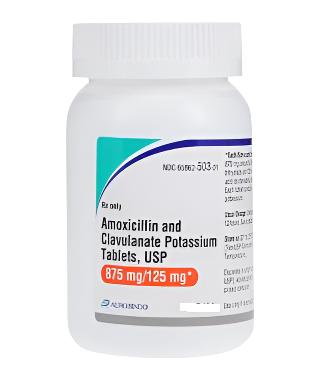
Amoxicillin-Pot Clavulanate
Amoxicillin-Pot Clavulanate
What is Amoxicillin-Pot Clavulanate?
Augmentin (amoxicillin/clavulanate potassium) is a prescription antibiotic used to treat a wide variety of bacterial infections, including sinus infections, ear infections, pneumonia, skin infections, urinary tract infections (UTIs), and certain dental infections. It combines amoxicillin with clavulanate potassium to help overcome antibiotic-resistant bacteria.
Side Effects
- Blistering, peeling, red skin rash
- Bloody or watery diarrhea, stomach cramps, fever
- Allergic reaction: Itching or hives, swelling in your face or hands, swelling or tingling in your mouth or throat, chest tightness, trouble breathing
Warnings
- Your doctor will do lab tests at regular visits to check on the effects of this medicine. Keep all appointments.
- Keep all medicine out of the reach of children. Never share your medicine with anyone.
- Tell your doctor if you are pregnant or breastfeeding, or if you have kidney disease, liver disease, or mononucleosis (mono).
- This medicine may cause the following problems:Serious skin reactions, including Stevens-Johnson syndrome, toxic epidermal necrolysis, acute generalized exanthematous pustulosis (AGEP), and drug reaction with eosinophilia and systemic symptoms (DRESS)Liver problems
- Tell any doctor or dentist who treats you that you are using this medicine. This medicine may affect certain medical test results.
Prescription savings · · · ·
What is Amoxicillin-Pot Clavulanate ?
Augmentin (amoxicillin/clavulanate potassium) is a prescription antibiotic used to treat a wide variety of bacterial infections, including sinus infections, ear infections, pneumonia, skin infections, urinary tract infections (UTIs), and certain dental infections. It combines amoxicillin with clavulanate potassium to help overcome antibiotic-resistant bacteria.
- Blistering, peeling, red skin rash
- Bloody or watery diarrhea, stomach cramps, fever
- Allergic reaction: Itching or hives, swelling in your face or hands, swelling or tingling in your mouth or throat, chest tightness, trouble breathing
- Change in how much or how often you urinate, painful or difficult urination, lower back or side pain
- Dark urine or pale stools, nausea, vomiting, loss of appetite, stomach pain, yellow eyes or skin
- Your doctor will do lab tests at regular visits to check on the effects of this medicine. Keep all appointments.
- Keep all medicine out of the reach of children. Never share your medicine with anyone.
- Tell your doctor if you are pregnant or breastfeeding, or if you have kidney disease, liver disease, or mononucleosis (mono).
- This medicine may cause the following problems:Serious skin reactions, including Stevens-Johnson syndrome, toxic epidermal necrolysis, acute generalized exanthematous pustulosis (AGEP), and drug reaction with eosinophilia and systemic symptoms (DRESS)Liver problems
- Tell any doctor or dentist who treats you that you are using this medicine. This medicine may affect certain medical test results.
- This medicine can cause diarrhea. Call your doctor if the diarrhea becomes severe, does not stop, or is bloody. Do not take any medicine to stop diarrhea until you have talked to your doctor. Diarrhea can occur 2 months or more after you stop taking this medicine. It may occur 2 months or more after you stop using this medicine.
- Birth control pills may not work as well while you are taking this medicine. Use another form of birth control to prevent pregnancy.
- Call your doctor if your symptoms do not improve or if they get worse.
- The chewable tablet and oral liquid contain phenylalanine. Talk to your doctor before you use this medicine if you have phenylketonuria (PKU).
Amoxicillin-Pot Clavulanate Coupons & Prices
Amoxicillin-Pot Clavulanate
4 ED medications in one dose
Apomorphine, sildenafil, tadalafil & vardenafil · One sublingual dose · Free express shipping
Looking for an amoxicillin/clavulanate potassium coupon? This antibiotic (the generic version of Augmentin) is already one of the lower-cost prescription antibiotics, but the cash price can vary widely from one pharmacy to the next — sometimes by a lot for the very same prescription. Rx.com compares live prices across more than 60,000 pharmacies so you can find the lowest price near you. Enter your ZIP above to see today's price and get a free discount coupon you can show your pharmacist.
What is amoxicillin/clavulanate and how does it work?
Amoxicillin/clavulanate potassium is a combination antibiotic sold under the brand names Augmentin, Augmentin XR, and Augmentin ES-600. It pairs amoxicillin — a penicillin-class (aminopenicillin) antibiotic — with clavulanate, a beta-lactamase inhibitor. Some bacteria defend themselves by making an enzyme called beta-lactamase that breaks down amoxicillin. The clavulanate blocks that enzyme, which lets the amoxicillin keep working against bacteria that plain amoxicillin alone can't beat.
It is FDA-approved to treat bacterial infections caused by these amoxicillin-resistant, beta-lactamase-producing organisms, including lower respiratory tract infections, acute bacterial sinusitis, acute otitis media (ear infections), skin and skin-structure infections, and urinary tract infections. It is also very commonly used, with guideline support, for community-acquired pneumonia, animal and human bite wounds, and dental infections. Like all antibiotics, it does not work against viral illnesses such as the common cold or the flu.
How much does amoxicillin/clavulanate cost without insurance?
Because a generic is available, amoxicillin/clavulanate is generally an affordable antibiotic even if you're paying cash without insurance. That said, the sticker price is not the same everywhere — two pharmacies in the same town can charge very different amounts for an identical prescription, which is exactly why comparing prices before you fill matters. Prices also depend on the strength, the quantity, and whether you're filling the standard tablets or a specific formulation like Augmentin XR or the ES-600 oral suspension.
Rx.com checks current prices across more than 60,000 U.S. pharmacies and shows you a free discount coupon for the lowest option near you — no insurance required. We don't post fixed dollar figures here because prices change; enter your ZIP above to see today's price for your exact strength and quantity.
Related antibiotics and alternatives
Amoxicillin/clavulanate is closely related to plain amoxicillin — the difference is the added clavulanate, which broadens the range of bacteria it can treat. Its brand-name equivalent is Augmentin. Depending on the infection and your medical history, a provider might instead prescribe another antibiotic such as cephalexin, azithromycin, or doxycycline.
Which antibiotic is right depends on the type of infection, local resistance patterns, and any drug allergies you have — that's a decision for your prescriber, not a price comparison. If you have a prescription for any of these, you can compare cash prices for each on Rx.com to see which is the most affordable at pharmacies near you.
Safety and side effects
The most common side effect of amoxicillin/clavulanate is diarrhea; nausea, vomiting, and vaginal yeast infections can also occur. Formulations with more clavulanate tend to cause more diarrhea. This medication should not be used by people with a history of a serious allergic reaction (such as anaphylaxis) to penicillins or cephalosporins, or by anyone who has previously had amoxicillin/clavulanate-associated liver problems (cholestatic jaundice or liver dysfunction). It has no boxed warning.
Less common but serious risks include liver injury (which can be delayed and is more likely with longer treatment and in older adults), severe skin reactions (such as Stevens-Johnson syndrome, toxic epidermal necrolysis, DRESS, and AGEP), anaphylaxis, and Clostridioides difficile-associated diarrhea. It may also make oral contraceptives less effective. Get medical help right away for a rash, trouble breathing, yellowing of the skin or eyes, or severe or bloody diarrhea. This information is not medical advice — always follow your prescriber's directions and talk with your doctor or pharmacist about your specific situation.
This Amoxicillin-Pot Clavulanate information was written and reviewed against authoritative U.S. medical sources — MedlinePlus (U.S. National Library of Medicine), DailyMed, and FDA prescribing information — and checked for accuracy. It is provided for education and is not a substitute for professional medical advice.
Verify the official label: Amoxicillin-Pot Clavulanate on DailyMed (FDA)
Reviewed against FDA labeling · Last reviewed July 2026
Related Drugs
Browse more medications: starting with A · full A-Z directory · by condition · common drugs
Medical disclaimer: This information is provided for general educational purposes only and is not medical advice. It is not a substitute for professional diagnosis or treatment. Always consult a licensed physician, pharmacist, or other qualified healthcare provider before starting, stopping, or changing any medication or treatment. Never disregard professional medical advice or delay seeking it because of something you read here. If you think you may have a medical emergency, call your doctor or 911 immediately.


