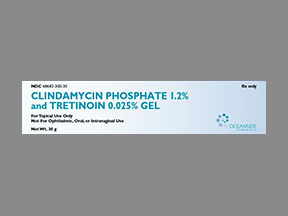
Clindamycin-Tretinoin
Clindamycin-Tretinoin 30GM of 1.2-0.025%
What is Clindamycin-Tretinoin?
Clindamycin-Tretinoin is a topical medication that combines clindamycin phosphate, an antibiotic, with tretinoin, a retinoid, used primarily to treat acne. Clindamycin works by reducing bacterial growth, while tretinoin promotes skin cell turnover to prevent pores from clogging, effectively targeting both inflammatory and non-inflammatory acne lesions. This combination therapy is generally prescribed for use once daily and is effective in reducing the severity of acne and promoting clearer skin.Side Effects
- Allergic reaction: Itching or hives, swelling in your face or hands, swelling or tingling in your mouth or throat, chest tightness, trouble breathing
- Diarrhea that is watery or contains blood
- Severe or ongoing skin redness, peeling, itching, blistering, crusting, or swelling
Warnings
- This medicine may cause a temporary change in skin color (lighter or darker).
- Topical application routeDo not use this medicine to treat a skin problem your doctor has not examined.
- Keep all medicine out of the reach of children. Never share your medicine with anyone.
- Tell your doctor if you are pregnant or breastfeeding, or you are planning to have general anesthesia for surgery.
- This medicine can cause diarrhea. Call your doctor if the diarrhea becomes severe, does not stop, or is bloody. Do not take any medicine to stop diarrhea until you have talked to your doctor. Diarrhea can occur 2 months or more after you stop taking this medicine.
Prescription savings · · · ·
What is Clindamycin-Tretinoin ?
Clindamycin-Tretinoin is a topical medication that combines clindamycin phosphate, an antibiotic, with tretinoin, a retinoid, used primarily to treat acne. Clindamycin works by reducing bacterial growth, while tretinoin promotes skin cell turnover to prevent pores from clogging, effectively targeting both inflammatory and non-inflammatory acne lesions. This combination therapy is generally prescribed for use once daily and is effective in reducing the severity of acne and promoting clearer skin.- Allergic reaction: Itching or hives, swelling in your face or hands, swelling or tingling in your mouth or throat, chest tightness, trouble breathing
- Diarrhea that is watery or contains blood
- Severe or ongoing skin redness, peeling, itching, blistering, crusting, or swelling
- This medicine may cause a temporary change in skin color (lighter or darker).
- Topical application routeDo not use this medicine to treat a skin problem your doctor has not examined.
- Keep all medicine out of the reach of children. Never share your medicine with anyone.
- Tell your doctor if you are pregnant or breastfeeding, or you are planning to have general anesthesia for surgery.
- This medicine can cause diarrhea. Call your doctor if the diarrhea becomes severe, does not stop, or is bloody. Do not take any medicine to stop diarrhea until you have talked to your doctor. Diarrhea can occur 2 months or more after you stop taking this medicine.
- This medicine may make your skin more sensitive to sunlight. Wear sunscreen. Do not use sunlamps or tanning beds.
Clindamycin-Tretinoin Coupons & Prices
Clindamycin-Tretinoin 30GM of 1.2-0.025%
Weight-loss medication, prescribed online
Licensed U.S. providers · No insurance needed · Shipped to your door
Clindamycin-Tretinoin prices by dosage
Lowest cash price with a free Rx.com coupon vs. the average retail price.
| Dosage | Quantity | Retail price | Rx.com price |
|---|---|---|---|
| 30gm of 1.2-0.025% · Tube Of Gel | 30 | $339.99 | $120.20 |
| 60gm of 1.2-0.025% · Tube Of Gel | 30 | $382.99 | $117.06 |
Cash prices near ZIP 77433; updated regularly. Actual pharmacy price may vary.
A clindamycin-tretinoin coupon from Rx.com can lower what you pay at the pharmacy counter for clindamycin phosphate 1.2% / tretinoin 0.025% topical gel, the generic version of the acne brand Ziana. The generic gel is already the lower-cost way to fill this prescription, but the cash price can still swing a lot from one pharmacy to the next, even between stores in the same town. Rx.com compares cash prices across more than 60,000 pharmacies nationwide, so you can see who is charging what before you drop off the prescription. Enter your ZIP code above to see today's price near you and print, text, or email your free coupon. There is no membership fee and no insurance required.
What clindamycin-tretinoin gel is and how it works
Clindamycin phosphate and tretinoin gel is a topical combination acne product. It pairs two medicines that work in different ways. Clindamycin is a lincosamide antibiotic that suppresses Cutibacterium acnes (formerly Propionibacterium acnes), the bacteria involved in acne, and helps calm inflammation. Tretinoin is a retinoid that normalizes the way skin cells shed inside the pore, unclogs follicles, and reduces the formation of blackheads and whiteheads. Putting both in one gel means one product treats the pimples you have and helps keep pores from plugging up again.
The gel is FDA-approved for the topical treatment of acne vulgaris in people 12 years of age and older. The label directs applying a pea-sized amount to the entire face once daily in the evening, not just as a spot treatment. This page is general information, not medical advice, so follow the directions your prescriber and pharmacist give you.
What clindamycin-tretinoin gel costs without insurance
An FDA-approved generic is available, and that is good news for cash payers: generic clindamycin phosphate 1.2% / tretinoin 0.025% gel is far less expensive than the brand. Even so, this is a dermatology product where the cash price you are quoted depends heavily on which pharmacy you walk into. Two stores a few miles apart can quote very different numbers for the same tube, because each pharmacy sets its own cash price. That is exactly why comparing before you fill is worth the two minutes it takes.
Here is how to keep the cost down:
- Ask your prescriber to write for the generic gel rather than the brand unless there is a specific reason for the brand.
- Enter your ZIP code above to compare today's cash price across the pharmacies near you.
- Use the free Rx.com coupon at checkout. It is a cash-discount coupon, not insurance, and you do not need to enroll or pay a fee to use it.
- Ask the pharmacist to compare the coupon price against your insurance copay and simply pay whichever is lower.
- Ask whether a larger tube size is a better value per gram, since this gel is used daily and long term.
There is no manufacturer copay savings card we can point you to for the generic. If you want to check what the brand's manufacturer offers, look at the official Bausch Health website directly; program terms and eligibility vary and change over time.
Brand names and how it compares to other acne treatments
Ziana is the brand name for this clindamycin 1.2% / tretinoin 0.025% gel. Veltin, another brand of the same combination, is no longer marketed in the US, so do not expect to find it. The generic gel is what most pharmacies stock and dispense today, and it contains the same two active ingredients at the same strengths.
Prescribers choose among several acne options depending on the type of acne, how the skin tolerates treatment, and cost:
- Tretinoin alone, a topical retinoid without the antibiotic, often used when the acne is mainly comedonal.
- Adapalene, another topical retinoid that some people find less irritating.
- Clindamycin alone as a topical antibiotic, though it is typically combined with another agent rather than used by itself long term.
- Doxycycline, an oral antibiotic sometimes used for inflammatory acne.
- Spironolactone, used in some adult patients with hormonally driven acne.
- Isotretinoin, an oral retinoid reserved for severe acne and prescribed under close medical supervision.
Which one is right for you is a conversation to have with your clinician or dermatologist.
Safety information you should know
Clindamycin-tretinoin gel does not carry a boxed warning, but the FDA label flags several things worth knowing. Clindamycin given by mouth or by injection has been associated with severe colitis that can be fatal, and diarrhea, bloody diarrhea, and colitis (including pseudomembranous colitis) have also been reported with topical clindamycin. C. difficile-associated diarrhea can occur. Stop the gel and call your doctor if you develop significant or persistent diarrhea. The gel is contraindicated if you have regional enteritis (Crohn's disease), ulcerative colitis, or a history of antibiotic-associated colitis. The tretinoin component makes skin more sensitive to sunlight and sunlamps, so minimize UV exposure, use sunscreen daily, wear protective clothing, and take care in wind and cold.
The most common effects are local: dryness, scaling or peeling, redness, itching, burning, and stinging, usually worst in the first few weeks as skin adjusts. Keep the gel away from your eyes, mouth, the creases at the sides of your nose, and other mucous membranes. Avoid abrasive or medicated soaps, harsh peeling agents, and other irritating topicals while using it. Tell your prescriber about everything you use, including erythromycin-containing products, which may not work well alongside clindamycin, and note that clindamycin may interact with neuromuscular blocking agents used in surgery. If you are pregnant, planning pregnancy, or breastfeeding, talk with your clinician before starting a topical retinoid. This page is general information and is not a substitute for advice from your own healthcare provider.
This Clindamycin-Tretinoin information was written and reviewed against authoritative U.S. medical sources — MedlinePlus (U.S. National Library of Medicine), DailyMed, and FDA prescribing information — and checked for accuracy. It is provided for education and is not a substitute for professional medical advice.
Verify the official label: Clindamycin-Tretinoin on DailyMed (FDA)
Reviewed against FDA labeling · Last reviewed July 2026
Related Drugs
Browse more medications: starting with C · full A-Z directory · by condition · common drugs
Medical disclaimer: This information is provided for general educational purposes only and is not medical advice. It is not a substitute for professional diagnosis or treatment. Always consult a licensed physician, pharmacist, or other qualified healthcare provider before starting, stopping, or changing any medication or treatment. Never disregard professional medical advice or delay seeking it because of something you read here. If you think you may have a medical emergency, call your doctor or 911 immediately.


