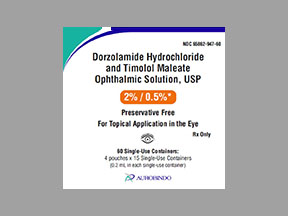
Dorzolamide Hcl-Timolol Mal Pf
Dorzolamide HCl-Timolol Mal PF 60 Solution
What is Dorzolamide Hcl-Timolol Mal Pf?
Dorzolamide HCl-Timolol Maleate PF is a combination ophthalmic solution used to reduce intraocular pressure in patients with open-angle glaucoma or ocular hypertension. Dorzolamide is a carbonic anhydrase inhibitor that reduces aqueous humor secretion, while Timolol is a beta-blocker that decreases the production of fluid in the eye. This preservative-free formula is particularly suitable for patients who are sensitive to preservatives.Side Effects
- Redness, pain, or swelling of your eye or eyelids
- Muscle weakness
- Chest pain, trouble breathing, cold sweat, bluish skin
Warnings
- Tell your doctor if you are pregnant or breastfeeding, or if you have kidney disease, liver disease, heart disease, diabetes, thyroid problems, or myasthenia gravis. Tell your doctor if you are allergic to sulfa drugs.
- Your doctor will do lab tests at regular visits to check on the effects of this medicine. Keep all appointments.
- Tell your doctor if you injure your eye or get an eye infection. Tell your doctor if you need to have eye surgery.
- Keep all medicine out of the reach of children. Never share your medicine with anyone.
- Lightheadedness, dizziness, or fainting
Prescription savings · · · ·
What is Dorzolamide Hcl-Timolol Mal Pf ?
Dorzolamide HCl-Timolol Maleate PF is a combination ophthalmic solution used to reduce intraocular pressure in patients with open-angle glaucoma or ocular hypertension. Dorzolamide is a carbonic anhydrase inhibitor that reduces aqueous humor secretion, while Timolol is a beta-blocker that decreases the production of fluid in the eye. This preservative-free formula is particularly suitable for patients who are sensitive to preservatives.- Redness, pain, or swelling of your eye or eyelids
- Muscle weakness
- Chest pain, trouble breathing, cold sweat, bluish skin
- Blistering, peeling, or red skin rash
- Allergic reaction: Itching or hives, swelling in your face or hands, swelling or tingling in your mouth or throat, chest tightness, trouble breathing
- Rapid weight gain, swelling in your hands, ankles, or feet
- Lightheadedness, dizziness, or fainting
- Tell your doctor if you are pregnant or breastfeeding, or if you have kidney disease, liver disease, heart disease, diabetes, thyroid problems, or myasthenia gravis. Tell your doctor if you are allergic to sulfa drugs.
- Your doctor will do lab tests at regular visits to check on the effects of this medicine. Keep all appointments.
- Tell your doctor if you injure your eye or get an eye infection. Tell your doctor if you need to have eye surgery.
- Keep all medicine out of the reach of children. Never share your medicine with anyone.
- Lightheadedness, dizziness, or fainting
- This medicine may cause the following problems: Breathing problemsHeart failureSerious allergic reactions
- Tell any doctor or dentist who treats you that you are using this medicine. You may need to stop using this medicine several days before you have surgery or medical tests.
Dorzolamide Hcl-Timolol Mal Pf Coupons & Prices
Dorzolamide HCl-Timolol Mal PF 60 Solution
Weight-loss medication, prescribed online
Licensed U.S. providers · No insurance needed · Shipped to your door
Dorzolamide Hcl-Timolol Mal Pf prices by dosage
Lowest cash price with a free Rx.com coupon vs. the average retail price.
| Dosage | Quantity | Retail price | Rx.com price |
|---|---|---|---|
| 60 of 2-0.5% · Box | 60 | $161.99 | $62.94 |
Cash prices near ZIP 77433; updated regularly. Actual pharmacy price may vary.
If you're comparing prices for a dorzolamide-hcl-timolol-mal-pf coupon, this preservative-free combination eye drop (the generic version of Cosopt PF) is stocked at most pharmacies, but the price you're quoted can differ quite a bit from one pharmacy to the next for the exact same single-use vials. Rx.com compares pricing across more than 60,000 U.S. pharmacies so you can see where it costs less near you before you fill — enter your ZIP above to see today's price.
What Is Dorzolamide-Timolol PF and How Does It Work?
Dorzolamide hydrochloride 2% / timolol maleate 0.5% ophthalmic solution, preservative-free, is the generic equivalent of Cosopt PF (Théa Pharma Inc.), packaged in single-use vials with no benzalkonium chloride (BAK) preservative. It combines two medicines with different mechanisms in one drop: dorzolamide, a carbonic anhydrase inhibitor, and timolol, a non-selective beta-blocker. Together they reduce the production of fluid inside the eye, lowering intraocular pressure (IOP).
It's FDA-approved for patients with open-angle glaucoma or ocular hypertension whose eye pressure isn't controlled well enough on a beta-blocker drop alone. The preservative-free formulation is specifically meant for people with ocular surface disease or a sensitivity/intolerance to BAK, the preservative used in the standard multi-dose bottle. The typical dose is one drop in the affected eye(s) twice daily; if you use another topical eye medication, space the doses at least 5 minutes apart.
Dorzolamide-Timolol PF Cost: Why Comparing Pharmacies Matters
A generic version of this combination is available, but generic pricing on eye drops — especially preservative-free, single-use vial packaging — can vary widely by pharmacy depending on where they source it and how they price it. That's the main reason it's worth comparing before you fill rather than assuming your regular pharmacy has the best price.
Rx.com pulls current pricing from tens of thousands of pharmacies nationwide so you can see how your local options stack up. Enter your ZIP code above to check today's price near you before you pick a pharmacy.
Cosopt vs. Cosopt PF, and Other Glaucoma Drop Options
Cosopt PF and standard Cosopt contain the identical combination of dorzolamide and timolol — the difference is the delivery. Standard Cosopt comes in a multi-dose bottle preserved with benzalkonium chloride; the PF version comes in individual, single-use vials with no BAK, which is why it's usually reserved for people who develop eye irritation or have ocular surface disease. Your eye doctor may also have you try the standard multi-dose version, dorzolamide-timolol, if preservative sensitivity isn't a concern for you.
Because this is a fixed-dose combination, some patients instead use the two ingredients separately — timolol maleate and dorzolamide HCl — dosed on their own schedules. Other classes of IOP-lowering drops your doctor might consider adding or switching to include the prostaglandin analog latanoprost and the alpha-2 agonist brimonidine tartrate. Which option is right depends on your eye pressure targets, other eye drops you're using, and your overall health — that's a conversation for your ophthalmologist or optometrist.
Safety Information
The timolol component is absorbed into the bloodstream even though it's an eye drop, so it carries the same cautions as oral beta-blockers: it should generally be avoided by people with asthma, severe COPD, slow heart rate (sinus bradycardia), certain heart block conditions, overt heart failure, or cardiogenic shock. It can also mask the warning signs of low blood sugar in people with diabetes and may worsen myasthenia gravis. Dorzolamide is chemically related to sulfonamide drugs, so sulfonamide-type reactions (including serious skin reactions or blood cell effects) are possible even with a topical drop.
The most common side effects are a bitter or sour taste, burning or stinging when the drop goes in, dry eyes, blurred vision, and punctate keratitis (small areas of surface eye irritation). Also mention that you use this medication before any surgery, since the beta-blocker component can affect anesthesia. This is general information, not medical advice — talk to your doctor or pharmacist about your specific situation.
This Dorzolamide Hcl-Timolol Mal Pf information was written and reviewed against authoritative U.S. medical sources — MedlinePlus (U.S. National Library of Medicine), DailyMed, and FDA prescribing information — and checked for accuracy. It is provided for education and is not a substitute for professional medical advice.
Verify the official label: Dorzolamide Hcl-Timolol Mal Pf on DailyMed (FDA)
Reviewed against FDA labeling · Last reviewed July 2026
Related Drugs
Browse more medications: starting with D · full A-Z directory · by condition · common drugs
Medical disclaimer: This information is provided for general educational purposes only and is not medical advice. It is not a substitute for professional diagnosis or treatment. Always consult a licensed physician, pharmacist, or other qualified healthcare provider before starting, stopping, or changing any medication or treatment. Never disregard professional medical advice or delay seeking it because of something you read here. If you think you may have a medical emergency, call your doctor or 911 immediately.


