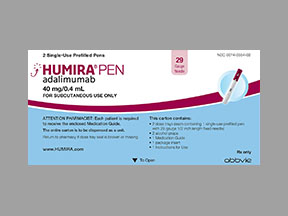
Humira
Humira 1 Auto-injector Kit
What is Humira?
Humira 1 Auto-injector Kit contains adalimumab, a medication used to treat various autoimmune conditions. It helps reduce inflammation and manage symptoms in conditions like arthritis and certain skin disorders.Side Effects
- Cough, fever, chills, runny or stuffy nose, sore throat, body aches
- Changes in vision
- Sores or white patches on your lips, mouth, or throat
Warnings
- Tell your doctor if you are pregnant or breastfeeding, or if you have liver disease, COPD, heart failure, diabetes, psoriasis, multiple sclerosis, optic neuritis, problems with your immune system, or a history of cancer or Guillain-Barré syndrome. Tell your doctor if you have any type of infection (including hepatitis B or tuberculosis) or an infection that keeps coming back.
- This medicine may cause the following problems: Increased risk for infectionIncreased risk of certain cancers, including lymphoma or leukemiaNervous system problemsNew or worsening heart failureImmune system problems, including lupus-like syndrome or autoimmune hepatitis
- You will need to have a skin test for tuberculosis (TB) before you start this medicine. Tell your doctor if you or anyone in your home has ever had a positive TB skin test or been exposed to TB.
- The needle cover of the prefilled syringe or pen contains dry natural rubber (a derivative of latex), which may cause allergic reactions in people who are sensitive to latex. Tell your doctor if you have a latex allergy before you start receiving this medicine.
- This medicine may make you bleed, bruise, or get infections more easily. Take precautions to prevent illness and injury. Wash your hands often.
Prescription savings · · · ·
What is Humira ?
Humira 1 Auto-injector Kit contains adalimumab, a medication used to treat various autoimmune conditions. It helps reduce inflammation and manage symptoms in conditions like arthritis and certain skin disorders.- Cough, fever, chills, runny or stuffy nose, sore throat, body aches
- Changes in vision
- Sores or white patches on your lips, mouth, or throat
- Dark urine or pale stools, nausea, vomiting, loss of appetite, stomach pain, yellow skin or eyes
- Allergic reaction: Itching or hives, swelling in your face or hands, swelling or tingling in your mouth or throat, chest tightness, trouble breathing
- Chest pain, uneven heartbeat, trouble breathing
- Numbness, tingling, or burning pain in your hands, arms, legs, or feet, joint pain
- Swollen glands in your neck, underarms, or groin
- Blistering, peeling, red skin rash, or red, scaly patches on the skin
- Rapid weight gain, swelling in your hands, ankles, lower legs, or feet
- Unusual bleeding, bruising, tiredness, weakness, or weight loss
- Change in how much or how often you urinate, painful urination
- Tell your doctor if you are pregnant or breastfeeding, or if you have liver disease, COPD, heart failure, diabetes, psoriasis, multiple sclerosis, optic neuritis, problems with your immune system, or a history of cancer or Guillain-Barré syndrome. Tell your doctor if you have any type of infection (including hepatitis B or tuberculosis) or an infection that keeps coming back.
- This medicine may cause the following problems: Increased risk for infectionIncreased risk of certain cancers, including lymphoma or leukemiaNervous system problemsNew or worsening heart failureImmune system problems, including lupus-like syndrome or autoimmune hepatitis
- You will need to have a skin test for tuberculosis (TB) before you start this medicine. Tell your doctor if you or anyone in your home has ever had a positive TB skin test or been exposed to TB.
- The needle cover of the prefilled syringe or pen contains dry natural rubber (a derivative of latex), which may cause allergic reactions in people who are sensitive to latex. Tell your doctor if you have a latex allergy before you start receiving this medicine.
- This medicine may make you bleed, bruise, or get infections more easily. Take precautions to prevent illness and injury. Wash your hands often.
- Your doctor will do lab tests at regular visits to check on the effects of this medicine. Keep all appointments.
- Keep all medicine out of the reach of children. Never share your medicine with anyone.
- Keep all medicine out of the reach of children. Never share your medicine with anyone.
- Rapid weight gain, swelling in your hands, ankles, lower legs, or feet
- Sores or white patches on your lips, mouth, or throat
- Swollen glands in your neck, underarms, or groin
- Unusual bleeding, bruising, tiredness, weakness, or weight loss
Humira Coupons & Prices
Humira 1 Auto-injector Kit

Weight-loss medication, prescribed online
Licensed U.S. providers · No insurance needed · Shipped to your door
Humira (adalimumab) is a brand-name biologic injection with no substitutable generic, so the price you pay depends heavily on your coverage and your pharmacy. A free Humira coupon from Rx.com is a cash-pay discount you can use at a participating pharmacy when you do not have insurance, when Medicare rules leave you paying cash, or when the manufacturer's savings card is declined. Enter your ZIP code above to see today's price near you, and compare it with your insurance copay and with the adalimumab biosimilars your prescriber may be able to switch you to.
What is Humira and how does it work?
Humira is adalimumab, a human IgG1 monoclonal antibody given as a subcutaneous injection (an injection under the skin). It is a tumor necrosis factor (TNF) blocker and a biologic disease-modifying antirheumatic drug (DMARD). TNF is a protein in the body that drives inflammation. By binding TNF and blocking its activity, adalimumab lowers the inflammation behind several immune-driven conditions.
The FDA has approved Humira for moderate to severe rheumatoid arthritis in adults; polyarticular juvenile idiopathic arthritis in children 2 years and older; psoriatic arthritis in adults; ankylosing spondylitis in adults; Crohn's disease in adults and children 6 years and older; ulcerative colitis in adults and children 5 years and older; moderate to severe chronic plaque psoriasis in adults who are candidates for systemic therapy or phototherapy; hidradenitis suppurativa in patients 12 years and older; and non-infectious intermediate, posterior, and panuveitis in patients 2 years and older. Your prescriber decides the dose and schedule for your condition. This page is information only, not medical advice.
Manufacturer savings card vs. the Rx.com cash coupon
AbbVie runs an official savings program for Humira, described on the manufacturer's own website (humira.com). Like most manufacturer copay cards, it is generally limited to people with commercial (private) insurance, and the terms, eligibility rules, and any limits vary and change over time, so read the program's current terms yourself before counting on it. People with Medicare, Medicaid, other government coverage, or no insurance at all are typically not eligible. AbbVie also operates a patient assistance program for people who qualify based on income and insurance status, which is separate from the copay card and worth asking your prescriber's office about.
The Rx.com coupon is different: it is a cash-pay discount, not insurance and not a copay card. It is the option that still works when you are uninsured, when you are on Medicare, or when the pharmacy tells you the manufacturer card was declined. It is free to use and there is no membership. Enter your ZIP code above to see today's cash price at pharmacies near you, then compare that against your insurance copay and pick whichever is lower. Prices vary a lot by pharmacy, so it is worth comparing.
Is there a generic? Biosimilars and other options
There is no generic Humira. Because adalimumab is a biologic, the lower-cost alternatives are biosimilars, not generics. FDA-approved adalimumab biosimilars marketed in the US include Amjevita (adalimumab-atto), Cyltezo (adalimumab-adbm), Hyrimoz (adalimumab-adaz), Hadlima (adalimumab-bwwd), Yuflyma (adalimumab-aaty), Hulio, Idacio, Yusimry, Abrilada, and Simlandi, along with some unbranded adalimumab products. Some of these are designated interchangeable, which in many states can allow a pharmacy substitution, while others require your prescriber to write for that specific product. Prices differ between these products and between pharmacies, so compare rather than assume any one is cheapest.
If adalimumab is not the right fit, prescribers may consider other TNF blockers such as Enbrel, Remicade, Cimzia, or Simponi; biologics with a different target such as Stelara; oral JAK inhibitors such as Rinvoq or Xeljanz; or a conventional DMARD such as methotrexate. These are not equivalent to one another, and the right choice depends on your diagnosis and history. Talk with your prescriber before changing anything.
Safety information you should know
Humira carries an FDA boxed warning for serious infections and malignancy. Serious infections leading to hospitalization or death have occurred, including tuberculosis (often reactivation of latent TB), invasive fungal infections such as histoplasmosis, coccidioidomycosis, and blastomycosis, and other bacterial, viral, and opportunistic infections. You should be tested for latent TB before starting and monitored during treatment, and latent TB should be treated first. Treatment should be stopped if a serious infection or sepsis develops. Risk is higher when adalimumab is combined with other immunosuppressants such as methotrexate or corticosteroids. The malignancy part of the boxed warning covers lymphoma and other cancers, some fatal, reported in children and adolescents on TNF blockers, and postmarketing cases of hepatosplenic T-cell lymphoma, a rare and usually fatal lymphoma seen mostly in adolescent and young adult males with Crohn's disease or ulcerative colitis taking adalimumab along with azathioprine or 6-mercaptopurine.
Other important risks on the label include hepatitis B reactivation in chronic carriers, new or worsening demyelinating disease (such as multiple sclerosis, optic neuritis, or Guillain-Barre syndrome), new or worsening congestive heart failure, low blood counts including rare aplastic anemia, hypersensitivity reactions including anaphylaxis, lupus-like syndrome, and rare severe liver reactions. Live vaccines should not be given during treatment, so bring immunizations up to date beforehand. Humira should not be combined with anakinra, abatacept, or other biologic DMARDs because of added infection risk. The most common side effects are injection-site reactions, upper respiratory infections, sinusitis, headache, and rash. This is a summary, not the full label and not medical advice. Read the medication guide and talk with your prescriber or pharmacist about your own situation.
This Humira information was written and reviewed against authoritative U.S. medical sources — MedlinePlus (U.S. National Library of Medicine), DailyMed, and FDA prescribing information — and checked for accuracy. It is provided for education and is not a substitute for professional medical advice.
Verify the official label: Humira on DailyMed (FDA)
Reviewed against FDA labeling · Last reviewed July 2026
Humira — Articles & Guides
2 articles

Related Drugs
Browse more medications: starting with H · full A-Z directory · by condition · common drugs
Medical disclaimer: This information is provided for general educational purposes only and is not medical advice. It is not a substitute for professional diagnosis or treatment. Always consult a licensed physician, pharmacist, or other qualified healthcare provider before starting, stopping, or changing any medication or treatment. Never disregard professional medical advice or delay seeking it because of something you read here. If you think you may have a medical emergency, call your doctor or 911 immediately.


