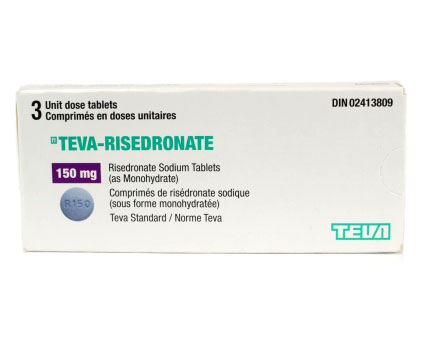
Risedronate Sodium
Risedronate Sodium
What is Risedronate Sodium?
Actonel is a calcium regulator used to prevent and treat osteoporosis. The generic version of Actonel is Risedronate. On average Actonel is priced at about $380 for a supply of 1, 150 mg tablet. Luckily, you can use our Rx.com savings offer to receive an Actonel discount of up to 80% off the retail price at participating pharmacies near you.
Side Effects
- Muscle spasms or twitching, tingling or numbness in your fingers, toes, or around your mouth
- Severe bone, joint, or muscle pain
- Allergic reaction: Itching or hives, swelling in your face or hands, swelling or tingling in your mouth or throat, chest tightness, trouble breathing
Warnings
- Tell your doctor if you are pregnant or breastfeeding, or if you have kidney disease, anemia, blood clotting problems, heartburn, ulcers or other stomach or bowel problems, or a history of cancer. Tell your doctor if you have dental problems or if you wear dentures. Also tell your doctor if you smoke or drink alcohol.
- This medicine may cause the following problems:Damage to your esophagusLow calcium levels in the bloodIncreased risk for a thigh bone fracture
- Tell any doctor or dentist who treats you that you are using this medicine. This medicine could cause jaw problems, especially if you have a tooth pulled or have other dental work.
- This medicine may interact with the dye used for bone scans.
- Your doctor will check your progress and the effects of this medicine at regular visits. Keep all appointments.
Prescription savings · · · ·
What is Risedronate Sodium ?
Actonel is a calcium regulator used to prevent and treat osteoporosis. The generic version of Actonel is Risedronate. On average Actonel is priced at about $380 for a supply of 1, 150 mg tablet. Luckily, you can use our Rx.com savings offer to receive an Actonel discount of up to 80% off the retail price at participating pharmacies near you.
- Muscle spasms or twitching, tingling or numbness in your fingers, toes, or around your mouth
- Severe bone, joint, or muscle pain
- Allergic reaction: Itching or hives, swelling in your face or hands, swelling or tingling in your mouth or throat, chest tightness, trouble breathing
- Blistering, peeling, red skin rash
- Chest pain, new or worsening heartburn, or a burning feeling in your throat
- Pain, swelling, numbness, or a heavy feeling in your mouth or jaw, loose teeth, or other tooth problems
- Pain or difficulty when swallowing
- Unusual pain in your thigh, groin, or hip
- Tell your doctor if you are pregnant or breastfeeding, or if you have kidney disease, anemia, blood clotting problems, heartburn, ulcers or other stomach or bowel problems, or a history of cancer. Tell your doctor if you have dental problems or if you wear dentures. Also tell your doctor if you smoke or drink alcohol.
- This medicine may cause the following problems:Damage to your esophagusLow calcium levels in the bloodIncreased risk for a thigh bone fracture
- Tell any doctor or dentist who treats you that you are using this medicine. This medicine could cause jaw problems, especially if you have a tooth pulled or have other dental work.
- This medicine may interact with the dye used for bone scans.
- Your doctor will check your progress and the effects of this medicine at regular visits. Keep all appointments.
- Keep all medicine out of the reach of children. Never share your medicine with anyone.
- Severe bone, joint, or muscle pain
- Unusual pain in your thigh, groin, or hip
Risedronate Sodium Coupons & Prices
Risedronate Sodium
Weight-loss medication, prescribed online
Licensed U.S. providers · No insurance needed · Shipped to your door
Risedronate Sodium prices by dosage
Lowest cash price with a free Rx.com coupon vs. the average retail price.
| Dosage | Quantity | Retail price | Rx.com price |
|---|---|---|---|
| 5mg · Tablet | 30 | $254.99 | $50.63 |
| 30mg · Tablet | 30 | $1,701.09 | $425.52 |
Cash prices near ZIP 77433; updated regularly. Actual pharmacy price may vary.
Use a free Rx.com risedronate sodium coupon to compare cash prices at more than 60,000 pharmacies before you fill. Risedronate sodium is the generic form of Actonel, a bisphosphonate used for osteoporosis and Paget's disease of bone. Even though a generic is available, what you pay out of pocket can differ a lot from one pharmacy to the next, which is exactly why it pays to check. Enter your ZIP above to see today's price near you and bring the coupon to the counter.
What is risedronate sodium and how does it work?
Risedronate sodium is a nitrogen-containing bisphosphonate, a class of medicines that slows bone resorption, the process in which the body breaks down old bone. Slowing that breakdown helps bone hold on to its mineral density. It was first approved in the U.S. in 1998 and is sold under the brand names Actonel and Atelvia (the delayed-release form). A separate product called Actonel with Calcium, which copackaged risedronate tablets together with calcium carbonate tablets, was formerly sold in the U.S. but is no longer marketed, so it is not something you can fill today.
The immediate-release tablets are FDA-approved to treat and prevent osteoporosis in postmenopausal women (reducing vertebral fractures and a composite endpoint of nonvertebral osteoporosis-related fractures), to increase bone mass in men with osteoporosis, to treat and prevent glucocorticoid-induced osteoporosis in men and women, and to treat Paget's disease of bone. They come as 5 mg daily, 35 mg weekly, 75 mg (taken two consecutive days each month), and 150 mg monthly; the Paget's disease regimen is 30 mg daily for two months. Atelvia, the delayed-release 35 mg weekly tablet, is approved only for treating postmenopausal osteoporosis and is taken right after breakfast instead of on an empty stomach.
What risedronate sodium costs without insurance
There is an FDA-approved generic risedronate sodium, so you do not have to buy the brand to get the same medicine. But "generic" does not mean every pharmacy charges the same thing. Cash prices for the identical strength and quantity can vary widely between a chain, a grocery pharmacy, and an independent down the street, and the pharmacy nearest you is not always the cheapest. There is no manufacturer savings card for generic risedronate sodium. AbbVie, which markets Actonel, runs its own patient savings site for its brand products; terms, eligibility, and availability vary and change over time, so check with them directly rather than assuming a brand offer applies to you.
Because the price spread is the real variable, comparing is the whole game. Rx.com checks cash prices across more than 60,000 U.S. pharmacies. Enter your ZIP above to see today's price for your strength and day supply, then show the coupon at the pharmacy. Coupons are for cash-paying customers and cannot be combined with insurance, so it is worth comparing the coupon price against your copay and picking whichever is lower.
Risedronate compared with other bisphosphonates
Risedronate sodium is one of several oral bisphosphonates used for osteoporosis. The closest relatives you will see on a pharmacy shelf are alendronate sodium (brand Fosamax) and ibandronate sodium (brand Boniva). They belong to the same class and all slow bone breakdown, but they differ in approved uses, dosing schedules, and how they are taken. Approved indications are specific to each product and each dosage form, so they are not interchangeable on your own.
Brand and generic versions of the same drug contain the same active ingredient. If you are comparing options, the practical questions are which product your prescriber recommends for your situation, which dosing schedule you will actually stick to, and what each one costs at your pharmacy today. Your prescriber and pharmacist are the right people to help you weigh that; only they can change your prescription.
Safety information to know before you fill
Risedronate sodium has no boxed warning, but the label lists several important cautions. The immediate-release tablet can irritate the esophagus and cause inflammation, ulcers, or bleeding, which is why the dosing directions matter so much: take it after you get up, on an empty stomach, with 6 to 8 ounces of plain water, and stay fully upright with no food, drink, or other medicines for at least 30 minutes. It is not for people who cannot stand or sit upright for 30 minutes, or who have esophageal problems that delay emptying such as a stricture or achalasia. It is also contraindicated in anyone with a known hypersensitivity to it, and it is not recommended if creatinine clearance is below 30 mL/min. Low blood calcium must be corrected before starting, and calcium and vitamin D are supplemented as needed.
Other label warnings include osteonecrosis of the jaw (risk is higher with invasive dental work, cancer, chemotherapy, corticosteroids, and poor oral hygiene, so a dental exam before starting is advised for people at risk); atypical low-energy fractures of the thigh bone, so tell your doctor about any new dull or aching hip, groin, or thigh pain; and severe, sometimes disabling bone, joint, or muscle pain that can begin days to years after starting. Risedronate stays in bone for years, which matters if pregnancy is possible; it should be stopped when pregnancy is recognized. This page is general information, not medical advice. Talk with your doctor or pharmacist about your own situation and report side effects to them.
This Risedronate Sodium information was written and reviewed against authoritative U.S. medical sources — MedlinePlus (U.S. National Library of Medicine), DailyMed, and FDA prescribing information — and checked for accuracy. It is provided for education and is not a substitute for professional medical advice.
Verify the official label: Risedronate Sodium on DailyMed (FDA)
Reviewed against FDA labeling · Last reviewed July 2026
Related Drugs
Browse more medications: starting with R · full A-Z directory · by condition · common drugs
Medical disclaimer: This information is provided for general educational purposes only and is not medical advice. It is not a substitute for professional diagnosis or treatment. Always consult a licensed physician, pharmacist, or other qualified healthcare provider before starting, stopping, or changing any medication or treatment. Never disregard professional medical advice or delay seeking it because of something you read here. If you think you may have a medical emergency, call your doctor or 911 immediately.


