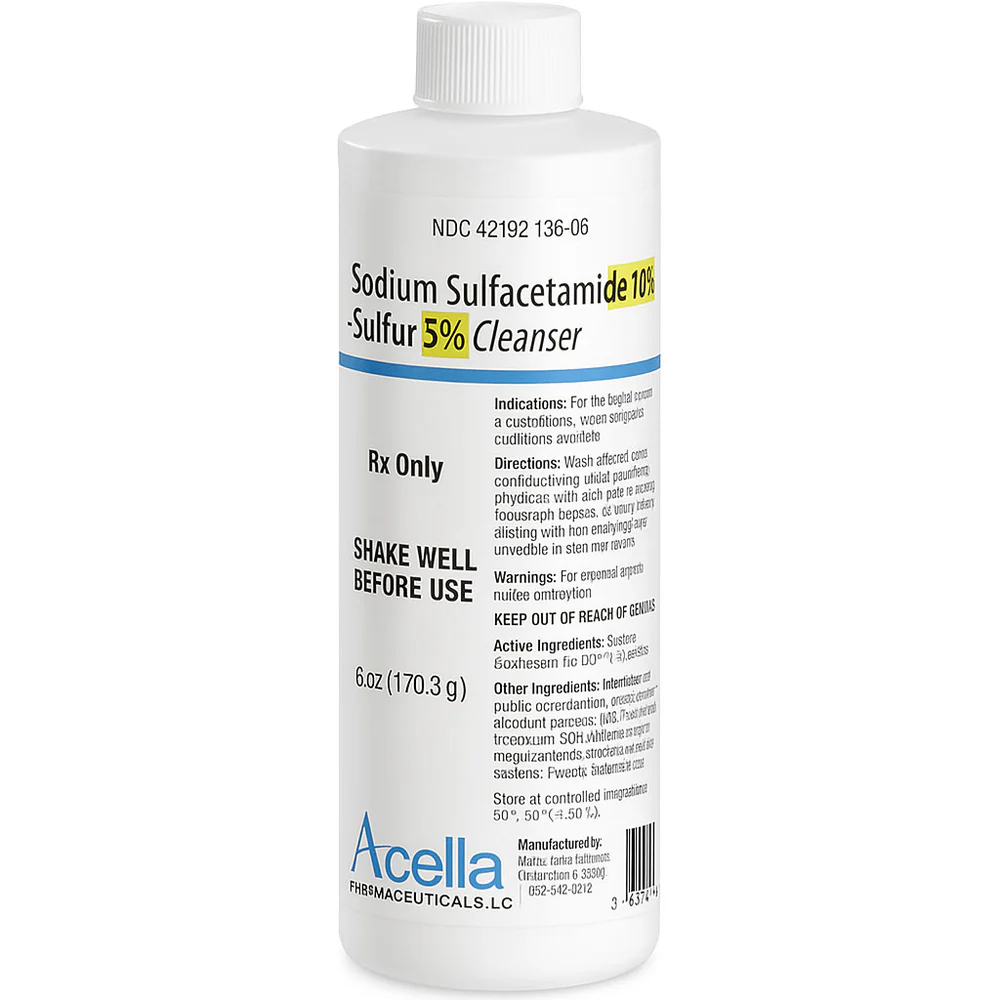
Sodium Sulfacetamide
Sodium Sulfacetamide
What is Sodium Sulfacetamide?
Sodium sulfacetamide is a sulfonamide antibiotic commonly used topically to treat bacterial skin infections, such as acne and seborrheic dermatitis. It works by inhibiting the growth of bacteria, helping to reduce inflammation and promote healing. Sodium sulfacetamide formulations may be found as creams, lotions, or washes, and are typically used in conjunction with other treatments under medical supervision.
Side Effects
- Nausea or vomiting.
- Joint pains.
- Allergic reaction: Itching or hives, swelling in your face or hands, swelling or tingling in your mouth or throat, chest tightness, trouble breathing
Warnings
- Make sure your doctor knows if you are pregnant or breast feeding, or if you have a fungus infection. If you have any open wounds on the area you are going to treat, ask your doctor before using this medicine.
- Call your doctor if your symptoms do not improve or if they get worse.
- Topical application routeDo not use this medicine to treat a skin problem your doctor has not examined.
- Joint pains.
- Nausea or vomiting.
Prescription savings · · · ·
What is Sodium Sulfacetamide ?
Sodium sulfacetamide is a sulfonamide antibiotic commonly used topically to treat bacterial skin infections, such as acne and seborrheic dermatitis. It works by inhibiting the growth of bacteria, helping to reduce inflammation and promote healing. Sodium sulfacetamide formulations may be found as creams, lotions, or washes, and are typically used in conjunction with other treatments under medical supervision.
- Nausea or vomiting.
- Joint pains.
- Allergic reaction: Itching or hives, swelling in your face or hands, swelling or tingling in your mouth or throat, chest tightness, trouble breathing
- Blistering, peeling, red skin rash.
- Fever, or soreness in your mouth.
- Make sure your doctor knows if you are pregnant or breast feeding, or if you have a fungus infection. If you have any open wounds on the area you are going to treat, ask your doctor before using this medicine.
- Call your doctor if your symptoms do not improve or if they get worse.
- Topical application routeDo not use this medicine to treat a skin problem your doctor has not examined.
- Joint pains.
- Nausea or vomiting.
Sodium Sulfacetamide Coupons & Prices
Sodium Sulfacetamide

4 ED medications in one dose
Apomorphine, sildenafil, tadalafil & vardenafil · One sublingual dose · Free express shipping
A sodium sulfacetamide coupon from Rx.com can lower what you pay at the pharmacy counter for this prescription topical sulfa antibiotic, which is used on the skin for acne vulgaris, seborrheic dermatitis and related conditions depending on the formulation. Several sodium sulfacetamide products have generics, though availability varies by dosage form and brand, and the cash price is not the same everywhere: lotions, creams, gels, foams, washes and shampoos are priced differently from pharmacy to pharmacy, and the sulfur combination products are priced differently again. Rx.com compares cash prices across more than 60,000 pharmacies, so enter your ZIP code above to see today's price near you and bring the coupon with your prescription.
What is sodium sulfacetamide and how does it work?
Sulfacetamide sodium is a topical sulfonamide antibacterial, in the same family people usually call "sulfa antibiotics." It works by competitively blocking bacteria from using para-aminobenzoic acid (PABA), which stops them from making folate. Without folate, Cutibacterium acnes and other bacteria on the skin cannot multiply normally. It is often combined with sulfur, a keratolytic that helps loosen and shed skin cells.
What the label covers depends on which product you have, and the approved uses are not the same across products that contain the same active ingredient. Sulfacetamide Sodium Topical Suspension USP, 10% (lotion), including the brand Klaron, is indicated in the topical treatment of acne vulgaris; seborrheic dermatitis is not an approved use for it. Ovace Plus (sodium sulfacetamide 10%, available as a cream, lotion, wash and shampoo) is indicated instead for the scaling dermatoses seborrheic dermatitis and seborrhea sicca (dandruff), and for secondary bacterial infections of the skin due to organisms susceptible to sulfonamides; acne vulgaris is not on its label. Sodium sulfacetamide combined with sulfur (strengths include 10%/5%, 9.8%/4.8% and 8%/4%) is indicated in the topical control of acne vulgaris, acne rosacea and seborrheic dermatitis.
How often you apply it also depends on the product. The label for the 10% lotion directs you to apply a thin film to affected areas twice daily. Ovace Plus for seborrheic dermatitis is applied to affected areas twice daily, with the interval between applications lengthened as the condition subsides. The sulfur combinations are generally applied once or twice daily. Sulfacetamide also comes in an ophthalmic (eye) form, which is a different route entirely and is not interchangeable with skin products. Follow the directions on your own prescription rather than a general description.
What sodium sulfacetamide costs without insurance, and why comparing matters
Many sodium sulfacetamide products have generic versions, and generics are usually the lower-cost route, though which forms have a generic varies. But "generic" does not mean one fixed price. Topical prescription prices swing widely between pharmacies in the same town, and the differences get bigger across dosage forms. A 10% lotion, a foam, a medicated wash and a sulfur combination cream are each priced on their own, and a pharmacy that is cheapest on one may not be cheapest on another. That is exactly why it is worth checking before you fill instead of assuming.
Manufacturer savings offers in this family come and go and are usually tied to a specific brand, so it is worth checking the manufacturer's own site for the exact product your prescriber wrote before you assume one does or does not exist. If you are paying cash and there is no offer you qualify for, a discount coupon is the main lever you have. Enter your ZIP code above to see today's price at pharmacies near you, then show the Rx.com coupon at the counter. A few honest tips: ask the pharmacist to price the exact strength and form your prescriber wrote, since substituting a different form is a prescription change, not a pharmacy decision; and if your plan has a copay, compare it against the cash coupon price, because for inexpensive topicals the coupon sometimes wins. You cannot combine a discount coupon with insurance on the same fill, so pick whichever is lower.
Alternatives and how sodium sulfacetamide compares
Sodium sulfacetamide is sometimes chosen when someone has not been able to tolerate other acne or rosacea topicals, though how any given product feels on your skin varies from person to person. Depending on your diagnosis, your prescriber might consider:
- sodium sulfacetamide with sulfur and Klaron or sulfacetamide sodium for acne, which are the same active ingredient in different formulations
- clindamycin phosphate, a topical antibiotic option for acne
- metronidazole and ivermectin cream, which are commonly used for rosacea
- benzoyl peroxide, tretinoin and azelaic acid, other topical acne approaches
- doxycycline, an oral antibiotic sometimes used when topicals alone are not enough
These are not equivalent to one another, and they are not substitutable at the pharmacy. Which one fits depends on your skin, your diagnosis, what you have already tried and what you can tolerate, and that is a conversation for your prescriber. If you and your prescriber do land on a different medicine, you can look up its price here the same way.
Safety information you should know
Sodium sulfacetamide topical does not carry a boxed warning, but the label does flag some serious points. Rare fatal reactions to sulfonamides have been reported, including Stevens-Johnson syndrome, toxic epidermal necrolysis, fulminant hepatic necrosis, agranulocytosis, aplastic anemia and other blood disorders. Stop using it and get medical help at the first sign of a rash, sores in the mouth or other mucous membranes, or any other sign of a hypersensitivity reaction. It is contraindicated in anyone with a known or suspected sulfa allergy or sensitivity to any ingredient in the product. Many formulations contain sodium metabisulfite, which can trigger allergic-type reactions, including anaphylaxis and life-threatening asthma episodes, in sulfite-sensitive people; this is seen more often in people with asthma.
Other label points: the labeling advises caution in people with kidney disease, since sulfonamides are cleared by the kidneys and can be absorbed into the body through damaged or broken skin, and some sulfur combination labels state the product is not to be used by patients with kidney disease. It is for external use only, so keep it away from your eyes, lips, other mucous membranes, and broken or scraped skin. Safety and effectiveness have not been established under age 12. Sulfur-containing combinations can cause local irritation, dryness, peeling and a noticeable odor, and can bleach fabric and hair. Do not use it at the same time as silver-containing preparations, which are chemically incompatible with it. This is a summary, not medical advice, and not a complete list of risks. Read the information that comes with your prescription and talk with your doctor or pharmacist about your own situation.
This Sodium Sulfacetamide information was written and reviewed against authoritative U.S. medical sources — MedlinePlus (U.S. National Library of Medicine), DailyMed, and FDA prescribing information — and checked for accuracy. It is provided for education and is not a substitute for professional medical advice.
Verify the official label: Sodium Sulfacetamide on DailyMed (FDA)
Reviewed against FDA labeling · Last reviewed July 2026
Related Drugs
Browse more medications: starting with S · full A-Z directory · by condition · common drugs
Medical disclaimer: This information is provided for general educational purposes only and is not medical advice. It is not a substitute for professional diagnosis or treatment. Always consult a licensed physician, pharmacist, or other qualified healthcare provider before starting, stopping, or changing any medication or treatment. Never disregard professional medical advice or delay seeking it because of something you read here. If you think you may have a medical emergency, call your doctor or 911 immediately.


