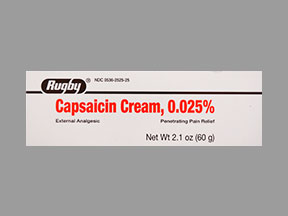
Capsaicin
Capsaicin 60GM of 0.025%
What is Capsaicin?
Capsaicin is a topical medication used to relieve minor pain in muscles and joints caused by conditions like arthritis, backaches, and sprains. It works by affecting nerve cells in the skin to reduce the sensation of pain.Side Effects
- Allergic reaction: Itching or hives, swelling in your face or hands, swelling or tingling in your mouth or throat, chest tightness, trouble breathing
- Blurred vision, dizziness, headache
- Burning or stinging sensation
Warnings
- This medicine may make your skin more sensitive to sunlight. Wear sunscreen. Do not use sunlamps or tanning beds. Do not take hot showers or baths, or exercise too much during treatment with this medicine.
- Topical application routeDo not use this medicine to treat a skin problem your doctor has not examined.
- Your doctor will check your progress and the effects of this medicine at regular visits. Keep all appointments. Your blood pressure will be measured while the patch is on your skin and after it has been removed. If you check your blood pressure at home and notice any changes, call your doctor right away.
- Tell your doctor if you are pregnant or breastfeeding, or if you have uncontrolled high blood pressure, or a recent history of heart or blood vessel problems or brain or blood vessel problems.
- Qutenza® patch may cause loss of sensory function. Tell your doctor if you have sensory function problems.
Prescription savings · · · ·
What is Capsaicin ?
Capsaicin is a topical medication used to relieve minor pain in muscles and joints caused by conditions like arthritis, backaches, and sprains. It works by affecting nerve cells in the skin to reduce the sensation of pain.- Allergic reaction: Itching or hives, swelling in your face or hands, swelling or tingling in your mouth or throat, chest tightness, trouble breathing
- Blurred vision, dizziness, headache
- Burning or stinging sensation
- Fast, slow, pounding, or uneven heartbeat
- Fever, chills, cough, sore throat, stuffy or runny nose, sneezing, trouble breathing, body aches
- Severe irritation, pain, redness, or swelling of the skin or eyes
- This medicine may make your skin more sensitive to sunlight. Wear sunscreen. Do not use sunlamps or tanning beds. Do not take hot showers or baths, or exercise too much during treatment with this medicine.
- Topical application routeDo not use this medicine to treat a skin problem your doctor has not examined.
- Your doctor will check your progress and the effects of this medicine at regular visits. Keep all appointments. Your blood pressure will be measured while the patch is on your skin and after it has been removed. If you check your blood pressure at home and notice any changes, call your doctor right away.
- Tell your doctor if you are pregnant or breastfeeding, or if you have uncontrolled high blood pressure, or a recent history of heart or blood vessel problems or brain or blood vessel problems.
- Qutenza® patch may cause loss of sensory function. Tell your doctor if you have sensory function problems.
- Zostrix®: You may need to use the medicine for 2 weeks or more before it relieves your pain. Keep using the medicine every day. If the medicine has not helped after a month, or if your pain becomes worse after a week, talk with your doctor.Keep all medicine out of the reach of children. Never share your medicine with anyone.
- Keep all medicine out of the reach of children. Never share your medicine with anyone.
Capsaicin Coupons & Prices
Capsaicin 60GM of 0.025%
Weight-loss medication, prescribed online
Licensed U.S. providers · No insurance needed · Shipped to your door
Looking for a capsaicin coupon? Capsaicin is the active ingredient in a range of topical pain products, from low-strength over-the-counter creams, gels, and patches (sold as Zostrix, Capzasin, Salonpas Hot, and Aspercreme Warming) to the prescription-only capsaicin 8% patch (Qutenza). The OTC versions are already inexpensive and sold without a prescription, while the prescription patch cost can vary widely from one pharmacy to another. Enter your ZIP above to see today's price on the prescription form near you, and use the free Rx.com discount card to compare cash prices across more than 60,000 U.S. pharmacies.
What is capsaicin and how does it work?
Capsaicin is the compound that makes chili peppers hot, and it works as a topical analgesic. It acts on a nerve receptor called TRPV1 (the vanilloid receptor), first stimulating and then reducing the pain signals that certain sensory nerves send to the brain. This is why capsaicin products often feel warm or produce a burning sensation when first applied.
It comes in two very different strengths. Low-concentration over-the-counter products (roughly 0.025% to 0.1% creams, gels, and patches) are used for minor muscle and joint pain from arthritis, backache, strains, sprains, and bruises. The high-concentration prescription capsaicin 8% patch (Qutenza) is FDA-approved for nerve pain of postherpetic neuralgia (the pain that can follow shingles) and for nerve pain of diabetic peripheral neuropathy of the feet. The 8% patch is applied in a clinic by a trained healthcare provider, not at home.
Capsaicin cost and coupons without insurance
Over-the-counter capsaicin creams, gels, and patches are generally low-cost and available on store shelves without a prescription, so an Rx discount coupon usually is not needed for those. The prescription capsaicin 8% patch (Qutenza) is a different story: as an in-office treatment, the cash price can vary a lot from one pharmacy or provider to another, which is exactly why comparing matters.
Rx.com compares cash prices across more than 60,000 pharmacies so you can see where the prescription form is cheapest near you. Enter your ZIP above to see today's price and print or text yourself the free discount card. The maker of Qutenza also offers a manufacturer savings program at its official site, Qutenza.com; eligibility and terms vary, so check the details there. A manufacturer copay card and a pharmacy discount coupon cannot be combined, so compare both to see which lands lower for you.
Alternatives and related pain treatments
Capsaicin is one of several options for localized or nerve-related pain, and the best choice depends on your condition. Related treatments people compare include:
- Qutenza - the brand name for the prescription capsaicin 8% patch applied in a clinic.
- Lidocaine - a topical numbing medicine, available as patches and creams, sometimes used for postherpetic neuralgia.
- Diclofenac - a topical anti-inflammatory (NSAID) gel commonly used for osteoarthritis joint pain.
- Gabapentin and pregabalin - oral prescription medicines for certain types of nerve pain.
This is general information, not medical advice. Your provider can help you decide which option, or combination, fits your situation.
Safety and side effects
Capsaicin has no boxed warning. The most common issue is a reaction where you apply it: burning, stinging, redness, and pain. These can be intense with the 8% patch, and blood pressure can rise temporarily during and after application, so providers monitor blood pressure and may use a cooling method or a local anesthetic. Do not apply capsaicin to broken or irritated skin or near the eyes, nose, or mouth, and wash your hands after use. Breathing in dried residue can cause coughing and throat irritation. Rare serious skin burns have been reported with over-the-counter topical products, so stop use and seek care if you notice blistering or severe pain.
The 8% patch must be applied only by trained healthcare providers wearing nitrile gloves. Always follow the product label or your provider's instructions, and talk with your provider or pharmacist about whether capsaicin is right for you.
This Capsaicin information was written and reviewed against authoritative U.S. medical sources — MedlinePlus (U.S. National Library of Medicine), DailyMed, and FDA prescribing information — and checked for accuracy. It is provided for education and is not a substitute for professional medical advice.
Verify the official label: Capsaicin on DailyMed (FDA)
Reviewed against FDA labeling · Last reviewed July 2026
Capsaicin — Articles & Guides
Related Drugs
Browse more medications: starting with C · full A-Z directory · by condition · common drugs
Medical disclaimer: This information is provided for general educational purposes only and is not medical advice. It is not a substitute for professional diagnosis or treatment. Always consult a licensed physician, pharmacist, or other qualified healthcare provider before starting, stopping, or changing any medication or treatment. Never disregard professional medical advice or delay seeking it because of something you read here. If you think you may have a medical emergency, call your doctor or 911 immediately.


