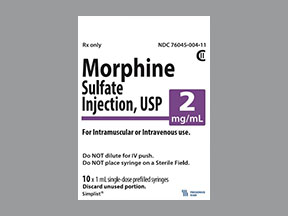
Morphine Sulfate
Morphine Sulfate 15MG
What is Morphine Sulfate?
If you suffer from acute or chronic pain, your doctor might prescribe morphine. For heart attack victims, morphine can be used to relieve chest pain. Labor pain in pregnancy has also been treated by morphine. The drug can be given by mouth, muscular injection, injection under the skin, or intravenously. Morphine is highly addictive and should only be taken under the guidance of an experienced physician.Side Effects
- Trouble breathing or slow breathing
- Allergic reaction: Itching or hives, swelling in your face or hands, swelling or tingling in your mouth or throat, chest tightness, trouble breathing
- Anxiety, restlessness, fast heartbeat, fever, sweating, muscle spasms, twitching, nausea, vomiting, diarrhea, seeing or hearing things that are not there
Warnings
- Tell your doctor if you are pregnant or breastfeeding, or if you have kidney disease, liver disease, heart disease, low blood pressure, breathing problems or lung disease (including asthma or COPD), Addison's disease, gallbladder problems, pancreas problems, thyroid problems, an enlarged prostate, trouble urinating, or stomach or bowel problems. Tell your doctor if you have a history of head injury, brain tumor, depression, seizures, or alcohol or drug abuse.
- This medicine may cause the following problems:High risk of overdose, which can lead to deathRespiratory depression (serious breathing problem that can be life-threatening)Worsening of painSerotonin syndrome (when used with certain medicines)Adrenal gland problemLow blood pressure
- This medicine may make you dizzy, drowsy, or lightheaded. Do not drive or do anything else that could be dangerous until you know how this medicine affects you.
- This medicine can be habit-forming. Do not use more than your prescribed dose. Call your doctor if you think your medicine is not working.
- Do not stop using this medicine suddenly. Your doctor will need to slowly decrease your dose before you stop it completely.
Prescription savings · · · ·
What is Morphine Sulfate ?
If you suffer from acute or chronic pain, your doctor might prescribe morphine. For heart attack victims, morphine can be used to relieve chest pain. Labor pain in pregnancy has also been treated by morphine. The drug can be given by mouth, muscular injection, injection under the skin, or intravenously. Morphine is highly addictive and should only be taken under the guidance of an experienced physician.- Trouble breathing or slow breathing
- Allergic reaction: Itching or hives, swelling in your face or hands, swelling or tingling in your mouth or throat, chest tightness, trouble breathing
- Anxiety, restlessness, fast heartbeat, fever, sweating, muscle spasms, twitching, nausea, vomiting, diarrhea, seeing or hearing things that are not there
- Blue lips, fingernails, or skin
- Severe confusion, lightheadedness, dizziness, or fainting
- Extreme dizziness or weakness, shallow breathing, slow or uneven heartbeat, sweating, cold or clammy skin, seizures
- Worsening of pain, increased sensitivity to pain
- Severe constipation, stomach pain, or vomiting
- Tell your doctor if you are pregnant or breastfeeding, or if you have kidney disease, liver disease, heart disease, low blood pressure, breathing problems or lung disease (including asthma or COPD), Addison's disease, gallbladder problems, pancreas problems, thyroid problems, an enlarged prostate, trouble urinating, or stomach or bowel problems. Tell your doctor if you have a history of head injury, brain tumor, depression, seizures, or alcohol or drug abuse.
- This medicine may cause the following problems:High risk of overdose, which can lead to deathRespiratory depression (serious breathing problem that can be life-threatening)Worsening of painSerotonin syndrome (when used with certain medicines)Adrenal gland problemLow blood pressure
- This medicine may make you dizzy, drowsy, or lightheaded. Do not drive or do anything else that could be dangerous until you know how this medicine affects you.
- This medicine can be habit-forming. Do not use more than your prescribed dose. Call your doctor if you think your medicine is not working.
- Do not stop using this medicine suddenly. Your doctor will need to slowly decrease your dose before you stop it completely.
- This medicine could cause infertility. Talk with your doctor before using this medicine if you plan to have children.
- This medicine may cause constipation, especially with long-term use. Ask your doctor if you should use a laxative to prevent and treat constipation.
- Keep all medicine out of the reach of children. Never share your medicine with anyone.
- Your doctor will do lab tests at regular visits to check on the effects of this medicine. Keep all appointments.
Morphine Sulfate Coupons & Prices
Morphine Sulfate 15MG
Weight-loss medication, prescribed online
Licensed U.S. providers · No insurance needed · Shipped to your door
Morphine Sulfate prices by dosage
Lowest cash price with a free Rx.com coupon vs. the average retail price.
| Dosage | Quantity | Retail price | Rx.com price |
|---|---|---|---|
| 15mg · Tablet | 30 | $25.99 | $17.44 |
| 30mg · Tablet | 30 | $40.79 | $27.05 |
Cash prices near ZIP 77433; updated regularly. Actual pharmacy price may vary.
A morphine sulfate coupon from Rx.com can lower what you pay at the pharmacy counter when you are paying cash or your insurance does not cover your prescription. Morphine sulfate is a generic opioid pain medicine. Cash prices for the same tablets, capsules or oral solution can differ a lot from one pharmacy to the next, so it pays to compare before you fill rather than assume any one pharmacy is cheapest. Rx.com compares cash prices at pharmacies near you, including the big chains and neighborhood independents. Enter your ZIP code above to see today's price near you and print, text or email your free coupon. Morphine sulfate is a Schedule II controlled substance and requires a prescription from your doctor.
What is morphine sulfate and how does it work?
Morphine sulfate is an opioid agonist analgesic. It is a natural opioid (a phenanthrene derivative) that works by attaching to mu-opioid receptors in the brain and spinal cord, which changes the way your nervous system senses and responds to pain. It is FDA-approved for the management of pain severe enough to require an opioid analgesic and for which alternative treatments are inadequate.
Morphine sulfate comes in several forms, and they are not interchangeable:
- Immediate-release tablets and oral solution - used for acute or around-the-clock pain, generally taken about every 4 hours.
- Extended-release tablets (MS Contin and generic morphine sulfate ER tablets) and extended-release capsules (generic morphine sulfate ER capsules) - used for around-the-clock, long-term treatment of severe pain, such as cancer pain or hospice and palliative care. The label states these products are not for as-needed (PRN) pain. Most strengths can be started in patients who are not opioid-tolerant with careful titration, but the higher doses are restricted: for MS Contin, a single dose greater than 60 mg, or a total daily dose greater than 120 mg, is only for patients already tolerant to an opioid of comparable potency.
- Injectable forms - used in medical settings for severe acute pain, including epidural and intrathecal use for surgical and intractable chronic pain.
Brand availability has changed over time. MS Contin is still marketed as an extended-release tablet, but several other morphine brands - including MorphaBond ER, Kadian, Arymo ER and the Roxanol oral solution brand - are no longer marketed in the U.S. Generic morphine sulfate extended-release tablets and capsules, immediate-release tablets and oral solution remain available. This information is educational and is not medical advice - your prescriber decides which form and strength is right for you.
Morphine sulfate cost without insurance, and how to save
There is no one price for morphine sulfate. Cash prices for the identical prescription can vary widely between pharmacies in the same town, and immediate-release tablets, extended-release tablets and capsules, and oral solution are all priced differently. Your final price also depends on the strength, the quantity your doctor writes for, and where you fill. That is exactly why comparing matters. Enter your ZIP code above to see today's price at pharmacies near you.
There is no manufacturer savings card for generic morphine sulfate. A free Rx.com coupon is a cash-discount card you show at the pharmacy instead of using insurance, and you can use it even if you are uninsured, have a high deductible, or your plan does not cover this medicine. You cannot combine a coupon with insurance on the same fill, so ask the pharmacist which price is lower. Because morphine sulfate is a Schedule II controlled substance, refills are not allowed on the same prescription and pharmacies have extra dispensing rules - your coupon lowers the cash price, but it does not change those rules. If you take morphine long term, ask your prescriber and pharmacist whether a 30-day supply of a common strength is a more affordable way to fill.
Morphine sulfate vs. other opioid pain medicines
Morphine is one of several opioid analgesics your doctor may consider. Others include oxycodone (also sold as extended-release OxyContin), hydrocodone-acetaminophen, hydromorphone, tramadol, and methadone. They differ in strength per milligram, how long they last, how they are broken down by the body, and how they are dosed, so switching between them is never a simple milligram-for-milligram swap. The metabolism differences matter for interactions, too: morphine is cleared mainly by glucuronidation rather than by the CYP3A4 enzyme system, so the CYP3A4 drug-interaction warnings that appear on oxycodone, hydrocodone, fentanyl and methadone labels are not part of the morphine label. Only your prescriber should convert you from one opioid to another.
All of these medicines are available as generics, and all of them can vary in cash price from pharmacy to pharmacy. If your prescriber has already chosen the right medicine for you, the useful question is not which opioid is cheapest in general - it is which pharmacy near you has the best price on the exact prescription you were given. Compare the price of your prescription on Rx.com before you fill, and check the price again if your dose or quantity changes.
Morphine sulfate safety, side effects and warnings
All morphine sulfate products carry FDA boxed warnings. The boxed warning on morphine sulfate extended-release tablets (MS Contin) covers six things: addiction, abuse and misuse, which can lead to overdose and death; life-threatening respiratory depression, with the greatest risk when starting the medicine or after a dose increase (older adults and people who are frail, debilitated or have lung disease need especially close monitoring); accidental ingestion, since even one dose, especially by a child, can be fatal; the risks of combining opioids with benzodiazepines or other central nervous system depressants, which can cause profound sedation, respiratory depression, coma and death; neonatal opioid withdrawal syndrome after prolonged use during pregnancy; and the requirements of the Opioid Analgesic REMS program.
Two other extended-release cautions are on the label, but outside the boxed warning. Under Limitations of Use and in the dosing and warnings sections, the label states that extended-release morphine is not indicated as an as-needed (PRN) analgesic, and that crushing, chewing or dissolving the extended-release tablets results in uncontrolled delivery of morphine and can lead to overdose or death. Swallow extended-release tablets and capsules whole.
Other important label warnings include a pharmacokinetic interaction with P-glycoprotein (P-gp) inhibitors such as quinidine: the label states that concomitant use of P-gp inhibitors can increase morphine exposure by about two-fold and can increase the risk of hypotension, respiratory depression, profound sedation, coma and death. The label also warns about adrenal insufficiency, severe low blood pressure, and risks in people with a head injury or increased pressure in the skull. Morphine is contraindicated in known or suspected gastrointestinal obstruction or paralytic ileus, in significant respiratory depression, in acute or severe bronchial asthma in an unmonitored setting, with MAO inhibitors taken within the past 14 days, and in people with a known hypersensitivity to morphine; serotonin syndrome can occur with serotonergic medicines. The most common side effects are constipation (which often persists and usually needs a bowel plan), nausea, vomiting, drowsiness, dizziness, sweating and itching. Keep naloxone on hand if you or someone in your household is at risk of overdose, store morphine locked and away from children, and never stop it abruptly after long-term use - your prescriber should taper you off. This page is educational and is not a substitute for medical advice; talk with your doctor or pharmacist about your own situation.
This Morphine Sulfate information was written and reviewed against authoritative U.S. medical sources — MedlinePlus (U.S. National Library of Medicine), DailyMed, and FDA prescribing information — and checked for accuracy. It is provided for education and is not a substitute for professional medical advice.
Verify the official label: Morphine Sulfate on DailyMed (FDA)
Reviewed against FDA labeling · Last reviewed July 2026
Related Drugs
Browse more medications: starting with M · full A-Z directory · by condition · common drugs
Medical disclaimer: This information is provided for general educational purposes only and is not medical advice. It is not a substitute for professional diagnosis or treatment. Always consult a licensed physician, pharmacist, or other qualified healthcare provider before starting, stopping, or changing any medication or treatment. Never disregard professional medical advice or delay seeking it because of something you read here. If you think you may have a medical emergency, call your doctor or 911 immediately.


