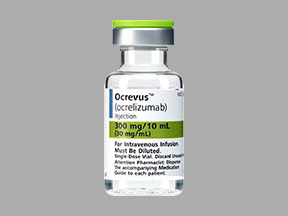
Ocrevus
Ocrevus 10ML of 300MG/10ML
What is Ocrevus?
Ocrevus is used in the treatment of multiple sclerosis. There is not a generic version presently available for Ocrevus. The average Ocrevus price is about $16,973 for a supply of 10 ml, 300 mg/10 ml solution. However, you can significantly lower the price of Ocrevus by using our free Singlecare coupon card at a local participating pharmacy.Side Effects
- Fever, chills, cough, runny or stuffy nose, sore throat, body aches
- Cold sores or blisters on the lips, nose, eyes, or genitals
- Lightheadedness, dizziness, fainting
Warnings
- Your doctor will do lab tests at regular visits to check on the effects of this medicine. Keep all appointments.
- Tell your doctor if you are breastfeeding or if you have liver disease, cancer, or any type of active infection.
- It is not safe to take this medicine during pregnancy. It could harm an unborn baby. Tell your doctor right away if you become pregnant. Use an effective form of birth control during treatment with this medicine and for 6 months after the last dose.
- This medicine may cause the following problems:Infusion reactions, which can be life-threateningIncreased risk of infections, which may be life-threatening (including bacterial, fungal, parasitic, viral, herpes, lung infection, hepatitis B, or progressive multifocal leukoencephalopathy)Increase risk for cancer (including breast cancer)
Prescription savings · · · ·
What is Ocrevus ?
Ocrevus is used in the treatment of multiple sclerosis. There is not a generic version presently available for Ocrevus. The average Ocrevus price is about $16,973 for a supply of 10 ml, 300 mg/10 ml solution. However, you can significantly lower the price of Ocrevus by using our free Singlecare coupon card at a local participating pharmacy.- Fever, chills, cough, runny or stuffy nose, sore throat, body aches
- Cold sores or blisters on the lips, nose, eyes, or genitals
- Lightheadedness, dizziness, fainting
- Dark urine or pale stools, nausea, vomiting, loss of appetite, stomach pain, yellow skin or eyes
- Rapid weight gain, swelling in your hands, ankles, or feet
- Skin rash, pain, or itching, changes in vision, confusion, eye pain or redness, stiff neck
- Trouble breathing, headache
- Unusual bleeding, bruising, or weakness
- Warmth or redness in your face, neck, arms, or upper chest
- Allergic reaction: Itching or hives, swelling in your face or hands, swelling or tingling in your mouth or throat, chest tightness, trouble breathing
- Fast, pounding, or uneven heartbeat
- Your doctor will do lab tests at regular visits to check on the effects of this medicine. Keep all appointments.
- Tell your doctor if you are breastfeeding or if you have liver disease, cancer, or any type of active infection.
- It is not safe to take this medicine during pregnancy. It could harm an unborn baby. Tell your doctor right away if you become pregnant. Use an effective form of birth control during treatment with this medicine and for 6 months after the last dose.
- This medicine may cause the following problems:Infusion reactions, which can be life-threateningIncreased risk of infections, which may be life-threatening (including bacterial, fungal, parasitic, viral, herpes, lung infection, hepatitis B, or progressive multifocal leukoencephalopathy)Increase risk for cancer (including breast cancer)
Ocrevus Coupons & Prices
Ocrevus 10ML of 300MG/10ML
4 ED medications in one dose
Sildenafil, tadalafil, apomorphine & L-Citrulline · Works in ~15 min · Lasts up to 36 hours
Ocrevus (ocrelizumab) is a brand-name infused medication for relapsing and primary progressive multiple sclerosis, and if you're comparing an Ocrevus coupon against the manufacturer's savings program, it helps to know how the two actually work before your next infusion — enter your ZIP above to see today's price at pharmacies and infusion centers near you.
What Is Ocrevus and How Does It Work?
Ocrevus is the brand name for ocrelizumab, a monoclonal antibody that targets and depletes CD20-positive B-cells, a type of immune cell involved in the nerve damage seen in multiple sclerosis (MS). It's FDA-approved for adults with relapsing forms of MS — including clinically isolated syndrome, relapsing-remitting disease, and active secondary progressive disease — as well as for primary progressive MS. It's also approved for relapsing-remitting MS in children 10 and older who weigh at least 25 kg.
Ocrevus is given as an intravenous (IV) infusion at a doctor's office or infusion center, starting with two initial doses, then continuing on a twice-a-year schedule. A newer option, Ocrevus Zunovo, combines ocrelizumab with hyaluronidase in a subcutaneous injection that takes about 10 minutes, offered as an alternative to the IV infusion.
Ocrevus Cost: Manufacturer Savings Card vs. Rx.com Coupon
Because Ocrevus is a brand-name biologic with no generic version, cost is a major factor for most patients. Genentech, the manufacturer, offers an official patient support program (search "Ocrevus financial support" on genentech.com or ocrevus.com) that can lower out-of-pocket costs — but like most manufacturer savings cards, it's generally limited to patients with commercial (private) insurance, and terms, eligibility, and any dollar limits vary and can change, so confirm current details directly with the program.
If you're uninsured, on Medicare, or your manufacturer card is declined at the pharmacy or infusion billing office, an Rx.com cash coupon can still be used to shop and compare pricing — it doesn't have the commercial-insurance restriction that manufacturer cards typically carry. Genentech's program materials also reference patient assistance options for those who qualify based on income or insurance status, which is worth asking about if cost is a barrier. Enter your ZIP above to compare current pricing near you.
Ocrevus Alternatives and Comparisons
Ocrevus is one of several disease-modifying therapies (DMTs) used for relapsing forms of MS, and the right choice depends on disease activity, administration preference, and a neurologist's recommendation. Options in the same general category of MS treatment include Tysabri (natalizumab, an infused therapy), Kesimpta (ofatumumab, a self-injected B-cell therapy), and oral options like Gilenya (fingolimod), Tecfidera (dimethyl fumarate), and Aubagio (teriflunomide).
Rituxan (rituximab) is a related anti-CD20 antibody that is sometimes used off-label in MS, though it isn't FDA-approved for that use. There is no generic or biosimilar version of ocrelizumab currently available, so switching between these options is a decision to make with your neurologist based on effectiveness and administration, not price alone.
Ocrevus Safety Information and Side Effects
Ocrevus carries several important warnings covering two main risk areas. First, infusion-related reactions are common — reported in roughly 34-40% of patients — which is why premedication with a corticosteroid, and often an antihistamine, is required before each dose. Second, Ocrevus increases the risk of infections, including possible reactivation of hepatitis B (screening is required before starting treatment) and progressive multifocal leukoencephalopathy (PML), a rare but serious brain infection. It should not be used in anyone with an active hepatitis B infection or a history of a life-threatening infusion reaction to ocrelizumab.
The label also notes an increased risk of malignancy, including breast cancer, associated with long-term B-cell depletion. This is general information, not medical advice — talk with your prescribing doctor about your personal risk factors and what monitoring is recommended while on Ocrevus.
This Ocrevus information was written and reviewed against authoritative U.S. medical sources — MedlinePlus (U.S. National Library of Medicine), DailyMed, and FDA prescribing information — and checked for accuracy. It is provided for education and is not a substitute for professional medical advice.
Verify the official label: Ocrevus on DailyMed (FDA)
Reviewed against FDA labeling · Last reviewed July 2026
Related Drugs
Browse more medications: starting with O · full A-Z directory · by condition · common drugs
Medical disclaimer: This information is provided for general educational purposes only and is not medical advice. It is not a substitute for professional diagnosis or treatment. Always consult a licensed physician, pharmacist, or other qualified healthcare provider before starting, stopping, or changing any medication or treatment. Never disregard professional medical advice or delay seeking it because of something you read here. If you think you may have a medical emergency, call your doctor or 911 immediately.


